
Class 11Physics3-2.Motion in PlaneDynamics of circular Motion (Centrifugal force) and Pendulum and Motion on Curved path
DifficultThe $x$ and $y$ displacements of a particle are given as $x(t) = a \sin \omega t$ and $y(t) = a \sin 2 \omega t$. Its trajectory will look like:
- A
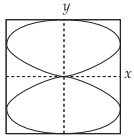
- B
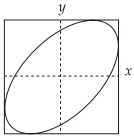
- C
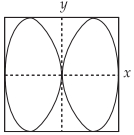
- D
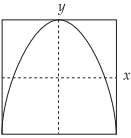
Explore More
Similar Questions
$A$ $500 \,kg$ car takes a round turn of radius $50 \,m$ with a velocity of $36 \,km/h$. The centripetal force is (in $\,N$)
DifficultMHT CET 2007
View Solution$A$ vehicle is moving on a track with constant speed as shown in the figure. The apparent weight of the vehicle is:
Easy
View Solution$A$ particle is moving with a uniform speed in a circular orbit of radius $R$ in a central force inversely proportional to the $n^{th}$ power of $R$. If the period of rotation of the particle is $T$,then
What should be the speed of a car in $m/s$ to cross a bridge with a radius of curvature of $20 \; m$ without losing contact with the bridge? $(g = 9.8 \; m/s^2)$
Medium
View SolutionTwo masses $M$ and $m$ are attached to a vertical axis by weightless threads of combined length $l$. They are set in rotational motion in a horizontal plane about this axis with constant angular velocity $\omega$. If the tensions in the threads are the same during motion,the distance of $M$ from the axis is
Difficult
View SolutionVedclass Products
For Students
Vedclass Test Series
Mock tests in real JEE/NEET style with performance analysis. 5-day free trial.
Start Free TrialFor Teachers
Exam Paper Generator
Generate Set A/B/C/D exam papers from 7.5L+ questions in 2 minutes. 3 chapters free.
Try FreeFor Institutes
Online Exam Module
Live online exams with unlimited students, 360° analytics & white-label branding.
See Demo