
Class 12PhysicsMoving Charges and MagnetismAmpere’s circuital law and its application (Solenoid and Toroid)
Easy$A$ long cylindrical wire of radius $R$ carries a uniform current $I$ flowing through it. The variation of magnetic field $B$ with distance $r$ from the axis of the wire is shown by:
- A
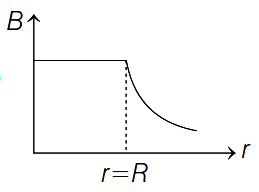
- B
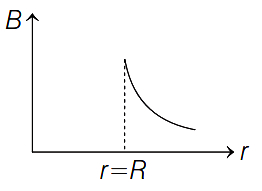
- C
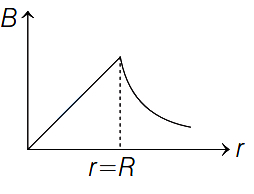
- D
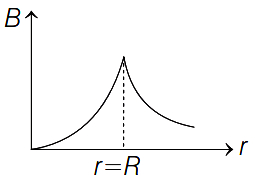
Explore More
Similar Questions
The magnetic field $(B)$ inside a long solenoid having '$n$' turns per unit length and carrying current '$i$' when an iron core is kept in it,is ($\mu_0 =$ permeability of vacuum,$\chi =$ magnetic susceptibility).
Ampere's law is true for which type of current?
Easy
View Solution$A$ long solenoid with $10.0 \text{ turns/cm}$ and a radius of $8 \text{ cm}$ carries a current of $7 \text{ mA}$. $A$ current-carrying straight conductor is located along the central axis of the solenoid. If the direction of the resulting magnetic field is $60^{\circ}$ to the axial direction at a point $5 \text{ cm}$ from the axis of the solenoid along the radial direction, then the current in the conductor is. [Take $\sqrt{2}=1.4, \sqrt{3}=1.7$] (in $\text{ A}$)
DifficultTS EAMCET 2022
View Solution$A$ thick current-carrying cable of radius $R$ carries current $I$ uniformly distributed across its cross-section. The variation of magnetic field $B(r)$ due to the cable with the distance $r$ from the axis of the cable is represented by:
MediumNEET 2021
View SolutionThe maximum magnetic field produced by a current of $12 \ A$ passing through a copper wire of diameter $1.2 \ mm$ is (in $mT$)
Vedclass Products
For Students
Vedclass Test Series
Mock tests in real JEE/NEET style with performance analysis. 5-day free trial.
Start Free TrialFor Teachers
Exam Paper Generator
Generate Set A/B/C/D exam papers from 7.5L+ questions in 2 minutes. 3 chapters free.
Try FreeFor Institutes
Online Exam Module
Live online exams with unlimited students, 360° analytics & white-label branding.
See Demo