
Which of the following graphs represents one node?
- A
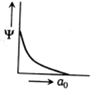
- B

- C

- D
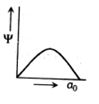
Explore More
Similar Questions
In $H$ atom,an orbit has a diameter of about $16.92 \ \mathring{A}$. What is the maximum number of electrons that can be accommodated in this orbit?
Medium
View SolutionGiven below are two statements:
Statement $I$: Rutherford's gold foil experiment cannot explain the line spectrum of hydrogen atom.
Statement $II$: Bohr's model of hydrogen atom contradicts Heisenberg's uncertainty principle.
In the light of the above statements,choose the most appropriate answer from the options given below:
Statement $I$: Rutherford's gold foil experiment cannot explain the line spectrum of hydrogen atom.
Statement $II$: Bohr's model of hydrogen atom contradicts Heisenberg's uncertainty principle.
In the light of the above statements,choose the most appropriate answer from the options given below:
Match the following columns:
Column-$I$ Column-$II$ $(1)$ Photon $(A)$ Value of $4$ for $N$ shell $(2)$ Electron $(B)$ Probability density $(3)$ $\psi^2$ $(C)$ Always $+$ value $(4)$ Principal quantum number $(n)$ $(D)$ Represents wavelength and momentum
| Column-$I$ | Column-$II$ |
|---|---|
| $(1)$ Photon | $(A)$ Value of $4$ for $N$ shell |
| $(2)$ Electron | $(B)$ Probability density |
| $(3)$ $\psi^2$ | $(C)$ Always $+$ value |
| $(4)$ Principal quantum number $(n)$ | $(D)$ Represents wavelength and momentum |
Medium
View SolutionMatch the following items:
$A$. Energy of ground state of $He^+$ $i$. $+6.04 \text{ eV}$ $B$. Potential energy of $I$ orbit of $H$ atom $ii$. $-27.2 \text{ eV}$ $C$. Kinetic energy of $II$ excited state of $He^+$ $iii$. $8.72 \times 10^{-18} \text{ J}$ $D$. Ionization potential of $He^+$ $iv$. $-54.4 \text{ eV}$
| $A$. Energy of ground state of $He^+$ | $i$. $+6.04 \text{ eV}$ |
| $B$. Potential energy of $I$ orbit of $H$ atom | $ii$. $-27.2 \text{ eV}$ |
| $C$. Kinetic energy of $II$ excited state of $He^+$ | $iii$. $8.72 \times 10^{-18} \text{ J}$ |
| $D$. Ionization potential of $He^+$ | $iv$. $-54.4 \text{ eV}$ |
Difficult
View SolutionFor the given electronic transitions,which of the following statements is correct?
Medium
View SolutionVedclass Products
For Students
Vedclass Test Series
Mock tests in real JEE/NEET style with performance analysis. 5-day free trial.
Start Free TrialFor Teachers
Exam Paper Generator
Generate Set A/B/C/D exam papers from 7.5L+ questions in 2 minutes. 3 chapters free.
Try FreeFor Institutes
Online Exam Module
Live online exams with unlimited students, 360° analytics & white-label branding.
See Demo