
Class 11PhysicsSystem of Particles and Rotational MotionConservation of angular momentum (combined translation and rotational motion)
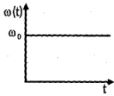
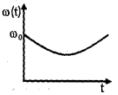
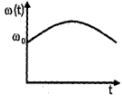
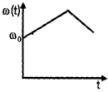
Difficult$A$ circular platform rotates in a horizontal plane about a vertical axis passing through its center. $A$ tortoise sits on the edge of the platform. The platform is given an initial angular velocity $\omega_0$. The tortoise now moves along a chord of the platform with a constant velocity (relative to the platform). How does the angular velocity $\omega(t)$ of the platform change with time $t$?
- A
- B
- C
- D
Explore More
Similar Questions
If the radius of a rotating disc is suddenly halved while its mass remains the same,its angular velocity will become:
Easy
View SolutionWhen a person dancing on ice pulls their arms inward,they start spinning faster. This is due to:
Easy
View Solution$A$ thin circular ring of mass $M$ and radius $R$ is rotating with a constant angular velocity $2 \; rad \; s^{-1}$ in a horizontal plane about an axis vertical to its plane and passing through the center of the ring. If two objects,each of mass $m$,are attached gently to the opposite ends of a diameter of the ring,the ring will then rotate with an angular velocity (in $rad \; s^{-1}$) of:
If the earth were to suddenly contract to $\frac{1}{n}^{th}$ of its present radius without any change in its mass,the duration of the new day will be nearly:
Difficult
View Solution$A$ rod of length $L$ and mass $M$ is free to move on a frictionless surface. $A$ ball of mass $m$ moving with speed $v$ strikes the rod as shown in the figure. What should be the mass of the ball so that it remains at rest after the collision?
Difficult
View SolutionVedclass Products
For Students
Vedclass Test Series
Mock tests in real JEE/NEET style with performance analysis. 5-day free trial.
Start Free TrialFor Teachers
Exam Paper Generator
Generate Set A/B/C/D exam papers from 7.5L+ questions in 2 minutes. 3 chapters free.
Try FreeFor Institutes
Online Exam Module
Live online exams with unlimited students, 360° analytics & white-label branding.
See Demo