
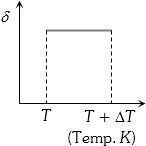
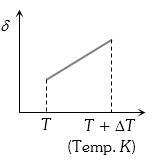
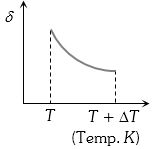
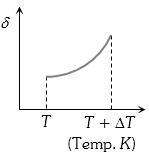
$A$ gas has temperature $T$ and volume $V$. At constant pressure,if the temperature is increased by $\Delta T$,the volume increases by $\Delta V$. How does $\delta = \frac{\Delta V}{V\Delta T}$ vary with temperature?
- A
- B
- C
- D
Explore More
Similar Questions
Two vessels of the same volume contain the same gas at the same temperature. If the pressure in the vessels is in the ratio of $1 : 2$,then
Difficult
View SolutionColumn-$I$ represents physical quantity and Column-$II$ represents formula. Match them correctly:
Column-$I$ Column-$II$ $(a)$ Kinetic energy per unit mole of gas. $(i)$ $\frac{1}{2}RT$ $(b)$ Kinetic energy per one molecule of gas. $(ii)$ $\frac{3}{2}RT$ $(iii)$ $\frac{3}{2}k_BT$
| Column-$I$ | Column-$II$ |
| $(a)$ Kinetic energy per unit mole of gas. | $(i)$ $\frac{1}{2}RT$ |
| $(b)$ Kinetic energy per one molecule of gas. | $(ii)$ $\frac{3}{2}RT$ |
| $(iii)$ $\frac{3}{2}k_BT$ |
Easy
View SolutionIf the pressure of $CO_2$ (real gas) in a container is given by $P = \frac{RT}{2V - b} - \frac{a}{4V^2}$,then the mass of the gas in the container is ...... $g$.
Medium
View Solution$A$ fixed mass of gas at constant pressure occupies a volume $V$. The gas undergoes a rise in temperature so that the r.m.s. velocity of the molecules is doubled. The new volume will be
Two closed containers of equal volume are filled with air at pressure $P_0$ and temperature $T_0$. Both are connected by a narrow tube. If one of the containers is maintained at temperature $T_0$ and the other at temperature $T$,then the new pressure in the containers will be:
Medium
View SolutionVedclass Products
For Students
Vedclass Test Series
Mock tests in real JEE/NEET style with performance analysis. 5-day free trial.
Start Free TrialFor Teachers
Exam Paper Generator
Generate Set A/B/C/D exam papers from 7.5L+ questions in 2 minutes. 3 chapters free.
Try FreeFor Institutes
Online Exam Module
Live online exams with unlimited students, 360° analytics & white-label branding.
See Demo