
Three positive charges $q$ are placed at the vertices of an equilateral triangle. How do their electric field lines appear?
- A
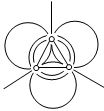
- B
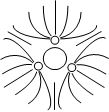
- C
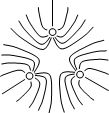
- D
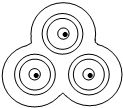
Explore More
Similar Questions
Six point charges are placed at the vertices of a regular hexagon of side $a$ as shown. If $E$ represents the electric field and $V$ represents the electric potential at the center $O$,then:
Medium
View SolutionFour charges are arranged at the corners of a square $ABCD$,as shown. The force on a $+ve$ charge kept at the centre of the square is
Easy
View SolutionThe diagrams depict four different charge distributions. All the charged particles are at the same distance $r$ from the origin $(i.e., OA = OB = OC = OD = r)$. $F_1, F_2, F_3,$ and $F_4$ are the magnitudes of the electrostatic force experienced by a point charge $q_0$ kept at the origin in Figure-$1$,Figure-$2$,Figure-$3$,and Figure-$4$ respectively. Choose the correct statement.
Medium
View SolutionWhich of the field patterns given below is valid for electric field as well as for magnetic field?
DifficultIIT 2011
View SolutionLet $E_1(r)$,$E_2(r)$,and $E_3(r)$ be the respective electric fields at a distance $r$ from a point charge $Q$,an infinitely long wire with constant linear charge density $\lambda$,and an infinite plane with uniform surface charge density $\sigma$. If $E_1(r_0) = E_2(r_0) = E_3(r_0)$ at a given distance $r_0$,then:
MediumIIT 2014
View SolutionVedclass Products
For Students
Vedclass Test Series
Mock tests in real JEE/NEET style with performance analysis. 5-day free trial.
Start Free TrialFor Teachers
Exam Paper Generator
Generate Set A/B/C/D exam papers from 7.5L+ questions in 2 minutes. 3 chapters free.
Try FreeFor Institutes
Online Exam Module
Live online exams with unlimited students, 360° analytics & white-label branding.
See Demo