
Class 11PhysicsSystem of Particles and Rotational MotionMix Example - System of Particles and Rotational Motion
EasyThe graph between angular momentum $L$ and angular velocity $\omega$ is:
- A
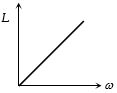
- B
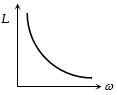
- C
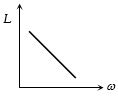
- D
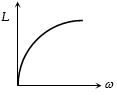
Explore More
Similar Questions
$A$ thin ring of mass $2 \ kg$ and radius $1 \ m$ is rolling without slipping on a horizontal plane with velocity $1 \ m/s$. $A$ small ball of mass $1 \ kg$,moving with velocity $2 \ m/s$ in the opposite direction,hits the ring at a height of $1.8 \ m$ and goes vertically up with velocity $1 \ m/s$. Immediately after the collision:
$(A)$ the ring has pure rotation about its stationary $CM$.
$(B)$ the ring comes to a complete stop.
$(C)$ friction between the ring and the ground is to the left.
$(D)$ there is no friction between the ring and the ground.
$(A)$ the ring has pure rotation about its stationary $CM$.
$(B)$ the ring comes to a complete stop.
$(C)$ friction between the ring and the ground is to the left.
$(D)$ there is no friction between the ring and the ground.
DifficultIIT 2011
View Solution$A$ uniform thin wooden plank $AB$ of length $L$ and mass $M$ is kept on a table with its $B$ end slightly outside the edge of the table. When an impulse $J$ is given to the end $B$,the plank moves up with the centre of mass rising a distance $h$ from the surface of the table. Then,
Two discs $A$ and $B$ are mounted coaxially on a vertical axle. The discs have moments of inertia $I$ and $2I$ respectively about the common axis. Disc $A$ is imparted an initial angular velocity $2\omega$ using the entire potential energy of a spring compressed by a distance $x_1$. Disc $B$ is imparted an angular velocity $\omega$ by a spring having the same spring constant and compressed by a distance $x_2$. Both the discs rotate in the clockwise direction.
$1.$ The ratio of $x_1/x_2$ is
$(A)$ $2$ $(B)$ $1/2$ $(C)$ $\sqrt{2}$ $(D)$ $1/\sqrt{2}$
$2.$ When disc $B$ is brought in contact with disc $A$,they acquire a common angular velocity in time $t$. The average frictional torque on one disc by the other during this period is
$(A)$ $\frac{2I\omega}{3t}$ $(B)$ $\frac{9I\omega}{2t}$ $(C)$ $\frac{9I\omega}{4t}$ $(D)$ $\frac{3I\omega}{2t}$
$3.$ The loss of kinetic energy during the above process is
$(A)$ $\frac{I\omega^2}{2}$ $(B)$ $\frac{I\omega^2}{3}$ $(C)$ $\frac{I\omega^2}{4}$ $(D)$ $\frac{I\omega^2}{6}$
$1.$ The ratio of $x_1/x_2$ is
$(A)$ $2$ $(B)$ $1/2$ $(C)$ $\sqrt{2}$ $(D)$ $1/\sqrt{2}$
$2.$ When disc $B$ is brought in contact with disc $A$,they acquire a common angular velocity in time $t$. The average frictional torque on one disc by the other during this period is
$(A)$ $\frac{2I\omega}{3t}$ $(B)$ $\frac{9I\omega}{2t}$ $(C)$ $\frac{9I\omega}{4t}$ $(D)$ $\frac{3I\omega}{2t}$
$3.$ The loss of kinetic energy during the above process is
$(A)$ $\frac{I\omega^2}{2}$ $(B)$ $\frac{I\omega^2}{3}$ $(C)$ $\frac{I\omega^2}{4}$ $(D)$ $\frac{I\omega^2}{6}$
$A$ thin uniform rod of mass $M$ and length $L$ has its moment of inertia $I_1$ about its perpendicular bisector. The rod is bent in the form of a semicircular arc. Now its moment of inertia through the centre of the semicircular arc and perpendicular to its plane is $I_2$. The ratio of $I_1 : I_2$ will be
Difficult
View Solution$A$ ring of mass $M$ and radius $R$ sliding with a velocity $v_0$ suddenly enters a rough surface where the coefficient of friction is $\mu$,as shown in the figure. Choose the correct statement$(s)$.
Vedclass Products
For Students
Vedclass Test Series
Mock tests in real JEE/NEET style with performance analysis. 5-day free trial.
Start Free TrialFor Teachers
Exam Paper Generator
Generate Set A/B/C/D exam papers from 7.5L+ questions in 2 minutes. 3 chapters free.
Try FreeFor Institutes
Online Exam Module
Live online exams with unlimited students, 360° analytics & white-label branding.
See Demo