
Class 11PhysicsNewton's Laws of Motion and FrictionMix Examples-Newton's Laws of Motion and Friction
Difficult$A$ man can move on a horizontal plank supported symmetrically as shown. The variation of normal reaction on support $A$ with distance $x$ of the man from the end of the plank is best represented by:
- A
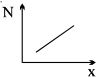
- B
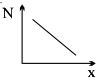
- C
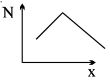
- D
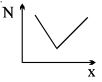
Explore More
Similar Questions
On a pulley of mass $M$ hangs a rope with two masses $m_{1}$ and $m_{2}$ $(m_{1} > m_{2})$ tied at the ends as shown in the figure. The pulley rotates without any friction,whereas the friction between the rope and the pulley is large enough to prevent any slipping. Which of the following plots best represents the difference between the tensions in the rope on the two sides of the pulley as a function of the mass of the pulley?
$A$ force of $(2.6 \hat{i} + 1.6 \hat{j}) \text{ N}$ acts on a body of mass $2 \text{ kg}$. If the velocity of the body at time $t = 0$ is $(3.6 \hat{i} - 4.8 \hat{j}) \text{ ms}^{-1}$, the time at which the body will just have a velocity along the $x$-axis only is: (in $\text{ s}$)
$A$ ball rests upon a flat piece of paper on a table top. The paper is pulled horizontally but quickly towards the right as shown. Relative to its initial position with respect to the table,the ball:
$(1)$ remains stationary if there is no friction between the paper and the ball.
$(2)$ moves to the left and starts rolling backwards,i.e.,to the left,if there is friction between the paper and the ball.
$(3)$ moves forward,i.e.,in the direction in which the paper is pulled.
Here,the correct statement$(s)$ is/are:
$(1)$ remains stationary if there is no friction between the paper and the ball.
$(2)$ moves to the left and starts rolling backwards,i.e.,to the left,if there is friction between the paper and the ball.
$(3)$ moves forward,i.e.,in the direction in which the paper is pulled.
Here,the correct statement$(s)$ is/are:
MediumKCET 2010
View Solution$A$ particle of mass $m$ is acted upon by a force $F$ given by the empirical law $F = \frac{R}{t^2} v(t)$. If this law is to be tested experimentally by observing the motion starting from rest,the best way is to plot:
DifficultJEE MAIN 2016
View Solution$A$ system consists of three masses $m_1, m_2$ and $m_3$ connected by a string passing over a pulley $P$. The mass $m_1$ hangs freely and $m_2$ and $m_3$ are on a rough horizontal table (the coefficient of friction $= \mu$). The pulley is frictionless and of negligible mass. The downward acceleration of mass $m_1$ is (Assume $m_1 = m_2 = m_3 = m$)
Difficult
View SolutionVedclass Products
For Students
Vedclass Test Series
Mock tests in real JEE/NEET style with performance analysis. 5-day free trial.
Start Free TrialFor Teachers
Exam Paper Generator
Generate Set A/B/C/D exam papers from 7.5L+ questions in 2 minutes. 3 chapters free.
Try FreeFor Institutes
Online Exam Module
Live online exams with unlimited students, 360° analytics & white-label branding.
See Demo