
Class 11PhysicsOscillationsPeriodic, Oscillatory motion and its characteristics and types of SHM and Equation of SHM
Medium$A$ particle of mass $m$ is released from rest and follows a parabolic path as shown. Assuming that the displacement of the mass from the origin is small,which graph correctly depicts the position of the particle as a function of time $?$
- A
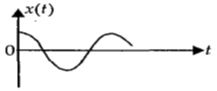
- B
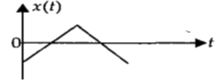
- C
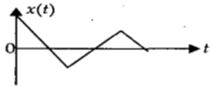
- D
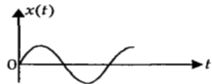
Explore More
Similar Questions
If displacement $x$ and velocity $v$ are related as $4v^2 = 25 - x^2$ in a $SHM$. Then the time period of the given $SHM$ is (Consider $SI$ units).
Medium
View SolutionFor a particle performing linear $S.H.M.$,its average speed over one oscillation is ($A=$ amplitude of $S.H.M.$,$n=$ frequency of oscillation) (in $nA$)
What is the difference between periodic motion and simple harmonic motion?
Medium
View SolutionWhen a particle of mass $m$ moves on the $x$-axis in a potential of the form $V(x)=kx^2$,it performs simple harmonic motion. The corresponding time period is proportional to $\sqrt{\frac{m}{k}}$,as can be seen easily using dimensional analysis. However,the motion of a particle can be periodic even when its potential energy increases on both sides of $x=0$ in a way different from $kx^2$ and its total energy is such that the particle does not escape to infinity. Consider a particle of mass $m$ moving on the $x$-axis. Its potential energy is $V(x)=\alpha x^4$ $(\alpha>0)$ for $|x|$ near the origin and becomes a constant equal to $V_0$ for $|x| \geq X_0$ (see figure).
$1.$ If the total energy of the particle is $E$,it will perform periodic motion only if
$(A)$ $E < 0$
$(B)$ $E > 0$
$(C)$ $V_0 > E > 0$
$(D)$ $E > V_0$
$2.$ For periodic motion of small amplitude $A$,the time period $T$ of this particle is proportional to
$(A)$ $A \sqrt{\frac{m}{\alpha}}$
$(B)$ $\frac{1}{A} \sqrt{\frac{m}{\alpha}}$
$(C)$ $A \sqrt{\frac{\alpha}{m}}$
$(D)$ $A \sqrt{\frac{\alpha}{m}}$
$3.$ The acceleration of this particle for $|x|>X_0$ is
$(A)$ proportional to $V_0$
$(B)$ proportional to $\frac{V_0}{mX_0}$
$(C)$ proportional to $\sqrt{\frac{V_0}{mX_0}}$
$(D)$ zero
Give the answer for questions $1, 2$ and $3$.
$1.$ If the total energy of the particle is $E$,it will perform periodic motion only if
$(A)$ $E < 0$
$(B)$ $E > 0$
$(C)$ $V_0 > E > 0$
$(D)$ $E > V_0$
$2.$ For periodic motion of small amplitude $A$,the time period $T$ of this particle is proportional to
$(A)$ $A \sqrt{\frac{m}{\alpha}}$
$(B)$ $\frac{1}{A} \sqrt{\frac{m}{\alpha}}$
$(C)$ $A \sqrt{\frac{\alpha}{m}}$
$(D)$ $A \sqrt{\frac{\alpha}{m}}$
$3.$ The acceleration of this particle for $|x|>X_0$ is
$(A)$ proportional to $V_0$
$(B)$ proportional to $\frac{V_0}{mX_0}$
$(C)$ proportional to $\sqrt{\frac{V_0}{mX_0}}$
$(D)$ zero
Give the answer for questions $1, 2$ and $3$.
$A$ simple harmonic motion is represented by $y = 5(\sin 3\pi t + \sqrt{3} \cos 3\pi t) \ cm$. The amplitude and time period of the motion are:
Vedclass Products
For Students
Vedclass Test Series
Mock tests in real JEE/NEET style with performance analysis. 5-day free trial.
Start Free TrialFor Teachers
Exam Paper Generator
Generate Set A/B/C/D exam papers from 7.5L+ questions in 2 minutes. 3 chapters free.
Try FreeFor Institutes
Online Exam Module
Live online exams with unlimited students, 360° analytics & white-label branding.
See Demo