
$A$ process is shown in the diagram. Which of the following curves may represent the same process?
- A
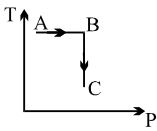
- B
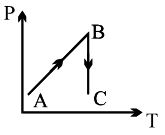
- C
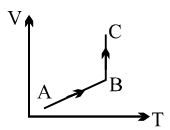
- D
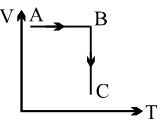
Explore More
Similar Questions
$A$ monoatomic gas at pressure $P$ having volume $V$ expands isothermally to a volume $2V$ and then adiabatically to a volume $16V$. The final pressure of the gas is $\left(\gamma = \frac{5}{3}\right)$.
$A$ small particle of mass $m$ moving inside a heavy, hollow and straight tube along the tube axis undergoes elastic collision at two ends. The tube has no friction and it is closed at one end by a flat surface while the other end is fitted with a heavy movable flat piston as shown in the figure. When the distance of the piston from the closed end is $L = L_0$, the particle speed is $v = v_0$. The piston is moved inward at a very low speed $V$ such that $V \ll \frac{dL}{L} v_0$, where $dL$ is the infinitely small displacement of the piston. Which of the following statement(s) is/are correct?
$(1)$ The rate at which the particle strikes the piston is $v / (2L)$
$(2)$ After each collision with the piston, the particle speed increases by $2V$
$(3)$ The particle's kinetic energy increases by a factor of $4$ when the piston is moved inward from $L_0$ to $L_0 / 2$
$(4)$ If the piston moves inward by $dL$, the particle speed increases by $v \frac{dL}{L}$
$(1)$ The rate at which the particle strikes the piston is $v / (2L)$
$(2)$ After each collision with the piston, the particle speed increases by $2V$
$(3)$ The particle's kinetic energy increases by a factor of $4$ when the piston is moved inward from $L_0$ to $L_0 / 2$
$(4)$ If the piston moves inward by $dL$, the particle speed increases by $v \frac{dL}{L}$
$A$ certain amount of gas is taken through a cyclic process $(A-B-C-D-A)$ that has two isobars, one isochore, and one isothermal process. The cycle can be represented on a $P-V$ indicator diagram as:
An ideal gas undergoes a cyclic thermodynamic process in different ways as shown in the corresponding $P-V$ diagrams in column $3$ of the table. Consider only the path from state $1$ to $2$. $W$ denotes the corresponding work done on the system. The equations and plots in the table have standard notations as used in thermodynamic processes. Here $\gamma$ is the ratio of heat capacities at constant pressure and constant volume. The number of moles in the gas is $n$.
Column $I$ Column $II$ Column $III$ $(I)$ $W_{1-2} = \frac{1}{\gamma-1}(P_2V_2 - P_1V_1)$ $(i)$ Isothermal $(P)$ [Graph $P$] $(II)$ $W_{1-2} = -P(V_2 - V_1)$ (ii) Isochoric $(Q)$ [Graph $Q$] $(III)$ $W_{1-2} = 0$ (iii) Isobaric $(R)$ [Graph $R$] $(IV)$ $W_{1-2} = -nRT \ln(\frac{V_2}{V_1})$ (iv) Adiabatic $(S)$ [Graph $S$]
$(1)$ Which of the following options is the only correct representation of a process in which $\Delta U = \Delta Q - P \Delta V$?
$[A] (II) (iii) (P)$ $[B] (II) (iii) (R)$ $[C] (II) (iv) (S)$ $[D] (III) (iii) (P)$
$(2)$ Which one of the following options is the correct combination?
$[A] (III) (ii) (S)$ $[B] (II) (iv) (R)$ $[C] (II) (iv) (P)$ $[D] (IV) (ii) (S)$
$(3)$ Which one of the following options correctly represents a thermodynamic process that is used as a correction in the determination of the speed of sound in an ideal gas?
$[A] (III) (iv) (R)$ $[B] (I) (ii) (Q)$ $[C] (I) (iv) (Q)$ $[D] (I) (iv) (R)$
| Column $I$ | Column $II$ | Column $III$ |
|---|---|---|
| $(I)$ $W_{1-2} = \frac{1}{\gamma-1}(P_2V_2 - P_1V_1)$ | $(i)$ Isothermal | $(P)$ [Graph $P$] |
| $(II)$ $W_{1-2} = -P(V_2 - V_1)$ | (ii) Isochoric | $(Q)$ [Graph $Q$] |
| $(III)$ $W_{1-2} = 0$ | (iii) Isobaric | $(R)$ [Graph $R$] |
| $(IV)$ $W_{1-2} = -nRT \ln(\frac{V_2}{V_1})$ | (iv) Adiabatic | $(S)$ [Graph $S$] |
$(1)$ Which of the following options is the only correct representation of a process in which $\Delta U = \Delta Q - P \Delta V$?
$[A] (II) (iii) (P)$ $[B] (II) (iii) (R)$ $[C] (II) (iv) (S)$ $[D] (III) (iii) (P)$
$(2)$ Which one of the following options is the correct combination?
$[A] (III) (ii) (S)$ $[B] (II) (iv) (R)$ $[C] (II) (iv) (P)$ $[D] (IV) (ii) (S)$
$(3)$ Which one of the following options correctly represents a thermodynamic process that is used as a correction in the determination of the speed of sound in an ideal gas?
$[A] (III) (iv) (R)$ $[B] (I) (ii) (Q)$ $[C] (I) (iv) (Q)$ $[D] (I) (iv) (R)$
MediumIIT 2017
View SolutionFill in the blanks:
$1.$ The heat required to raise the temperature of a body by $1\,K$ is called ...... .
$2.$ $A$ temperature difference of $10\,^{\circ}C$ is equivalent to a temperature difference of ...... on the Fahrenheit temperature scale.
$3.$ For an isothermal process of an ideal gas,$\frac{dP}{P} = .........$
$1.$ The heat required to raise the temperature of a body by $1\,K$ is called ...... .
$2.$ $A$ temperature difference of $10\,^{\circ}C$ is equivalent to a temperature difference of ...... on the Fahrenheit temperature scale.
$3.$ For an isothermal process of an ideal gas,$\frac{dP}{P} = .........$
Medium
View SolutionVedclass Products
For Students
Vedclass Test Series
Mock tests in real JEE/NEET style with performance analysis. 5-day free trial.
Start Free TrialFor Teachers
Exam Paper Generator
Generate Set A/B/C/D exam papers from 7.5L+ questions in 2 minutes. 3 chapters free.
Try FreeFor Institutes
Online Exam Module
Live online exams with unlimited students, 360° analytics & white-label branding.
See Demo