
$A$ right-angled isosceles prism is held on the surface of a liquid composed of miscible solvents $A$ and $B$ of refractive index $n_{A}=1.5$ and $n_{B}=1.3$,respectively. The refractive index of the prism is $n_{p}=1.5$ and that of the liquid is given by $n_{L}=C_{A} n_{A}+(1-C_{A}) n_{B}$,where $C_{A}$ is the percentage of solvent $A$ in the liquid. If $\theta_{C}$ is the critical angle at the prism-liquid interface,the plot which best represents the variation of the critical angle with the percentage of solvent is
- A
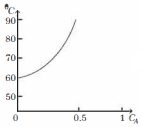
- B
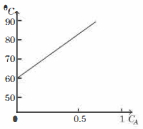
- C
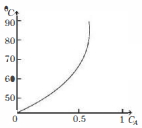
- D
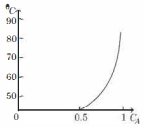
Explore More
Similar Questions
$A$ cylindrical transparent rod of refractive index $\mu = \frac{2}{\sqrt{3}}$ is surrounded by air. $A$ light ray is incident at the midpoint of one end of the rod as shown in the figure. The angle of incidence $\theta$ for which the light ray undergoes total internal reflection at the side wall of the rod is:
Difficult
View SolutionWhite light is incident on the interface of glass and air as shown in the figure. If green light is just totally internally reflected,then the reflected rays inside the glass contain:
The phenomenon utilised in an optical fibre is
For a ray of light,the critical angle is minimum,when it travels from
Why is the brilliance of a diamond observed?
Medium
View SolutionVedclass Products
For Students
Vedclass Test Series
Mock tests in real JEE/NEET style with performance analysis. 5-day free trial.
Start Free TrialFor Teachers
Exam Paper Generator
Generate Set A/B/C/D exam papers from 7.5L+ questions in 2 minutes. 3 chapters free.
Try FreeFor Institutes
Online Exam Module
Live online exams with unlimited students, 360° analytics & white-label branding.
See Demo