
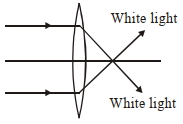
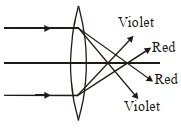
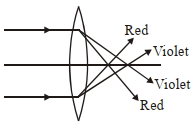
$A$ white light is falling on a bi-convex lens. Which of the following options represents the correct qualitative behaviour of the focussing of this light?
- A
- B
- C
- D
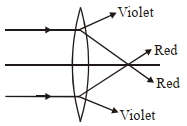
Explore More
Similar Questions
The radius of curvature of the curved face of a plano-convex lens is $12 \,cm$ and its refractive index is $1.5$. Then,the focal length of the lens is (in $\,cm$)
Monochromatic light rays parallel to $x$-axis strike a convex lens $AB$. If the lens oscillates such that $AB$ tilts up to a small angle $\theta$ (in radian) on either side of $y$-axis,then the amplitude of oscillation of the image will be ($f =$ focal length of the lens):
$A$ convex lens focuses an object $20 \ cm$ from it on a screen placed $5 \ cm$ away from it. $A$ glass plate (refractive index $\mu = \frac{7}{5}$) of thickness $t = 1.4 \ cm$ is inserted between the lens and the screen. What is the new distance of the object from the lens so that its image is again focused on the screen (in $cm$)?
DifficultTS EAMCET 2022
View Solution$A$ thin converging lens of focal length $25 \,cm$ forms a sharp image of an object on a screen placed at a distance of $75 \,cm$ from the lens. Later, the screen is moved closer to the lens by a distance of $25 \,cm$. The distance through which the object is to be shifted so that its image on the screen is sharp again is
DifficultAP EAMCET 2019
View Solution$A$ divergent lens will produce
Easy
View SolutionVedclass Products
For Students
Vedclass Test Series
Mock tests in real JEE/NEET style with performance analysis. 5-day free trial.
Start Free TrialFor Teachers
Exam Paper Generator
Generate Set A/B/C/D exam papers from 7.5L+ questions in 2 minutes. 3 chapters free.
Try FreeFor Institutes
Online Exam Module
Live online exams with unlimited students, 360° analytics & white-label branding.
See Demo