
Difficult
Among the following graphs showing the variation of rate constant $(k)$ with temperature $(T)$ for a reaction,the one that exhibits Arrhenius behaviour over the entire temperature range is:
- A
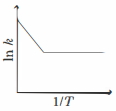
- B
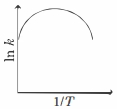
- C
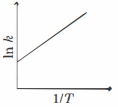
- D
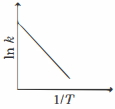
Explore More
Similar Questions
$A$ reaction takes place in three steps with individual rate constants and activation energies. The overall rate constant is given by $k = (\frac{k_1 k_2}{k_3})^{2/3}$. The overall activation energy of the reaction in $kJ/mol$ is:
$Step$ $Rate\ Constant\ /\ Activation\ energy$ $Step\ 1$ $k_1, E_{a_1} = 180\ kJ/mol$ $Step\ 2$ $k_2, E_{a_2} = 80\ kJ/mol$ $Step\ 3$ $k_3, E_{a_3} = 50\ kJ/mol$
| $Step$ | $Rate\ Constant\ /\ Activation\ energy$ |
| $Step\ 1$ | $k_1, E_{a_1} = 180\ kJ/mol$ |
| $Step\ 2$ | $k_2, E_{a_2} = 80\ kJ/mol$ |
| $Step\ 3$ | $k_3, E_{a_3} = 50\ kJ/mol$ |
Difficult
View SolutionAt temperature $T \ K$,the rate constant of a reaction is $1/10$th of the rate constant at temperature $2T \ K$. What will be the activation energy of this reaction (in $RT$)?
Medium
View SolutionThe rate law for the reaction $2NO + Cl_2 \rightarrow 2NOCl$ is given by $\text{rate} = k[NO]^2[Cl_2]$. Under what conditions will the value of the rate constant $k$ increase?
For a chemical reaction,if the temperature is increased from $25\,^{\circ}C$ to $55\,^{\circ}C$,the rate of reaction will change by a factor of (Assume $\mu = 3$).
Medium
View SolutionAssertion $(A)$ : $A$ catalyst increases the rate of a reaction.
Reason $(R)$ : In presence of a catalyst, the activation energy of the reaction increases.
The correct answer is
Reason $(R)$ : In presence of a catalyst, the activation energy of the reaction increases.
The correct answer is
Vedclass Products
For Students
Vedclass Test Series
Mock tests in real JEE/NEET style with performance analysis. 5-day free trial.
Start Free TrialFor Teachers
Exam Paper Generator
Generate Set A/B/C/D exam papers from 7.5L+ questions in 2 minutes. 3 chapters free.
Try FreeFor Institutes
Online Exam Module
Live online exams with unlimited students, 360° analytics & white-label branding.
See Demo