
An electric current $i_1$ can flow in either direction through loop $(1)$ and induces a current $i_2$ in loop $(2)$. Positive $i_1$ is defined when the current flows from $'a'$ to $'b'$ in loop $(1)$,and positive $i_2$ is defined when the current flows from $'c'$ to $'d'$ in loop $(2)$. In an experiment,the graph of $i_2$ against time $'t'$ is as shown below. Which one$(s)$ of the following graphs could have caused $i_2$ to behave as given above?
- A
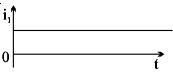
- B
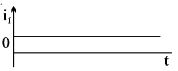
- C
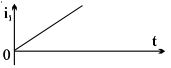
- D
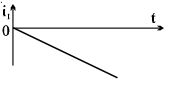
Explore More
Similar Questions
If a change in current of $0.01 \,A$ in one coil produces a change in magnetic flux of $2 \times 10^{-2} \,Wb$ in the other coil,then the mutual inductance of the two coils in henry is (in $\,H$)
The mutual inductance of a system of two coils does not depend on . . . . . . .
Two coils of self-inductances $2\, mH$ and $8\, mH$ are placed so close together that the effective flux in one coil is completely linked with the other. The mutual inductance between these coils is......$mH$.
Medium
View Solution$A$ transformer works on the principle of
$A$ coil of radius '$r$' is placed on another coil (whose radius is '$R$' and current flowing through it is changing) so that their centres coincide $(R \gg r)$. If both the coils are coplanar,then the mutual inductance between them is $(\mu_0 = \text{permeability of free space})$
Vedclass Products
For Students
Vedclass Test Series
Mock tests in real JEE/NEET style with performance analysis. 5-day free trial.
Start Free TrialFor Teachers
Exam Paper Generator
Generate Set A/B/C/D exam papers from 7.5L+ questions in 2 minutes. 3 chapters free.
Try FreeFor Institutes
Online Exam Module
Live online exams with unlimited students, 360° analytics & white-label branding.
See Demo