
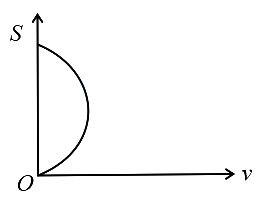
An object is moving with a uniform acceleration which is parallel to its instantaneous direction of motion. The displacement $(s)-$ velocity $(v)$ graph of this object is
- A
- B
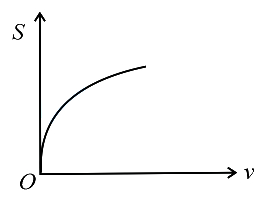
- C
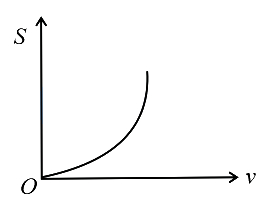
- D
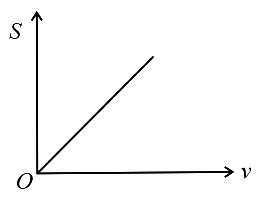
Explore More
Similar Questions
The ratio of displacement in $n$ seconds and in the $n^{th}$ second for a particle moving in a straight line under constant acceleration starting from rest is:
Difficult
View Solution$A$ car accelerates from rest at a constant rate $\alpha$ for some time,after which it decelerates at a constant rate $\beta$ and comes to rest. If the total time elapsed is $t$,then the maximum velocity acquired by the car is
DifficultIIT 1978
View Solution$A$ car passes three points $A$, $B$ and $C$ at $3 \text{ m/s}$, $6 \text{ m/s}$ and $9 \text{ m/s}$ respectively in a straight line with uniform acceleration. If distance $AB = 60 \text{ m}$, then find the distance $BC$. (in $m$)
DifficultMHT CET 2026
View Solution$A$ $150 \,m$ long train is moving with a uniform velocity of $45 \,km/h$. The time taken by the train to cross a bridge of length $850 \,m$ is..........$sec$.
Medium
View Solution$A$ bullet fired into a fixed target loses half of its velocity after penetrating $3\,cm$. How much further will it penetrate before coming to rest,assuming that it faces constant resistance to motion? (in $cm$)
DifficultAIEEE 2005
View SolutionVedclass Products
For Students
Vedclass Test Series
Mock tests in real JEE/NEET style with performance analysis. 5-day free trial.
Start Free TrialFor Teachers
Exam Paper Generator
Generate Set A/B/C/D exam papers from 7.5L+ questions in 2 minutes. 3 chapters free.
Try FreeFor Institutes
Online Exam Module
Live online exams with unlimited students, 360° analytics & white-label branding.
See Demo