
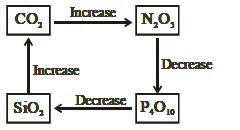
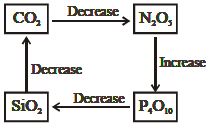
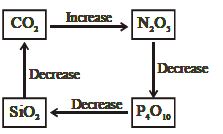
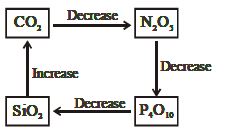
Which of the following diagrams correctly represents the trend in the acidic strength of the given oxides?
- A
- B
- C
- D
Explore More
Similar Questions
Identify the correct order of basicity for the following oxides: $Na_2O, MgO, CuO, SiO_2$.
Difficult
View SolutionChemical properties of $Li$ and $Mg$ are similar because
Easy
View SolutionIf the valence shell electronic configuration for an element is $ns^2 np^5$,this element will belong to the group of
Explain the trends in chemical reactivity and properties across the periodic table.
Medium
View SolutionThe first $\left( \Delta_{i}H_{1} \right)$ and the second $\left( \Delta_{i}H_{2} \right)$ ionization enthalpies (in $kJ \ mol^{-1}$) and the $\left( \Delta_{eg}H \right)$ electron gain enthalpy (in $kJ \ mol^{-1}$) of a few elements are given below:
Elements $\left( \Delta_{i}H_{1} \right)$ $\left( \Delta_{i}H_{2} \right)$ $\left( \Delta_{eg}H \right)$ $I$ $520$ $7300$ $-60$ $II$ $419$ $3051$ $-48$ $III$ $1681$ $3374$ $-328$ $IV$ $1008$ $1846$ $-295$ $V$ $2372$ $8581$ $+48$ $VI$ $738$ $1451$ $-40$
Which of the above elements is likely to be:
$(a)$ the least reactive element.
$(b)$ the most reactive metal.
$(c)$ the most reactive non-metal.
$(d)$ the least reactive non-metal.
$(e)$ the metal which can form a stable binary halide of the formula $MX_{2}$ ($X =$ halogen).
$(f)$ the metal which can form a predominantly stable covalent halide of the formula $MX$ ($X =$ halogen)?
| Elements | $\left( \Delta_{i}H_{1} \right)$ | $\left( \Delta_{i}H_{2} \right)$ | $\left( \Delta_{eg}H \right)$ |
|---|---|---|---|
| $I$ | $520$ | $7300$ | $-60$ |
| $II$ | $419$ | $3051$ | $-48$ |
| $III$ | $1681$ | $3374$ | $-328$ |
| $IV$ | $1008$ | $1846$ | $-295$ |
| $V$ | $2372$ | $8581$ | $+48$ |
| $VI$ | $738$ | $1451$ | $-40$ |
Which of the above elements is likely to be:
$(a)$ the least reactive element.
$(b)$ the most reactive metal.
$(c)$ the most reactive non-metal.
$(d)$ the least reactive non-metal.
$(e)$ the metal which can form a stable binary halide of the formula $MX_{2}$ ($X =$ halogen).
$(f)$ the metal which can form a predominantly stable covalent halide of the formula $MX$ ($X =$ halogen)?
Medium
View SolutionVedclass Products
For Students
Vedclass Test Series
Mock tests in real JEE/NEET style with performance analysis. 5-day free trial.
Start Free TrialFor Teachers
Exam Paper Generator
Generate Set A/B/C/D exam papers from 7.5L+ questions in 2 minutes. 3 chapters free.
Try FreeFor Institutes
Online Exam Module
Live online exams with unlimited students, 360° analytics & white-label branding.
See Demo