
During which of the following thermodynamic processes represented by a $PV$ diagram can the heat energy absorbed by the system be equal to the area under the $PV$ graph?
- A
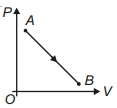
- B
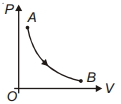
- C
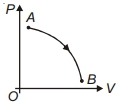
- DAll of these
Explore More
Similar Questions
One mole of an ideal gas expands at a constant temperature of $300 \, K$ from an initial volume of $10 \, L$ to a final volume of $20 \, L$. The work done in expanding the gas is ...... $J$. $(R = 8.31 \, J/mol \cdot K)$
Medium
View SolutionThe work done by an ideal gas of $2 \text{ moles}$ in increasing its volume from $V$ to $2V$ at constant temperature $T$ is $W$. The work done by an ideal gas of $4 \text{ moles}$ in increasing its volume from $V$ to $8V$ at constant temperature $\frac{T}{2}$ is:
If an ideal gas is compressed isothermally,then:
Easy
View SolutionFor an isothermal expansion of a perfect gas,the value of $\frac{\Delta P}{P}$ is equal to:
Easy
View SolutionTwo identical containers $A$ and $B$ with frictionless pistons contain the same ideal gas at the same temperature and the same volume $V$. The mass of the gas in $A$ is ${m_A}$ and that in $B$ is ${m_B}$. The gas in each cylinder is now allowed to expand isothermally to the same final volume $2V$. The changes in the pressure in $A$ and $B$ are found to be $\Delta P$ and $1.5 \Delta P$ respectively. Then:
DifficultAIIMS 2010
View SolutionVedclass Products
For Students
Vedclass Test Series
Mock tests in real JEE/NEET style with performance analysis. 5-day free trial.
Start Free TrialFor Teachers
Exam Paper Generator
Generate Set A/B/C/D exam papers from 7.5L+ questions in 2 minutes. 3 chapters free.
Try FreeFor Institutes
Online Exam Module
Live online exams with unlimited students, 360° analytics & white-label branding.
See Demo