
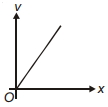
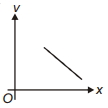
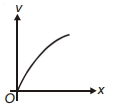
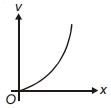
For a body moving with uniform acceleration along a straight line, the variation of its velocity $(v)$ with position $(x)$ is best represented by:
- A
- B
- C
- D
Explore More
Similar Questions
$A$ bus moving along a straight highway with a speed of $72 \,km/h$ is brought to a halt within $4 \,s$ after applying the brakes. The distance travelled by the bus during this time (assume the retardation is uniform) is . . . . . . $m$.
DifficultJEE MAIN 2024
View Solution$A$ car starts from rest and moves with uniform acceleration. Describe the shapes of the $(i)$ $x-t$, $(ii)$ $v-t$, and $(iii)$ $a-t$ graphs for this motion.
Easy
View SolutionThe speeds of two identical cars are $u$ and $4u$ at a specific instant. The ratio of the respective distances in which the two cars are stopped from that instant is
$A$ goods train accelerating uniformly on a straight railway track approaches an electric pole standing on the side of the track. Its engine passes the pole with velocity $u$ and the guard's room passes with velocity $v$. The middle wagon of the train passes the pole with a velocity of:
MediumAIEEE 2012
View Solution$A$ particle of mass $1\,kg$ is moving along the $x-$axis,where its velocity depends on the $x-$coordinate as $v = 2\sqrt{x}\,m/s$. Find the net force acting on the particle $2\,s$ after the start of motion.
Medium
View SolutionVedclass Products
For Students
Vedclass Test Series
Mock tests in real JEE/NEET style with performance analysis. 5-day free trial.
Start Free TrialFor Teachers
Exam Paper Generator
Generate Set A/B/C/D exam papers from 7.5L+ questions in 2 minutes. 3 chapters free.
Try FreeFor Institutes
Online Exam Module
Live online exams with unlimited students, 360° analytics & white-label branding.
See Demo