
The graphical variation of the electric field $E$ due to a uniformly charged insulating solid sphere of radius $R$ with respect to the distance $r$ from the centre $O$ is represented by:
- A
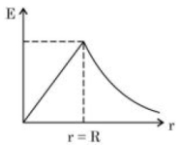
- B
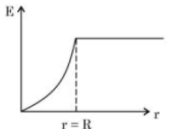
- C
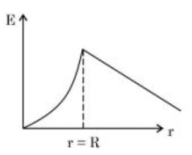
- D
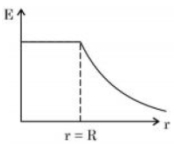
Explore More
Similar Questions
$A$ negatively charged plate has a surface charge density of $\sigma = 2 \times 10^{-6} \ C/m^2$. An electron with kinetic energy $KE = 200 \ eV$ is projected towards the plate. If the electron does not strike the plate,find the minimum initial distance $r$ in $mm$ from the plate.
Medium
View SolutionElectric field due to an infinite,straight,uniformly charged wire varies with distance $r$ as:
An early model for an atom considered it to have a positively charged point nucleus of charge $Ze$,surrounded by a uniform density of negative charge up to a radius $R$. The atom as a whole is neutral. For this model,what is the electric field at a distance $r$ from the nucleus?
Medium
View SolutionTwo large thin parallel metal plates have surface charge densities of equal magnitude but opposite signs $(\sigma = 26.4 \times 10^{-12} \ C/m^2)$. The electric field between these plates is ........ $N/C$.
Easy
View SolutionAn infinitely long thin straight wire has a uniform linear charge density of $\frac{1}{3} \text{ C m}^{-1}$. The magnitude of the force acting on a charge of $3 \mu\text{C}$ situated at a point $18 \text{ cm}$ away from the wire is:
$\left(\frac{1}{4 \pi \varepsilon_0} = 9 \times 10^9 \text{ N m}^2 \text{ C}^{-2}\right)$
$\left(\frac{1}{4 \pi \varepsilon_0} = 9 \times 10^9 \text{ N m}^2 \text{ C}^{-2}\right)$
Vedclass Products
For Students
Vedclass Test Series
Mock tests in real JEE/NEET style with performance analysis. 5-day free trial.
Start Free TrialFor Teachers
Exam Paper Generator
Generate Set A/B/C/D exam papers from 7.5L+ questions in 2 minutes. 3 chapters free.
Try FreeFor Institutes
Online Exam Module
Live online exams with unlimited students, 360° analytics & white-label branding.
See Demo