
If a body moving in a circular path maintains a constant speed of $10 \,ms^{-1}$, then which of the following correctly describes the relation between acceleration $(a)$ and radius $(r)$?
- A
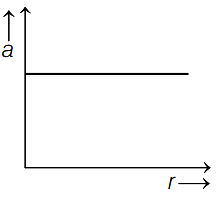
- B
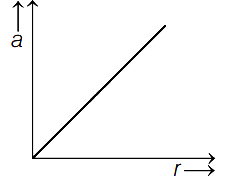
- C
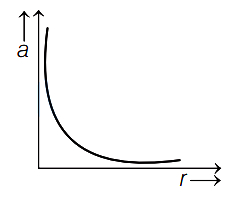
- D
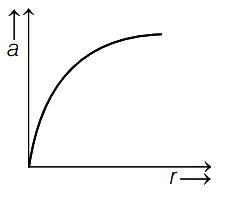
Explore More
Similar Questions
Two objects of masses $m_1$ and $m_2$ are moving in circles of radii $r_1$ and $r_2$ respectively. Their respective angular speeds $\omega_1$ and $\omega_2$ are such that they both complete one revolution in the same time $t$. The ratio of the linear speed of $m_2$ to that of $m_1$ is:
What is the physical quantity represented by the unit $rpm$? Express it in $rad/s$.
Medium
View Solution$A$ particle is performing uniform circular motion. The velocity of the particle at an instant of time is $(6 \hat{i} - 2 \hat{j}) \ m/s$ and the angular velocity is $\vec{\omega} = (a \hat{i} + b \hat{j}) \ rad/s$. Then the value of $\frac{b}{a}$ is:
Medium
View SolutionThe angular speed of a flywheel making $120 \, \text{revolutions/minute}$ is:
Medium
View Solution$A$ particle is moving on a circular path of radius $r$ with uniform speed $v$. The magnitude of change in velocity when the particle moves from $P$ to $Q$ is $(\angle POQ = 40^o)$.
Medium
View SolutionVedclass Products
For Students
Vedclass Test Series
Mock tests in real JEE/NEET style with performance analysis. 5-day free trial.
Start Free TrialFor Teachers
Exam Paper Generator
Generate Set A/B/C/D exam papers from 7.5L+ questions in 2 minutes. 3 chapters free.
Try FreeFor Institutes
Online Exam Module
Live online exams with unlimited students, 360° analytics & white-label branding.
See Demo