
In the diodes shown in the diagrams,which one is reverse biased?
- A
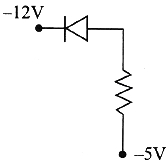
- B
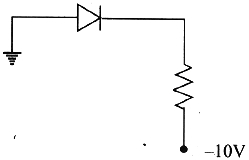
- C
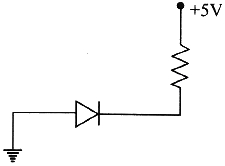
- DThe diode with $p$-side at $+5 \text{ V}$ and $n$-side at $0 \text{ V}$.
Explore More
Similar Questions
If the potential barrier across a $p-n$ junction is $0.6\,V$,then the electric field intensity in the depletion region having a width of $6 \times 10^{-6}\,m$ will be $......\times 10^{5}\,N/C$.
The barrier potential of a $P-N$ junction diode does not depend on:
The diode used in the circuit shown in the figure has a constant voltage drop of $0.5\; V$ at all currents and a maximum power rating of $100\; mW$. What should be the value of the resistor $R$,connected in series with the diode,to obtain the maximum current? (in $\Omega$)
MediumAIPMT 1997
View SolutionIn the following circuit of $PN$ junction diodes $D_1, D_2$ and $D_3$ are ideal,then the current $i$ is:
Medium
View SolutionIn a $p-n$ junction, an electric field of $5 \times 10^5 \ V/m$ exists in the depletion region. The minimum kinetic energy of a conduction electron, in order to diffuse from $n$-side to the $p$-side, is found to be $3.2 \times 10^{-20} \ J$. The width of the depletion region is,
Vedclass Products
For Students
Vedclass Test Series
Mock tests in real JEE/NEET style with performance analysis. 5-day free trial.
Start Free TrialFor Teachers
Exam Paper Generator
Generate Set A/B/C/D exam papers from 7.5L+ questions in 2 minutes. 3 chapters free.
Try FreeFor Institutes
Online Exam Module
Live online exams with unlimited students, 360° analytics & white-label branding.
See Demo