
In which of the following cases is the junction diode $NOT$ in reverse bias?
- A
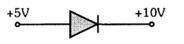
- B
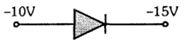
- C
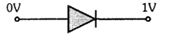
- D

Explore More
Similar Questions
The voltage gains of two amplifiers connected in series are $8$ and $12.5$. If the voltage of the input signal is $200 \mu V$, then the voltage of the output signal is
The figure shows an intrinsic semiconductor $S$ connected in series with a variable resistor $R$ and a constant voltage source $V$. The value of $R$ can be adjusted to maintain a constant current in the ammeter $A$. Under what condition will the semiconductor $S$ get heated? Give reasons.
Medium
View SolutionThe energy of a photon of sodium light $(\lambda = 589 \text{ nm})$ is equal to the band gap of a semiconductor. Find the minimum energy $E$ in $eV$ required to create an electron-hole pair.
Medium
View SolutionGiven below are two statements:
Statement $I$: Photovoltaic devices can convert optical radiation into electricity.
Statement $II$: Zener diode is designed to operate under reverse bias in the breakdown region.
In the light of the above statements,choose the most appropriate answer from the options given below:
Statement $I$: Photovoltaic devices can convert optical radiation into electricity.
Statement $II$: Zener diode is designed to operate under reverse bias in the breakdown region.
In the light of the above statements,choose the most appropriate answer from the options given below:
MediumNEET 2023
View SolutionWhich of the following $p-n$ junction devices is not used in reverse bias?
Easy
View SolutionVedclass Products
For Students
Vedclass Test Series
Mock tests in real JEE/NEET style with performance analysis. 5-day free trial.
Start Free TrialFor Teachers
Exam Paper Generator
Generate Set A/B/C/D exam papers from 7.5L+ questions in 2 minutes. 3 chapters free.
Try FreeFor Institutes
Online Exam Module
Live online exams with unlimited students, 360° analytics & white-label branding.
See Demo