
In which of the following graphs is $x = c$ the point of inflection?
- A
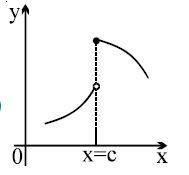
- B
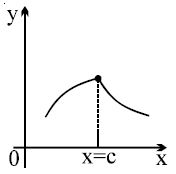
- C
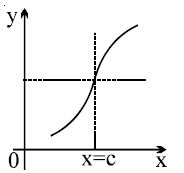
- DAll of the above
Explore More
Similar Questions
Let $f(x) = ax^2 - b|x|$,where $a$ and $b$ are constants. Then at $x = 0$,$f(x)$ has
Let $f: R \to R$ be a twice differentiable function such that the quadratic equation $f(x)m^{2}-2f^{\prime}(x)m+f^{\prime\prime}(x)=0$ in $m$ has two equal roots for every $x \in R$. If $f(0)=1$, $f^{\prime}(0)=2$ and $(\alpha, \beta)$ is the largest interval in which the function $g(x) = f(\log_{e}x-x)$ is increasing, then $\alpha+\beta$ is equal to:
Let $f, g: R \rightarrow R$ be two real-valued functions defined as $f(x)=\begin{cases} -|x+3| & , x < 0 \\ e^{x} & , x \geq 0 \end{cases}$ and $g(x)=\begin{cases} x^{2}+k_{1} x & , x < 0 \\ 4 x+k_{2} & , x \geq 0 \end{cases}$,where $k_{1}$ and $k_{2}$ are real constants. If $(g \circ f)$ is differentiable at $x=0$,then $(g \circ f)(-4)+(g \circ f)(4)$ is equal to
DifficultJEE MAIN 2022
View SolutionWhich of the following statements is false?
Difficult
View SolutionMatch each function in List-$I$ to its derivative given in List-$II$.
List-$I$ List-$II$ $(A) \sin ^{-1}\left(\frac{2 x}{1+x^2}\right)$ $(I) \cos x-\sin x$ $(B) \tan ^{-1}\left(\frac{1-x}{1+x}\right)$ $(II) \frac{-1}{1+x^2}$ $(C) e^{\log (\sin x+\cos x)}$ $(III) \frac{2}{1+x^2}$ $(D) \sqrt{1-\sin 2 x} \text{ for } (0 < x < \frac{\pi}{4})$ $(IV) \cos x+\sin x$ $(V) -\sin x-\cos x$
The correct match is:
| List-$I$ | List-$II$ |
| $(A) \sin ^{-1}\left(\frac{2 x}{1+x^2}\right)$ | $(I) \cos x-\sin x$ |
| $(B) \tan ^{-1}\left(\frac{1-x}{1+x}\right)$ | $(II) \frac{-1}{1+x^2}$ |
| $(C) e^{\log (\sin x+\cos x)}$ | $(III) \frac{2}{1+x^2}$ |
| $(D) \sqrt{1-\sin 2 x} \text{ for } (0 < x < \frac{\pi}{4})$ | $(IV) \cos x+\sin x$ |
| $(V) -\sin x-\cos x$ |
The correct match is:
Vedclass Products
For Students
Vedclass Test Series
Mock tests in real JEE/NEET style with performance analysis. 5-day free trial.
Start Free TrialFor Teachers
Exam Paper Generator
Generate Set A/B/C/D exam papers from 7.5L+ questions in 2 minutes. 3 chapters free.
Try FreeFor Institutes
Online Exam Module
Live online exams with unlimited students, 360° analytics & white-label branding.
See Demo