
Difficult
Reactant $A$ converts to product $D$ through the given mechanism (with the net evolution of heat) :
$A \rightarrow B$ $slow ; \Delta H=+ve$ $B \rightarrow C$ $fast ; \Delta H=-ve$ $C \rightarrow D$ $fast ; \Delta H=-ve$
Which of the following represents the above reaction mechanism ?
| $A \rightarrow B$ | $slow ; \Delta H=+ve$ |
| $B \rightarrow C$ | $fast ; \Delta H=-ve$ |
| $C \rightarrow D$ | $fast ; \Delta H=-ve$ |
Which of the following represents the above reaction mechanism ?
- A
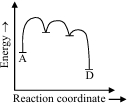
- B
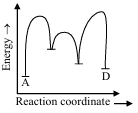
- C
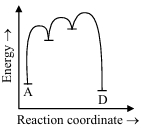
- D
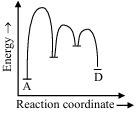
Explore More
Similar Questions
Which of the following is true for a reaction as per collision theory?
The reaction rate at a given temperature becomes slower,then
Medium
View SolutionIn most cases,for a rise of $10 \ K$ temperature,the rate constant is doubled or tripled. This is due to the reason that
MediumAIIMS 2011
View SolutionThe following equation is obtained for a first order reaction at $300 \ K$.
$\log_{10} \frac{k}{A} = 0.00174$
What is the activation energy (in $J \ mol^{-1}$) of the reaction?
$(R = 8.314 \ J \ mol^{-1} \ K^{-1})$
$\log_{10} \frac{k}{A} = 0.00174$
What is the activation energy (in $J \ mol^{-1}$) of the reaction?
$(R = 8.314 \ J \ mol^{-1} \ K^{-1})$
For the reaction $A + B \rightarrow C + D$,$\Delta H = -20 \ kJ \ mol^{-1}$. The activation energy for the forward reaction is $85 \ kJ \ mol^{-1}$. The activation energy for the reverse reaction is ......... $kJ \ mol^{-1}$.
Easy
View SolutionVedclass Products
For Students
Vedclass Test Series
Mock tests in real JEE/NEET style with performance analysis. 5-day free trial.
Start Free TrialFor Teachers
Exam Paper Generator
Generate Set A/B/C/D exam papers from 7.5L+ questions in 2 minutes. 3 chapters free.
Try FreeFor Institutes
Online Exam Module
Live online exams with unlimited students, 360° analytics & white-label branding.
See Demo