
The correct figure that shows,schematically,the wave pattern produced by the superposition of two waves of frequencies $9\,Hz$ and $11\,Hz$ is:
- A
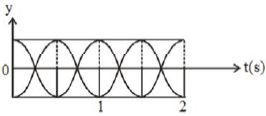
- B
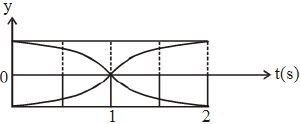
- C
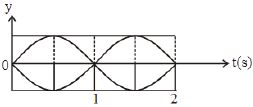
- D
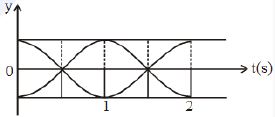
Explore More
Similar Questions
Three sound waves of equal amplitudes have frequencies $(f-1)$,$f$,and $(f+1)$. They superpose to produce beats. The number of beats produced per second will be:
Medium
View SolutionTwo tuning forks with frequencies $380 \,Hz$ and $384 \,Hz$ are sounded together. They produce $4$ beats per second. What is the time interval between the maximum sound and the next minimum sound?
Medium
View SolutionTwo strings $X$ and $Y$ of a sitar produce a beat frequency of $4 \ Hz$. When the tension of the string $Y$ is slightly increased,the beat frequency is found to be $2 \ Hz$. If the frequency of $X$ is $300 \ Hz$,then the original frequency of $Y$ was .... $Hz$.
Medium
View Solution$A$ tuning fork $A$ of unknown frequency produces $5 \, beats/s$ with a fork of known frequency $340 \, Hz$. When fork $A$ is filed,the beat frequency decreases to $2 \, beats/s$. What is the frequency of fork $A$ in $Hz$?
$50$ tuning forks are arranged in increasing order of their frequencies such that each gives $4 \, \text{beats/sec}$ with its previous tuning fork. If the frequency of the last fork is the octave of the first, then the frequency of the first tuning fork is ... $Hz$.
Easy
View SolutionVedclass Products
For Students
Vedclass Test Series
Mock tests in real JEE/NEET style with performance analysis. 5-day free trial.
Start Free TrialFor Teachers
Exam Paper Generator
Generate Set A/B/C/D exam papers from 7.5L+ questions in 2 minutes. 3 chapters free.
Try FreeFor Institutes
Online Exam Module
Live online exams with unlimited students, 360° analytics & white-label branding.
See Demo