
Medium
The displacement of a ball falling from rest in a viscous medium is plotted against time. Choose a possible option.
- A

- B

- C
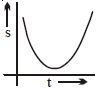
- D
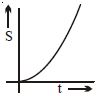
Explore More
Similar Questions
$A$ small spherical solid ball is dropped in a viscous liquid. Its journey in the liquid is best described by which curve in the figure?
Medium
View SolutionIf the terminal speed of a sphere $A$ [density $\rho_A = 7.5 \ kg \ m^{-3}$] is $0.4 \ ms^{-1}$ in a viscous liquid [density $\rho_L = 1.5 \ kg \ m^{-3}$],the terminal speed of sphere $B$ [density $\rho_B = 3 \ kg \ m^{-3}$] of the same size in the same liquid is: (in $ms^{-1}$)
Eight spherical rain drops of the same mass and radius are falling down with a terminal speed of $6 \,cm \,s^{-1}$. If they coalesce to form one big drop, what will be the terminal speed of the bigger drop? (Neglect the buoyancy of the air)
DifficultAP EAMCET 2009
View SolutionIn an experiment to calculate the coefficient of viscosity of a liquid by measuring terminal velocity, it was observed that a ball of mass $(\frac{\pi}{2}) \ gm$ and radius $0.5 \ cm$ takes $5 \ s$ to fall steadily through a height of $50 \ cm$ inside a long column of liquid of density $1.2 \ gm/cc$. The coefficient of viscosity will be given as: (in $\text{poise}$)
Medium
View SolutionThe terminal velocity $v$ of a spherical ball of lead of radius $R$ falling through a viscous liquid varies with $R$ such that
Vedclass Products
For Students
Vedclass Test Series
Mock tests in real JEE/NEET style with performance analysis. 5-day free trial.
Start Free TrialFor Teachers
Exam Paper Generator
Generate Set A/B/C/D exam papers from 7.5L+ questions in 2 minutes. 3 chapters free.
Try FreeFor Institutes
Online Exam Module
Live online exams with unlimited students, 360° analytics & white-label branding.
See Demo