
Class 12PhysicsDual Nature of Radiation and matterPhotoelectric Effect by Lenard and it's Observations
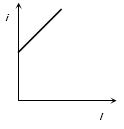
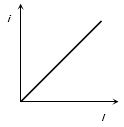
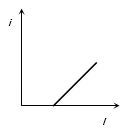
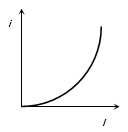
EasyThe graph between the intensity of light $(I)$ falling on a metallic plate and the generated photoelectric current $(i)$ is:
- A
- B
- C
- D
Explore More
Similar Questions
The work functions of Caesium $(Cs)$, Potassium $(K)$, and Sodium $(Na)$ are $2.14\,eV$, $2.30\,eV$, and $2.75\,eV$ respectively. If incident electromagnetic radiation has an incident energy of $2.20\,eV$, which of these photosensitive surfaces may emit photoelectrons?
MediumNEET 2023
View Solution$A$ convex lens of focal length $40 \ cm$ forms an image of an extended source of light on a photoelectric cell. $A$ current $I$ is produced. The lens is replaced by another convex lens having the same diameter but focal length $20 \ cm$. The photoelectric current now is:
DifficultJEE MAIN 2024
View SolutionWhich one of the following is true in photoelectric emission?
Medium
View SolutionAssertion : The photoelectrons produced by a monochromatic light beam incident on a metal surface have a spread in their kinetic energies.
Reason : The work function of the metal varies as a function of depth from the surface.
Reason : The work function of the metal varies as a function of depth from the surface.
From the following graph of photo-current against collector plate potential,for two different intensities of light $I_{1}$ and $I_{2}$,one can conclude:
DifficultKCET 2017
View SolutionVedclass Products
For Students
Vedclass Test Series
Mock tests in real JEE/NEET style with performance analysis. 5-day free trial.
Start Free TrialFor Teachers
Exam Paper Generator
Generate Set A/B/C/D exam papers from 7.5L+ questions in 2 minutes. 3 chapters free.
Try FreeFor Institutes
Online Exam Module
Live online exams with unlimited students, 360° analytics & white-label branding.
See Demo