
Class 11PhysicsKinetic Theory of GasesGas Laws (Charles, Boyle's, Avagadro's, Gay Lussacs and Dalton's law) and Ideal gas Equation
EasyFor an ideal gas undergoing a constant temperature process (isothermal process),what is the nature of the graph between pressure $(P)$ and $\frac{1}{V}$ (where $V$ is volume)?
- A
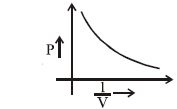
- B
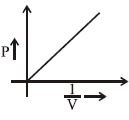
- C
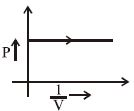
- D
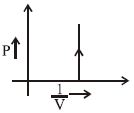
Explore More
Similar Questions
An open container contains $x$ moles of gas at $T$ $K$. If the temperature is tripled,then the amount of gas that exits the container is:
Medium
View Solution$A$ long cylindrical pipe of radius $20 \,cm$ is closed at its upper end and has an airtight piston of negligible mass as shown. When a $50 \,kg$ mass is attached to the other end of the piston,it moves down by a distance $\Delta l$ before coming to equilibrium. Assuming air to be an ideal gas,$\Delta l / l$ (see figure) is close to ($g=10 \,m/s^2$,atmospheric pressure is $10^5 \,Pa$):
DifficultKVPY 2017
View SolutionWhy is an increase in the temperature of a gas at constant volume and constant pressure not possible?
Easy
View Solution$A$ narrow glass tube,$80 \,cm$ long and open at both ends,is half-immersed in mercury. Now,the top of the tube is closed and it is taken out of the mercury. $A$ column of mercury $20 \,cm$ long remains in the tube. Find the atmospheric pressure.
Medium
View SolutionThe mass of oxygen gas occupying a volume of $11.2 \text{ litres}$ at a temperature $27^{\circ}C$ and a pressure of $760 \text{ mm}$ of mercury in kilograms is $[$ Molecular weight of oxygen $= 32]$
DifficultTS EAMCET 2002
View SolutionVedclass Products
For Students
Vedclass Test Series
Mock tests in real JEE/NEET style with performance analysis. 5-day free trial.
Start Free TrialFor Teachers
Exam Paper Generator
Generate Set A/B/C/D exam papers from 7.5L+ questions in 2 minutes. 3 chapters free.
Try FreeFor Institutes
Online Exam Module
Live online exams with unlimited students, 360° analytics & white-label branding.
See Demo