
The graph between wave number $(\bar \nu)$ and angular frequency $(\omega)$ is
- A
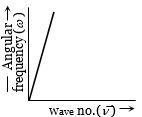
- B
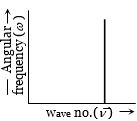
- C
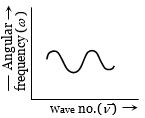
- D
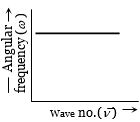
Explore More
Similar Questions
The displacement of a particle is given by $y = 5 \times 10^{-4} \sin(100t - 50x)$,where $x$ is in meters and $t$ is in seconds. Find the velocity of the wave in $m/s$.
Easy
View SolutionThe figure represents the instantaneous picture of a transverse harmonic wave travelling along the negative $x$-axis. Identify the correct statement(s) related to the movement of the points shown in the figure. The points moving opposite to the direction of propagation (i.e., moving in the negative $y$-direction) are:
Difficult
View SolutionTwo points are located at a distance of $10\; m$ and $15 \;m$ from the source of oscillation. The period of oscillation is $0.05 \;s$ and the velocity of the wave is $300 \;m/s$. What is the phase difference between the oscillations of the two points?
MediumAIPMT 2008
View Solution$A$ transverse wave propagates in a medium with a velocity of $1450 \, m/s$. The distance between the nearest points at which the oscillations of the particles are in the opposite phase (phase difference of $\pi$) is $0.1 \, m$. What is the frequency of the wave in $Hz$?
Medium
View SolutionThe phase difference between two points separated by $0.8 \ m$ in a wave of frequency $120 \ Hz$ is $\frac{\pi}{2}$. The velocity of the wave is ..... $m/s$.
Medium
View SolutionVedclass Products
For Students
Vedclass Test Series
Mock tests in real JEE/NEET style with performance analysis. 5-day free trial.
Start Free TrialFor Teachers
Exam Paper Generator
Generate Set A/B/C/D exam papers from 7.5L+ questions in 2 minutes. 3 chapters free.
Try FreeFor Institutes
Online Exam Module
Live online exams with unlimited students, 360° analytics & white-label branding.
See Demo