
The graph which shows the variation of $\left(\frac{1}{\lambda^2}\right)$ and its kinetic energy,$E$ is (where $\lambda$ is de Broglie wavelength of a free particle):
- A
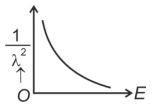
- B
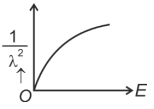
- C
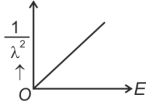
- D
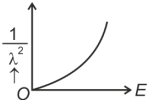
Explore More
Similar Questions
An $\alpha$-particle moves in a circular path of radius $0.83\, cm$ in the presence of a magnetic field of $0.25\, Wb/m^2$. The de Broglie wavelength associated with the particle will be .............. $\mathring{A}$.
DifficultAIPMT 2012
View Solution$A$ bomb projected from the ground at an angle $\theta$ $\left( \theta \neq 90^\circ \right)$ explodes into two fragments of equal mass at the topmost point of its trajectory. If one of the fragments returns to the point of projection,then the ratio of the de Broglie wavelength of the second fragment just after the explosion to that of the bomb just before the explosion is:
Difficult
View SolutionThe equation $\lambda = \frac{1.227}{x} \text{ nm}$ can be used to find the de-Broglie wavelength of an electron. In this equation,$x$ stands for:
The wavelength of a very fast-moving electron $(v \approx c)$ is:
Medium
View Solution$A$ nucleus of mass $M$,moving slowly,absorbs a neutron of mass $m_N$ and then breaks into two nuclei of masses $m_1$ and $5m_1$. If the de Broglie wavelength of the nucleus with mass $m_1$ is $\lambda$,then what will be the de Broglie wavelength of the other nucleus?
Easy
View SolutionVedclass Products
For Students
Vedclass Test Series
Mock tests in real JEE/NEET style with performance analysis. 5-day free trial.
Start Free TrialFor Teachers
Exam Paper Generator
Generate Set A/B/C/D exam papers from 7.5L+ questions in 2 minutes. 3 chapters free.
Try FreeFor Institutes
Online Exam Module
Live online exams with unlimited students, 360° analytics & white-label branding.
See Demo