
The mass density of a spherical body is given by $\rho(r) = \frac{k}{r}$ for $r \leq R$ and $\rho(r) = 0$ for $r > R$,where $r$ is the distance from the centre. The correct graph that describes qualitatively the acceleration,$a$,of a test particle as a function of $r$ is
- A
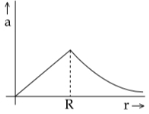
- B
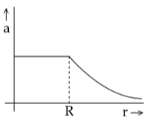
- C
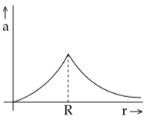
- D
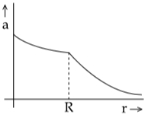
Explore More
Similar Questions
Four particles,each of mass $M$ and equidistant from each other,move along a circle of radius $R$ under the action of their mutual gravitational attraction. The speed of each particle is
DifficultJEE MAIN 2014
View Solution$A$ particle is dropped on Earth from a height $R$ (radius of Earth) and it bounces back to a height $R/2$. The coefficient of restitution for the collision is (ignore air resistance and rotation of Earth).
Difficult
View Solution$A$ study of binary stars is most helpful in
Which one of the following plots represents the variation of gravitational field on a particle with distance $r$ due to a thin spherical shell of radius $R$? ($r$ is measured from the centre of the spherical shell)
MediumAIPMT 2012
View SolutionTwo spherical bodies of mass $M$ and $5M$ and radii $R$ and $2R$ are released in free space with initial separation between their centres equal to $12R.$ If they attract each other due to gravitational force only,then the distance covered by the smaller body before collision is (in $R$)
MediumAIEEE 2003
View SolutionVedclass Products
For Students
Vedclass Test Series
Mock tests in real JEE/NEET style with performance analysis. 5-day free trial.
Start Free TrialFor Teachers
Exam Paper Generator
Generate Set A/B/C/D exam papers from 7.5L+ questions in 2 minutes. 3 chapters free.
Try FreeFor Institutes
Online Exam Module
Live online exams with unlimited students, 360° analytics & white-label branding.
See Demo