
The variation of induced emf $(E)$ with time $(t)$ in a coil if a short bar magnet is moved along its axis with a constant velocity is best represented as
- A
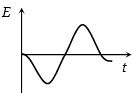
- B
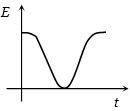
- C
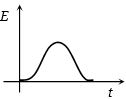
- D
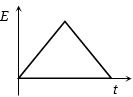
Explore More
Similar Questions
$A$ dynamo is a device for converting:
Easy
View Solution$A$ special metal $S$ conducts electricity without any resistance. $A$ closed wire loop,made of $S$,does not allow any change in flux through itself by inducing a suitable current to generate a compensating flux. The induced current in the loop cannot decay due to its zero resistance. This current gives rise to a magnetic moment which in turn repels the source of magnetic field or flux. Consider such a loop,of radius $a$,with its center at the origin. $A$ magnetic dipole of moment $m$ is brought along the axis of this loop from infinity to a point at distance $r \gg a$ from the center of the loop with its north pole always facing the loop,as shown in the figure.
The magnitude of the magnetic field of a dipole $m$,at a point on its axis at distance $r$,is $\frac{\mu_0}{2 \pi} \frac{m}{r^3}$,where $\mu_0$ is the permeability of free space. The magnitude of the force between two magnetic dipoles with moments $m_1$ and $m_2$,separated by a distance $r$ on the common axis,with their north poles facing each other,is $\frac{k m_1 m_2}{r^4}$,where $k$ is a constant of appropriate dimensions. The direction of this force is along the line joining the two dipoles.
$(1)$ When the dipole $m$ is placed at a distance $r$ from the center of the loop (as shown in the figure),the current induced in the loop will be proportional to
$(A) \frac{m}{r^3} \quad (B) \frac{m^2}{r^2} \quad (C) \frac{m}{r^2} \quad (D) \frac{m^2}{r}$
$(2)$ The work done in bringing the dipole from infinity to a distance $r$ from the center of the loop by the given process is proportional to
$(A) \frac{m}{r^5} \quad (B) \frac{m^2}{r^5} \quad (C) \frac{m^2}{r^6} \quad (D) \frac{m^2}{r^7}$
The magnitude of the magnetic field of a dipole $m$,at a point on its axis at distance $r$,is $\frac{\mu_0}{2 \pi} \frac{m}{r^3}$,where $\mu_0$ is the permeability of free space. The magnitude of the force between two magnetic dipoles with moments $m_1$ and $m_2$,separated by a distance $r$ on the common axis,with their north poles facing each other,is $\frac{k m_1 m_2}{r^4}$,where $k$ is a constant of appropriate dimensions. The direction of this force is along the line joining the two dipoles.
$(1)$ When the dipole $m$ is placed at a distance $r$ from the center of the loop (as shown in the figure),the current induced in the loop will be proportional to
$(A) \frac{m}{r^3} \quad (B) \frac{m^2}{r^2} \quad (C) \frac{m}{r^2} \quad (D) \frac{m^2}{r}$
$(2)$ The work done in bringing the dipole from infinity to a distance $r$ from the center of the loop by the given process is proportional to
$(A) \frac{m}{r^5} \quad (B) \frac{m^2}{r^5} \quad (C) \frac{m^2}{r^6} \quad (D) \frac{m^2}{r^7}$
The network shown in the figure is part of a complete circuit. If at a certain instant the current $i$ is $5 \, A$ and is decreasing at the rate of $10^3 \, A/s$, then $V_B - V_A$ is: (in $ \, V$)
The plane of a circular coil of resistance $7.5 \ \Omega$ is placed perpendicular to a uniform magnetic field. The flux $\phi$ (in weber) through the coil varies with time $t$ (in second) as $\phi = 2t^2 + 3t - 2$. The induced power in the coil at time $t = 3 \ s$ is (in $W$)
$A$ small bar magnet is moved through a coil at a constant speed from one end to the other. Which of the following series of observations will be seen on the galvanometer $G$ attached across the coil? Three positions shown describe: $(a)$ the magnet's entry,$(b)$ the magnet is completely inside,and $(c)$ the magnet's exit.
Vedclass Products
For Students
Vedclass Test Series
Mock tests in real JEE/NEET style with performance analysis. 5-day free trial.
Start Free TrialFor Teachers
Exam Paper Generator
Generate Set A/B/C/D exam papers from 7.5L+ questions in 2 minutes. 3 chapters free.
Try FreeFor Institutes
Online Exam Module
Live online exams with unlimited students, 360° analytics & white-label branding.
See Demo