
Three positive charges of equal value $q$ are placed at the vertices of an equilateral triangle. The resulting lines of force should be sketched as in:
- A
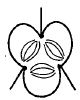
- B

- C

- D

Explore More
Similar Questions
Choose the incorrect statement:
$(a)$ The electric lines of force entering into a Gaussian surface provide negative flux.
$(b)$ $A$ charge '$q$' is placed at the centre of a cube. The flux through all the faces will be the same.
$(c)$ In a uniform electric field,the net flux through a closed Gaussian surface containing no net charge is zero.
$(d)$ When the electric field is parallel to a Gaussian surface,it provides a finite non-zero flux.
Choose the most appropriate answer from the options given below:
$(a)$ The electric lines of force entering into a Gaussian surface provide negative flux.
$(b)$ $A$ charge '$q$' is placed at the centre of a cube. The flux through all the faces will be the same.
$(c)$ In a uniform electric field,the net flux through a closed Gaussian surface containing no net charge is zero.
$(d)$ When the electric field is parallel to a Gaussian surface,it provides a finite non-zero flux.
Choose the most appropriate answer from the options given below:
Consider the charges and the Gaussian surface shown in the figure. When calculating the electric flux through the spherical surface,the electric field is due to which of the following?
Medium
View Solution$A$ $6 \mu C$ charge is placed at the centre of a cube. What will be the electric flux through each face of the cube? (Take $\frac{1}{4 \pi \epsilon_0} = 9 \times 10^9 \ Nm^2 C^{-2}$)
$A$ charge $q$ is placed at the center of a cubical box of side $a$ with the top open. The flux of the electric field through one of the five closed surfaces of the cubical box is:
Medium
View SolutionTwo charges of $5 Q$ and $-2 Q$ are situated at the points $(3 a, 0)$ and $(-5 a, 0)$ respectively. The electric flux through a sphere of radius $4 a$ having its center at the origin is
DifficultJEE MAIN 2024
View SolutionVedclass Products
For Students
Vedclass Test Series
Mock tests in real JEE/NEET style with performance analysis. 5-day free trial.
Start Free TrialFor Teachers
Exam Paper Generator
Generate Set A/B/C/D exam papers from 7.5L+ questions in 2 minutes. 3 chapters free.
Try FreeFor Institutes
Online Exam Module
Live online exams with unlimited students, 360° analytics & white-label branding.
See Demo