
Two immiscible liquids $A$ and $B$ are kept in an $U$-tube. If the density of liquid $A$ is smaller than the density of liquid $B$,then the equilibrium situation is
- A
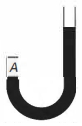
- B
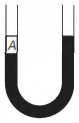
- C
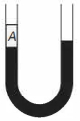
- DNone of these
Explore More
Similar Questions
If a vessel containing a fluid of density $\rho$ up to height $h$ is accelerated vertically downwards with acceleration $a_0$,then the pressure by the fluid at the bottom of the vessel is given by the equation ........ ($p_0$ denotes the atmospheric pressure and $g$ denotes the acceleration due to gravity).
DifficultAP EAMCET 2020
View SolutionTwo vessels have the same base area but different shapes. The first vessel takes twice the volume of water that the second vessel requires to fill up to a particular common height. Is the force exerted by the water on the base of the vessel the same in the two cases? If so,why do the vessels filled with water to that same height give different readings on a weighing scale?
Easy
View Solution$A$ cubical block of wood, of length $10 \,cm$, floats at the interface between oil of density $800 \,kg/m^3$ and water. The lower surface of the block is $1.5 \,cm$ below the interface. If the depth of water is $10 \,cm$ below the interface and oil is up to $10 \,cm$ above the interface, then the difference in pressure at the lower and the upper face of the wooden block is:
(Assume density of water, $\rho_w = 1000 \,kg/m^3$ and acceleration due to gravity, $g = 10 \,m/s^2$) (in $\,Pa$)
(Assume density of water, $\rho_w = 1000 \,kg/m^3$ and acceleration due to gravity, $g = 10 \,m/s^2$) (in $\,Pa$)
Liquid is ...... while gas is ...... . (Fill in the blank) [incompressible,compressible]
Easy
View Solution$A$ litre of alcohol weighs
Easy
View SolutionVedclass Products
For Students
Vedclass Test Series
Mock tests in real JEE/NEET style with performance analysis. 5-day free trial.
Start Free TrialFor Teachers
Exam Paper Generator
Generate Set A/B/C/D exam papers from 7.5L+ questions in 2 minutes. 3 chapters free.
Try FreeFor Institutes
Online Exam Module
Live online exams with unlimited students, 360° analytics & white-label branding.
See Demo