
Two parallel beams of protons and electrons,carrying equal currents,are fixed at a separation $d$. The protons and electrons move in opposite directions. $P$ is a point on a line joining the beams,at a distance $x$ from the proton beam. The magnetic field at $P$ is $B$. If $B$ is plotted against $x$,which of the following best represents the resulting curve?
- A
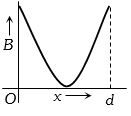
- B
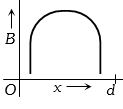
- C
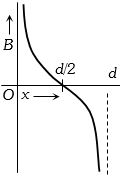
- D
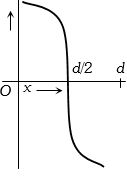
Explore More
Similar Questions
$A$ loop of irregular shape made of flexible conducting wire carrying a clockwise current is placed in a uniform inward magnetic field,such that its plane is perpendicular to the field. Then the loop:
Easy
View SolutionMark the correct statement.
Easy
View SolutionThe magnetic field at the centre of a circular coil of radius $r$ is $\pi$ times that due to a long straight wire at a distance $r$ from it,for equal currents. Figure shows three cases: in all cases,the circular part has radius $r$ and straight ones are infinitely long. For the same current,the $B$ field at the centre $P$ in cases $1$,$2$,and $3$ have the ratio:
Difficult
View SolutionThe figure shows a circular loop of radius $a$ with two long parallel wires (numbered $1$ and $2$) all in the plane of the paper. The distance of each wire from the centre of the loop is $d$. The loop and the wires are carrying the same current $I$. The current in the loop is in the counterclockwise direction if seen from above.
$1.$ When $d \approx a$ but wires are not touching the loop,it is found that the net magnetic field on the axis of the loop is zero at a height $h$ above the loop. In that case
$(A)$ current in wire $1$ and wire $2$ is in the direction $PQ$ and $RS$,respectively and $h \approx a$
$(B)$ current in wire $1$ and wire $2$ is in the direction $PQ$ and $SR$,respectively and $h \approx a$
$(C)$ current in wire $1$ and wire $2$ is in the direction $PQ$ and $SR$,respectively and $h \approx 1.2 a$
$(D)$ current in wire $1$ and wire $2$ is in the direction $PQ$ and $RS$,respectively and $h \approx 1.2 a$
$2.$ Consider $d \gg a$,and the loop is rotated about its diameter parallel to the wires by $30^{\circ}$ from the position shown in the figure. If the currents in the wires are in the opposite directions,the torque on the loop at its new position will be (assume that the net field due to the wires is constant over the loop)
$(A)$ $\frac{\mu_0 I^2 a^2}{d}$ $(B)$ $\frac{\mu_0 I^2 a^2}{2 d}$ $(C)$ $\frac{\sqrt{3} \mu_0 I^2 a^2}{d}$ $(D)$ $\frac{\sqrt{3} \mu_0 I^2 a^2}{2 d}$
Give the answer for question $1$ and $2$.
$1.$ When $d \approx a$ but wires are not touching the loop,it is found that the net magnetic field on the axis of the loop is zero at a height $h$ above the loop. In that case
$(A)$ current in wire $1$ and wire $2$ is in the direction $PQ$ and $RS$,respectively and $h \approx a$
$(B)$ current in wire $1$ and wire $2$ is in the direction $PQ$ and $SR$,respectively and $h \approx a$
$(C)$ current in wire $1$ and wire $2$ is in the direction $PQ$ and $SR$,respectively and $h \approx 1.2 a$
$(D)$ current in wire $1$ and wire $2$ is in the direction $PQ$ and $RS$,respectively and $h \approx 1.2 a$
$2.$ Consider $d \gg a$,and the loop is rotated about its diameter parallel to the wires by $30^{\circ}$ from the position shown in the figure. If the currents in the wires are in the opposite directions,the torque on the loop at its new position will be (assume that the net field due to the wires is constant over the loop)
$(A)$ $\frac{\mu_0 I^2 a^2}{d}$ $(B)$ $\frac{\mu_0 I^2 a^2}{2 d}$ $(C)$ $\frac{\sqrt{3} \mu_0 I^2 a^2}{d}$ $(D)$ $\frac{\sqrt{3} \mu_0 I^2 a^2}{2 d}$
Give the answer for question $1$ and $2$.
Two particles carrying equal charges move parallel to each other with the speed $150 \ km/s$. If $F_1$ and $F_2$ are magnetic and electric forces between two charged particles, then $\frac{|F_1|}{|F_2|}$ is (Let $\mu_0 \varepsilon_0 = \frac{1}{9 \times 10^{16}} \ s^2/m^2$)
Vedclass Products
For Students
Vedclass Test Series
Mock tests in real JEE/NEET style with performance analysis. 5-day free trial.
Start Free TrialFor Teachers
Exam Paper Generator
Generate Set A/B/C/D exam papers from 7.5L+ questions in 2 minutes. 3 chapters free.
Try FreeFor Institutes
Online Exam Module
Live online exams with unlimited students, 360° analytics & white-label branding.
See Demo