
Two very long straight parallel wires,parallel to the $y-$axis,carry currents $4I$ and $I$ along the $+y$ direction and $-y$ direction,respectively. The wires pass through the $x-$axis at the points $(d, 0, 0)$ and $(-d, 0, 0)$ respectively. The graph of the magnetic field $z-$component as one moves along the $x-$axis from $x=-d$ to $x=+d$ is best given by:
- A
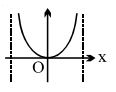
- B
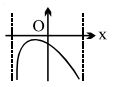
- C
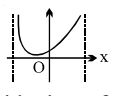
- D
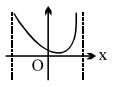
Explore More
Similar Questions
In order to make the parabolas formed by singly ionized ions in one spectrograph and doubly ionized ions in another Thomson's mass spectrograph coincide,the electric fields and magnetic fields are kept in the ratios $1 : 2$ and $3 : 2$ respectively. Then the ratio of the masses of the ions is
Difficult
View Solution$A$ charged particle (electron or proton) is introduced at the origin $(x=0, y=0, z=0)$ with a given initial velocity $\overrightarrow{v}$. $A$ uniform electric field $\overrightarrow{E}$ and magnetic field $\vec{B}$ are given in columns $I, II$ and $III$, respectively. The quantities $E_0, B_0$ are positive in magnitude.
Column $I$ Column $II$ Column $III$ $(I)$ Electron with $\overrightarrow{v}=2 \frac{E_0}{B_0} \hat{x}$ $(i)$ $\overrightarrow{E}=E_0 \hat{z}$ $(P)$ $\overrightarrow{B}=-B_0 \hat{x}$ $(II)$ Electron with $\overrightarrow{v}=\frac{E_0}{B_0} \hat{y}$ $(ii)$ $\overrightarrow{E}=-E_0 \hat{y}$ $(Q)$ $\overrightarrow{B}=B_0 \hat{x}$ $(III)$ Proton with $\overrightarrow{v}=0$ $(iii)$ $\overrightarrow{E}=-E_0 \hat{x}$ $(R)$ $\overrightarrow{B}=B_0 \hat{y}$ $(IV)$ Proton with $\overrightarrow{v}=2 \frac{E_0}{B_0} \hat{x}$ $(iv)$ $\overrightarrow{E}=E_0 \hat{x}$ $(S)$ $\overrightarrow{B}=B_0 \hat{z}$
$(1)$ In which case will the particle move in a straight line with constant velocity?
$(2)$ In which case will the particle describe a helical path with axis along the positive $z$ direction?
$(3)$ In which case would the particle move in a straight line along the negative direction of $y$-axis (i.e., move along $-\hat{y}$)?
| Column $I$ | Column $II$ | Column $III$ |
| $(I)$ Electron with $\overrightarrow{v}=2 \frac{E_0}{B_0} \hat{x}$ | $(i)$ $\overrightarrow{E}=E_0 \hat{z}$ | $(P)$ $\overrightarrow{B}=-B_0 \hat{x}$ |
| $(II)$ Electron with $\overrightarrow{v}=\frac{E_0}{B_0} \hat{y}$ | $(ii)$ $\overrightarrow{E}=-E_0 \hat{y}$ | $(Q)$ $\overrightarrow{B}=B_0 \hat{x}$ |
| $(III)$ Proton with $\overrightarrow{v}=0$ | $(iii)$ $\overrightarrow{E}=-E_0 \hat{x}$ | $(R)$ $\overrightarrow{B}=B_0 \hat{y}$ |
| $(IV)$ Proton with $\overrightarrow{v}=2 \frac{E_0}{B_0} \hat{x}$ | $(iv)$ $\overrightarrow{E}=E_0 \hat{x}$ | $(S)$ $\overrightarrow{B}=B_0 \hat{z}$ |
$(1)$ In which case will the particle move in a straight line with constant velocity?
$(2)$ In which case will the particle describe a helical path with axis along the positive $z$ direction?
$(3)$ In which case would the particle move in a straight line along the negative direction of $y$-axis (i.e., move along $-\hat{y}$)?
Choose the correct statement.
Medium
View SolutionTwo particles carrying equal charges move parallel to each other with the speed $150 \ km/s$. If $F_1$ and $F_2$ are magnetic and electric forces between two charged particles, then $\frac{|F_1|}{|F_2|}$ is (Let $\mu_0 \varepsilon_0 = \frac{1}{9 \times 10^{16}} \ s^2/m^2$)
Two parallel beams of electrons moving in the same direction produce a mutual force:
Easy
View SolutionVedclass Products
For Students
Vedclass Test Series
Mock tests in real JEE/NEET style with performance analysis. 5-day free trial.
Start Free TrialFor Teachers
Exam Paper Generator
Generate Set A/B/C/D exam papers from 7.5L+ questions in 2 minutes. 3 chapters free.
Try FreeFor Institutes
Online Exam Module
Live online exams with unlimited students, 360° analytics & white-label branding.
See Demo