
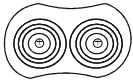
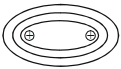
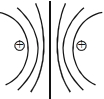
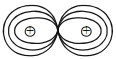
Which of the following figures shows the correct equipotential surfaces of a system of two positive charges?
- A
- B
- C
- D
Explore More
Similar Questions
Positive and negative point charges of equal magnitude are kept at $(0, 0, a/2)$ and $(0, 0, -a/2)$,respectively. The work done by the electric field when another positive point charge is moved from $(-a, 0, 0)$ to $(0, a, 0)$ is
$A$ charge $+Q$ is placed at the centre of a circular path of radius $r$. The work done to bring a charge $+q$ from one end of the diameter to the other end of the circular path in the electric field produced by charge $+Q$ is $.......$
$A$ uniform electric field exists in the plane of the paper as shown. Here $A, B, C$, and $D$ are points on the circle. $V_{A}, V_{B}, V_{C}$, and $V_{D}$ are the potentials at those points respectively. Then:
Assertion $(A)$: In a region of constant potential,the electric field is zero and there can be no charge inside the region.
Reason $(R)$: According to Gauss's law,the charge inside the region should be zero if the electric field is zero.
Reason $(R)$: According to Gauss's law,the charge inside the region should be zero if the electric field is zero.
Two point charges $-Q$ and $+Q / \sqrt{3}$ are placed in the $xy$-plane at the origin $(0,0)$ and a point $(2,0)$,respectively,as shown in the figure. This results in an equipotential circle of radius $R$ and potential $V = 0$ in the $xy$-plane with its center at $(b, 0)$. All lengths are measured in meters.
$(1)$ The value of $R$ is. . . . meter.
$(2)$ The value of $b$ is. . . . . .meter.
$(1)$ The value of $R$ is. . . . meter.
$(2)$ The value of $b$ is. . . . . .meter.
Vedclass Products
For Students
Vedclass Test Series
Mock tests in real JEE/NEET style with performance analysis. 5-day free trial.
Start Free TrialFor Teachers
Exam Paper Generator
Generate Set A/B/C/D exam papers from 7.5L+ questions in 2 minutes. 3 chapters free.
Try FreeFor Institutes
Online Exam Module
Live online exams with unlimited students, 360° analytics & white-label branding.
See Demo