
Which of the following graphs represents the variation of magnetic field $B$ with perpendicular distance $r$ from an infinitely long,straight conductor carrying current?
- A
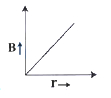
- B

- C

- D
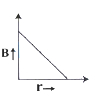
Explore More
Similar Questions
Two infinite length wires carry currents $8 \ A$ and $6 \ A$ respectively and are placed along the $X$ and $Y$ axes respectively. The magnetic field at a point $P(0, 0, d)$ will be:
Two circular coils are made from the same wire,but the radius of the $1^{\text{st}}$ coil is twice that of the $2^{\text{nd}}$ coil. If the magnetic field at their centers is the same,then the ratio of the potential difference applied across them is ($1^{\text{st}}$ to $2^{\text{nd}}$ coil).
DifficultMHT CET 2023
View SolutionTwo very thin metallic wires placed along $X$ and $Y$-axis carry equal currents as shown in the figure. $AB$ and $CD$ are lines at $45^\circ$ with the axes,with the origin of the axes at $O$. The magnetic field will be zero on the line:
Two parallel long current-carrying wires separated by a distance $2r$ are shown in the figure. The ratio of the magnetic field at $A$ to the magnetic field produced at $C$ is $\frac{x}{7}$. The value of $x$ is $\qquad$
DifficultJEE MAIN 2024
View SolutionExplain the experiment which demonstrates the magnetic field produced due to a straight long current-carrying wire.
Medium
View SolutionVedclass Products
For Students
Vedclass Test Series
Mock tests in real JEE/NEET style with performance analysis. 5-day free trial.
Start Free TrialFor Teachers
Exam Paper Generator
Generate Set A/B/C/D exam papers from 7.5L+ questions in 2 minutes. 3 chapters free.
Try FreeFor Institutes
Online Exam Module
Live online exams with unlimited students, 360° analytics & white-label branding.
See Demo