
Which one of the following graphs between molar conductivity $\left(\Lambda_m\right)$ versus $\sqrt{C}$ is correct?
- A
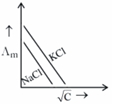
- B
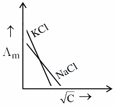
- C
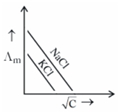
- D
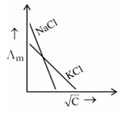
Explore More
Similar Questions
Solutions $A$,$B$,and $C$ of the same strong electrolyte offered resistances of $50 \ \Omega$,$100 \ \Omega$,and $150 \ \Omega$ in a given conductivity cell. The resistance observed if they are mixed in a volume proportion which is the reciprocal of their resistances and tested in the same conductivity cell would be ............. $\Omega$.
Difficult
View SolutionTollen's reagent is used for the detection of aldehyde. When a solution of $AgNO_3$ is added to glucose with $NH_4OH$,gluconic acid is formed.
$Ag^{+} + e^{-} \rightarrow Ag ; E^{\circ}_{red} = 0.8 \ V$
$C_6H_{12}O_6 + H_2O \rightarrow C_6H_{12}O_7 + 2H^{+} + 2e^{-} ; E^{\circ}_{oxd} = -0.05 \ V$
$Ag(NH_3)_2^{+} + e^{-} \rightarrow Ag_{(s)} + 2NH_3 ; E^{\circ}_{red} = 0.337 \ V$
[Use $2.303 \times \frac{RT}{F} = 0.0592$ and $\frac{F}{RT} = 38.92$ at $298 \ K$]
$1.$ $2Ag^{+} + C_6H_{12}O_6 + H_2O \rightarrow 2Ag_{(s)} + C_6H_{12}O_7 + 2H^{+}$. Find $\ln K$ of this reaction.
$(A) \ 66.13 \quad (B) \ 58.38 \quad (C) \ 28.30 \quad (D) \ 46.29$
$2.$ When ammonia is added to the solution,$pH$ is raised to $11$. Which half-cell reaction is affected by $pH$ and by how much?
$(A) E_{oxd}$ will increase by a factor of $0.65 \ V$ from $E^{\circ}_{oxd}$
$(B) E_{oxd}$ will decrease by a factor of $0.65 \ V$ from $E^{\circ}_{oxd}$
$(C) E_{red}$ will increase by a factor of $0.65 \ V$ from $E^{\circ}_{red}$
$(D) E_{red}$ will decrease by a factor of $0.65 \ V$ from $E^{\circ}_{red}$
$3.$ Ammonia is always added in this reaction. Which of the following must be incorrect?
$(A) NH_3$ combines with $Ag^{+}$ to form a complex.
$(B) Ag(NH_3)_2^{+}$ is a stronger oxidising reagent than $Ag^{+}$.
$(C)$ In absence of $NH_3$,silver salt of gluconic acid is formed.
$(D) NH_3$ has affected the standard reduction potential of glucose/gluconic acid electrode.
Give the answer for questions $1, 2$ and $3$.
$Ag^{+} + e^{-} \rightarrow Ag ; E^{\circ}_{red} = 0.8 \ V$
$C_6H_{12}O_6 + H_2O \rightarrow C_6H_{12}O_7 + 2H^{+} + 2e^{-} ; E^{\circ}_{oxd} = -0.05 \ V$
$Ag(NH_3)_2^{+} + e^{-} \rightarrow Ag_{(s)} + 2NH_3 ; E^{\circ}_{red} = 0.337 \ V$
[Use $2.303 \times \frac{RT}{F} = 0.0592$ and $\frac{F}{RT} = 38.92$ at $298 \ K$]
$1.$ $2Ag^{+} + C_6H_{12}O_6 + H_2O \rightarrow 2Ag_{(s)} + C_6H_{12}O_7 + 2H^{+}$. Find $\ln K$ of this reaction.
$(A) \ 66.13 \quad (B) \ 58.38 \quad (C) \ 28.30 \quad (D) \ 46.29$
$2.$ When ammonia is added to the solution,$pH$ is raised to $11$. Which half-cell reaction is affected by $pH$ and by how much?
$(A) E_{oxd}$ will increase by a factor of $0.65 \ V$ from $E^{\circ}_{oxd}$
$(B) E_{oxd}$ will decrease by a factor of $0.65 \ V$ from $E^{\circ}_{oxd}$
$(C) E_{red}$ will increase by a factor of $0.65 \ V$ from $E^{\circ}_{red}$
$(D) E_{red}$ will decrease by a factor of $0.65 \ V$ from $E^{\circ}_{red}$
$3.$ Ammonia is always added in this reaction. Which of the following must be incorrect?
$(A) NH_3$ combines with $Ag^{+}$ to form a complex.
$(B) Ag(NH_3)_2^{+}$ is a stronger oxidising reagent than $Ag^{+}$.
$(C)$ In absence of $NH_3$,silver salt of gluconic acid is formed.
$(D) NH_3$ has affected the standard reduction potential of glucose/gluconic acid electrode.
Give the answer for questions $1, 2$ and $3$.
Copper from copper sulphate solution can be displaced by .............. The standard reduction potentials of some electrodes are given below:
$E^o (Fe^{2+}, Fe) = -0.44 \ V$
$E^o (Zn^{2+}, Zn) = -0.76 \ V$
$E^o (Cu^{2+}, Cu) = +0.34 \ V$
$E^o (Cr^{2+}, Cr) = -0.74 \ V$
$E^o (H^{+}, 1/2H_2) = 0.00 \ V$
$E^o (Fe^{2+}, Fe) = -0.44 \ V$
$E^o (Zn^{2+}, Zn) = -0.76 \ V$
$E^o (Cu^{2+}, Cu) = +0.34 \ V$
$E^o (Cr^{2+}, Cr) = -0.74 \ V$
$E^o (H^{+}, 1/2H_2) = 0.00 \ V$
Medium
View SolutionWhich of the following statements is not correct?
Choose the correct representation of conductometric titration of benzoic acid vs sodium hydroxide.
DifficultJEE MAIN 2023
View SolutionVedclass Products
For Students
Vedclass Test Series
Mock tests in real JEE/NEET style with performance analysis. 5-day free trial.
Start Free TrialFor Teachers
Exam Paper Generator
Generate Set A/B/C/D exam papers from 7.5L+ questions in 2 minutes. 3 chapters free.
Try FreeFor Institutes
Online Exam Module
Live online exams with unlimited students, 360° analytics & white-label branding.
See Demo