
A English
Blood vessel Questions in English
Class 11 Biology · Body Fluids and Circulations · Blood vessel
108+
Questions
English
Language
100%
With Solutions
Showing 48 of 108 questions in English
51
MediumMCQ
An artery is a blood vessel that carries blood:
A
Away from the heart
B
Towards the heart
C
Which is impure without any exception
D
None of the above
Solution
(A) An artery is a blood vessel that carries blood away from the heart to various organs of the body.
In the systemic circulation,arteries carry oxygenated blood,while in the pulmonary circulation,the pulmonary artery carries deoxygenated blood from the heart to the lungs.
Therefore,the defining characteristic of an artery is the direction of blood flow (away from the heart),not the oxygen content.
In the systemic circulation,arteries carry oxygenated blood,while in the pulmonary circulation,the pulmonary artery carries deoxygenated blood from the heart to the lungs.
Therefore,the defining characteristic of an artery is the direction of blood flow (away from the heart),not the oxygen content.
0 likes
View Solution52
MediumMCQ
Which vessel transports sugar from the digestive system to the liver?
A
Hepatic artery
B
Hepatic portal vein
C
Pulmonary vein
D
None of the above
Solution
(B) The $Hepatic \text{ } portal \text{ } vein$ is a blood vessel that carries blood from the gastrointestinal tract and spleen to the liver. This system is responsible for transporting absorbed nutrients, including sugars (glucose), from the digestive system to the liver for processing, storage, or distribution to the rest of the body. Therefore, the correct option is $B$.
0 likes
View Solution53
MediumMCQ
Which blood capillaries are observed to study the circulatory system in a rat?
A
Mesentery
B
Kidney
C
Liver
D
Lungs
Solution
(A) The mesentery is a thin,transparent fold of the peritoneum that attaches the intestines to the abdominal wall. Because it is thin and highly vascularized,it is the ideal site for observing blood flow through capillaries under a microscope in a living rat. This preparation allows for the direct visualization of microcirculation,including the movement of red blood cells through the capillary network.
0 likes
View Solution54
MediumMCQ
How does the pulmonary artery differ from a vein?
A
Thick wall
B
Thin wall
C
Valves
D
Both $(B)$ and $(C)$
Solution
(A) The pulmonary artery is an artery,and like all arteries,it possesses a thicker wall compared to veins to withstand higher blood pressure.
Veins are characterized by having thinner walls and the presence of valves to prevent the backflow of blood.
Since the pulmonary artery is an artery,it does not have valves,whereas veins do.
Therefore,the pulmonary artery differs from a vein by having a thicker wall and lacking valves.
However,looking at the options provided,the question asks how the pulmonary artery differs from a vein.
Since the pulmonary artery has a thick wall (unlike the thin wall of a vein) and lacks valves (unlike the presence of valves in a vein),option $(A)$ is the most accurate description of the structural difference.
Veins are characterized by having thinner walls and the presence of valves to prevent the backflow of blood.
Since the pulmonary artery is an artery,it does not have valves,whereas veins do.
Therefore,the pulmonary artery differs from a vein by having a thicker wall and lacking valves.
However,looking at the options provided,the question asks how the pulmonary artery differs from a vein.
Since the pulmonary artery has a thick wall (unlike the thin wall of a vein) and lacks valves (unlike the presence of valves in a vein),option $(A)$ is the most accurate description of the structural difference.
0 likes
View Solution55
MediumMCQ
In which of the following vessel walls is the internal elastic lamina present?
A
Arteries
B
Veins
C
Both
D
Heart
Solution
(A) The wall of an artery consists of three layers: $Tunica$ $intima$ (innermost),$Tunica$ $media$ (middle),and $Tunica$ $externa$ (outermost).
The $Tunica$ $intima$ is composed of an endothelial lining and a layer of connective tissue.
An internal elastic lamina (or internal elastic membrane) is a layer of elastic fibers that separates the $Tunica$ $intima$ from the $Tunica$ $media$ in arteries.
This structure is characteristic of arteries and is generally absent or poorly developed in veins.
The $Tunica$ $intima$ is composed of an endothelial lining and a layer of connective tissue.
An internal elastic lamina (or internal elastic membrane) is a layer of elastic fibers that separates the $Tunica$ $intima$ from the $Tunica$ $media$ in arteries.
This structure is characteristic of arteries and is generally absent or poorly developed in veins.
0 likes
View Solution56
MediumMCQ
What are the cells that form the wall of a blood vessel called?
A
Oxyntic cells
B
Endothelial cells
C
Parietal cells
D
Hemocytes
Solution
(B) The wall of a blood vessel,such as an artery or vein,is lined internally by a thin layer of simple squamous epithelium known as the endothelium.
These endothelial cells play a crucial role in regulating vascular tone,blood flow,and the exchange of substances between the blood and surrounding tissues.
Therefore,the cells that form the innermost lining (and thus the wall structure) of a blood vessel are called endothelial cells.
These endothelial cells play a crucial role in regulating vascular tone,blood flow,and the exchange of substances between the blood and surrounding tissues.
Therefore,the cells that form the innermost lining (and thus the wall structure) of a blood vessel are called endothelial cells.
0 likes
View Solution57
MediumMCQ
Which of the following features distinguishes a vein from an artery?
A
Presence of valves to regulate blood flow
B
Narrow lumen
C
Muscular wall
D
Pigmented wall providing dark color
Solution
(A) Veins are blood vessels that carry blood towards the heart.
Unlike arteries,which have thick,elastic,and muscular walls to withstand high pressure,veins have thinner walls.
Because blood pressure in veins is significantly lower,they possess internal valves to prevent the backflow of blood and ensure unidirectional flow towards the heart.
Arteries generally have a narrow lumen,whereas veins have a wider lumen.
Therefore,the presence of valves is a key distinguishing feature of veins.
Unlike arteries,which have thick,elastic,and muscular walls to withstand high pressure,veins have thinner walls.
Because blood pressure in veins is significantly lower,they possess internal valves to prevent the backflow of blood and ensure unidirectional flow towards the heart.
Arteries generally have a narrow lumen,whereas veins have a wider lumen.
Therefore,the presence of valves is a key distinguishing feature of veins.
0 likes
View Solution58
MediumMCQ
Which statement is true for veins?
A
Every vein carries deoxygenated blood.
B
Every vein carries oxygenated blood.
C
They transport blood from organs towards the heart.
D
They transport blood from the heart towards organs.
Solution
(C) Veins are blood vessels that transport blood from various body organs towards the heart.
While most veins carry deoxygenated blood,the pulmonary vein is an exception as it carries oxygenated blood from the lungs to the heart.
Therefore,the defining characteristic of a vein is the direction of blood flow (towards the heart) rather than the oxygen content of the blood.
While most veins carry deoxygenated blood,the pulmonary vein is an exception as it carries oxygenated blood from the lungs to the heart.
Therefore,the defining characteristic of a vein is the direction of blood flow (towards the heart) rather than the oxygen content of the blood.
0 likes
View Solution59
MediumMCQ
Which vein carries oxygenated blood, unlike all other veins?
A
Renal vein
B
Hepatic vein
C
Hepatic portal vein
D
Pulmonary vein
Solution
(D) In the human circulatory system, veins typically carry deoxygenated blood from the tissues back to the heart.
However, the $Pulmonary \text{ vein}$ is an exception to this rule.
It carries oxygenated blood from the lungs to the left atrium of the heart.
Therefore, the correct option is $D$.
However, the $Pulmonary \text{ vein}$ is an exception to this rule.
It carries oxygenated blood from the lungs to the left atrium of the heart.
Therefore, the correct option is $D$.
0 likes
View Solution60
MediumMCQ
Arteries are best defined as vessels that:
A
carry oxygenated blood to different organs.
B
carry blood away from the heart to different organs.
C
break up into capillaries and reunite to form veins.
D
carry blood from one visceral organ to another visceral organ.
Solution
(B) Arteries are defined as blood vessels that transport blood away from the heart to various organs of the body.
While most arteries carry oxygenated blood,the pulmonary artery is an exception as it carries deoxygenated blood to the lungs.
Therefore,the defining characteristic of an artery is the direction of blood flow,which is away from the heart.
Thus,the correct option is $B$.
While most arteries carry oxygenated blood,the pulmonary artery is an exception as it carries deoxygenated blood to the lungs.
Therefore,the defining characteristic of an artery is the direction of blood flow,which is away from the heart.
Thus,the correct option is $B$.
0 likes
View Solution61
EasyMCQ
Which of the following is devoid of valves?
A
Arteries
B
Veins
C
Lymph vessels
D
Heart chambers
Solution
(A) Arteries are blood vessels that carry oxygenated blood away from the heart to various body parts. Because the blood in arteries is under high pressure due to the pumping action of the heart,they do not require valves to prevent backflow. In contrast,veins and lymph vessels contain valves to ensure unidirectional flow against gravity,and the heart contains valves to prevent the backflow of blood between chambers.
0 likes
View Solution62
MediumMCQ
Which of the following has the largest total surface area in the circulatory system?
A
Heart
B
Capillaries
C
Arteries
D
Veins
Solution
(B) The circulatory system consists of arteries,arterioles,capillaries,venules,and veins.
Capillaries are the smallest blood vessels,with a diameter of approximately $8-10 \ \mu m$.
Although individual capillaries are very small,they exist in such vast numbers that their combined total cross-sectional area is significantly greater than that of arteries or veins.
This massive total surface area is crucial for the efficient exchange of gases,nutrients,and waste products between the blood and the surrounding tissues.
Capillaries are the smallest blood vessels,with a diameter of approximately $8-10 \ \mu m$.
Although individual capillaries are very small,they exist in such vast numbers that their combined total cross-sectional area is significantly greater than that of arteries or veins.
This massive total surface area is crucial for the efficient exchange of gases,nutrients,and waste products between the blood and the surrounding tissues.
0 likes
View Solution63
MediumMCQ
What does $Vasa$ $vasorum$ represent?
A
Jugular anastomosis
B
Carotid labyrinth that regulates blood pressure
C
Nutritive function of 'vessel of vessel'
D
None of the above
Solution
(C) $Vasa$ $vasorum$ refers to a network of small blood vessels that supply the walls of large blood vessels,such as the aorta and vena cava.
Since the walls of these large vessels are too thick for nutrients and oxygen to diffuse from the main lumen,these specialized small vessels provide the necessary blood supply.
Therefore,they are often described as the 'vessels of vessels' or having a 'nutritive function' for the vessel walls.
Since the walls of these large vessels are too thick for nutrients and oxygen to diffuse from the main lumen,these specialized small vessels provide the necessary blood supply.
Therefore,they are often described as the 'vessels of vessels' or having a 'nutritive function' for the vessel walls.
0 likes
View Solution64
MediumMCQ
Which of the following structures consists of a single layer of cells?
A
Blood vessel
B
Artery
C
Vein
D
Capillary
Solution
(D) The $Capillary$ is the smallest blood vessel in the circulatory system.
It is composed of a single layer of endothelial cells, which allows for the efficient exchange of gases, nutrients, and waste products between the blood and the surrounding tissues.
In contrast, arteries and veins have thicker walls consisting of three layers: tunica intima, tunica media, and tunica externa.
It is composed of a single layer of endothelial cells, which allows for the efficient exchange of gases, nutrients, and waste products between the blood and the surrounding tissues.
In contrast, arteries and veins have thicker walls consisting of three layers: tunica intima, tunica media, and tunica externa.
0 likes
View Solution65
EasyMCQ
$A$ capillary network is a network of what?
A
Nerves
B
Muscle fibers
C
Blood capillaries
D
Lymphatic vessels
Solution
(C) capillary network is a dense,interconnected mesh of microscopic blood vessels known as capillaries. These vessels connect arterioles and venules,facilitating the exchange of oxygen,nutrients,and waste products between the blood and the surrounding tissues. Therefore,the correct answer is $C$.
0 likes
View Solution66
EasyMCQ
The internal carotid artery supplies blood to which of the following?
A
Kidneys
B
Liver
C
Heart
D
Brain
Solution
(D) The internal carotid artery is a major paired artery that arises from the common carotid artery. It primarily supplies blood to the brain,as well as the eyes and other structures within the cranial cavity. Therefore,the correct option is $D$.
0 likes
View Solution67
MediumMCQ
In a closed circulatory system,the blood pressure in the arteries is ......... .
A
High and regular
B
Low and regular
C
High and irregular
D
Low and irregular
Solution
(A) In a closed circulatory system,blood is confined within vessels. The arteries,which carry blood away from the heart,experience high pressure due to the pumping action of the heart. This pressure is regular because it fluctuates in a rhythmic pattern corresponding to the cardiac cycle (systole and diastole). Therefore,the blood pressure in the arteries is high and regular.
0 likes
View Solution68
MediumMCQ
In a closed circulatory system, there is the presence of ........., but the absence of ..........
A
Capillaries, Blood sinuses
B
Arteries, Veins
C
Veins, Capillaries
D
Blood sinuses, Capillaries
Solution
(A) In a closed circulatory system, blood is pumped by the heart and flows through a series of blood vessels of varying diameters ($arteries$, $veins$, and $capillaries$).
Blood does not come in direct contact with the cells or tissues.
Blood sinuses (or $haemocoel$) are characteristic of an open circulatory system, where blood flows into open spaces or cavities.
Therefore, a closed circulatory system is characterized by the presence of $capillaries$ and the absence of $blood \text{ } sinuses$.
Blood does not come in direct contact with the cells or tissues.
Blood sinuses (or $haemocoel$) are characteristic of an open circulatory system, where blood flows into open spaces or cavities.
Therefore, a closed circulatory system is characterized by the presence of $capillaries$ and the absence of $blood \text{ } sinuses$.
0 likes
View Solution69
EasyMCQ
Which of the following is another characteristic of the circulatory system in animals where the volume of blood is limited?
A
Blood is transported through arteries,veins,and capillaries.
B
Blood pressure is low and irregular.
C
Blood vessels open into blood-filled spaces called sinuses.
D
The sinuses are filled with blood.
Solution
(C) In animals with an open circulatory system,the blood volume is limited and it is pumped out of the heart into blood vessels that open into body cavities or spaces known as sinuses.
Because the blood is not confined to a closed network of vessels,the blood pressure remains low and irregular.
Therefore,the characteristic feature of such a system is that blood vessels open into blood-filled spaces called sinuses.
Because the blood is not confined to a closed network of vessels,the blood pressure remains low and irregular.
Therefore,the characteristic feature of such a system is that blood vessels open into blood-filled spaces called sinuses.
0 likes
View Solution70
MediumMCQ
Statement $X$: Blood is transported to the cells in the body through blood vessels.
Statement $Y$: Blood pressure is high and regular.
Statement $Y$: Blood pressure is high and regular.
A
Both Statement $X$ and Statement $Y$ are incorrect.
B
Statement $X$ is correct and Statement $Y$ is incorrect.
C
Both Statement $X$ and Statement $Y$ are correct,and Statement $X$ is the explanation of Statement $Y$.
D
Both Statement $X$ and Statement $Y$ are correct,and Statement $X$ is not the explanation of Statement $Y$.
Solution
(B) Statement $X$ is correct because blood is indeed transported to body cells via blood vessels (arteries,veins,and capillaries).
Statement $Y$ is incorrect because blood pressure is not uniform throughout the circulatory system; it is high in arteries and significantly lower in veins and capillaries. Furthermore,blood pressure is pulsatile (rhythmic) due to the heartbeat,not constant or 'regular' in the sense of being steady.
Statement $Y$ is incorrect because blood pressure is not uniform throughout the circulatory system; it is high in arteries and significantly lower in veins and capillaries. Furthermore,blood pressure is pulsatile (rhythmic) due to the heartbeat,not constant or 'regular' in the sense of being steady.
0 likes
View Solution71
MediumMCQ
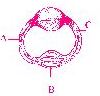
In the given figure,what do $A, B,$ and $C$ represent respectively?
A
Artery,Vein,Capillary
B
Vein,Artery,Capillary
C
Artery,Capillary,Vein
D
Vein,Capillary,Artery
Solution
(C) Based on the anatomical structure of blood vessels shown in the diagram:
$A$ represents an Artery,which has a thick muscular wall and a narrow lumen.
$B$ represents a Capillary,which is a single-layered vessel involved in exchange.
$C$ represents a Vein,which has a thinner wall and a wider lumen compared to an artery.
Therefore,the correct sequence is Artery,Capillary,Vein.
$A$ represents an Artery,which has a thick muscular wall and a narrow lumen.
$B$ represents a Capillary,which is a single-layered vessel involved in exchange.
$C$ represents a Vein,which has a thinner wall and a wider lumen compared to an artery.
Therefore,the correct sequence is Artery,Capillary,Vein.
0 likes
View Solution72
MediumMCQ
Arteries are best defined as the vessels which
A
supply oxygenated blood to the different organs
B
carry blood away from the heart to different organs
C
break up into capillaries which reunite to form a vein
D
carry blood from one visceral organ to another visceral organ.
Solution
(B) The correct answer is $B$.
Arteries are defined as the blood vessels that carry blood away from the heart to various organs of the body.
While most arteries carry oxygenated blood,the pulmonary artery is an exception as it carries deoxygenated blood from the heart to the lungs.
Therefore,the primary functional definition of an artery is based on the direction of blood flow (away from the heart) rather than the oxygen content of the blood.
Arteries are defined as the blood vessels that carry blood away from the heart to various organs of the body.
While most arteries carry oxygenated blood,the pulmonary artery is an exception as it carries deoxygenated blood from the heart to the lungs.
Therefore,the primary functional definition of an artery is based on the direction of blood flow (away from the heart) rather than the oxygen content of the blood.
0 likes
View Solution73
MediumMCQ
Fastest distribution of some injectable material/medicine and with no risk of any kind can be achieved by injecting it into the
A
muscles
B
arteries
C
veins
D
lymph vessels
Solution
(C) The correct answer is $C$. Intravenous injection is the most effective method for the rapid distribution of drugs or substances throughout the body because veins carry blood directly to the heart,which then pumps it to all tissues. Intramuscular injections are typically used for slower absorption or localized effects.
0 likes
View Solution74
MediumMCQ
Blood will lose most of the oxygen through....
A
Arteries
B
Veins
C
Capillaries
D
Lungs
Solution
(C) The exchange of gases, nutrients, and waste products between the blood and the surrounding tissues occurs in the $Capillaries$.
$Capillaries$ are the smallest blood vessels with very thin walls (a single layer of endothelial cells), which facilitate the diffusion of oxygen from the blood into the tissues and the uptake of carbon dioxide from the tissues into the blood.
Therefore, blood loses most of its oxygen while passing through the $Capillaries$ of the systemic circulation.
$Capillaries$ are the smallest blood vessels with very thin walls (a single layer of endothelial cells), which facilitate the diffusion of oxygen from the blood into the tissues and the uptake of carbon dioxide from the tissues into the blood.
Therefore, blood loses most of its oxygen while passing through the $Capillaries$ of the systemic circulation.
0 likes
View Solution75
MediumMCQ
This layer is more thickened in an artery than in a vein,so the lumen is small in an artery.
A
Tunica intima
B
Tunica media
C
Tunica externa
D
Serosa
Solution
(B) The wall of blood vessels consists of three layers: $Tunica$ $intima$ (inner layer),$Tunica$ $media$ (middle layer),and $Tunica$ $externa$ (outer layer).
In arteries,the $Tunica$ $media$ is significantly thicker and more muscular compared to veins.
This increased thickness of the $Tunica$ $media$ provides structural support to withstand high blood pressure and results in a narrower lumen in arteries compared to veins.
In arteries,the $Tunica$ $media$ is significantly thicker and more muscular compared to veins.
This increased thickness of the $Tunica$ $media$ provides structural support to withstand high blood pressure and results in a narrower lumen in arteries compared to veins.
0 likes
View Solution76
MediumMCQ
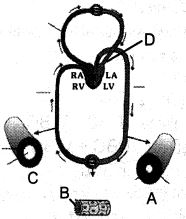
The figure shows blood circulation in humans with labels $A$ to $D.$ Select the option that correctly identifies the label and the functions of the part.
A
$A-$ Artery: Thick-walled,blood flows under high pressure.
B
$B-$ Capillary: Thin-walled,single-cell layer thick,site of exchange.
C
$C-$ Vein: Thin-walled,contains valves,blood flows at low pressure.
D
$D-$ Pulmonary vein: Carries oxygenated blood to the heart,$PO_2 = 95 \, mm \, Hg$.
Solution
(D) In the given figure:
$A$ represents an artery,which has a thick muscular wall to withstand high pressure.
$B$ represents a capillary,which is a single-cell layer thick to facilitate the exchange of materials.
$C$ represents a vein,which has a thin wall and a large lumen.
$D$ represents the pulmonary vein,which carries oxygenated blood from the lungs to the left atrium $(LA)$ of the heart. The partial pressure of oxygen $(PO_2)$ in the pulmonary vein is approximately $95 \, mm \, Hg$.
Therefore,option $D$ is the correct identification.
$A$ represents an artery,which has a thick muscular wall to withstand high pressure.
$B$ represents a capillary,which is a single-cell layer thick to facilitate the exchange of materials.
$C$ represents a vein,which has a thin wall and a large lumen.
$D$ represents the pulmonary vein,which carries oxygenated blood from the lungs to the left atrium $(LA)$ of the heart. The partial pressure of oxygen $(PO_2)$ in the pulmonary vein is approximately $95 \, mm \, Hg$.
Therefore,option $D$ is the correct identification.
0 likes
View Solution77
MediumMCQ
Choose the incorrect sentence regarding arteries and veins.
A
Tunica externa is an external layer of fibrous connective tissue with collagen fibres.
B
The tunica media is comparatively thin in the veins.
C
The tunica intima is the middle layer and possesses elastic fibres.
D
Basically,each artery and vein consists of three layers.
Solution
(C) The wall of blood vessels (arteries and veins) consists of three layers:
$1$. Tunica intima: The innermost layer,which is a lining of squamous endothelium.
$2$. Tunica media: The middle layer,which consists of smooth muscle and elastic fibres.
$3$. Tunica externa: The outermost layer,which is composed of fibrous connective tissue with collagen fibres.
Option $C$ is incorrect because the tunica intima is the innermost layer,not the middle layer. The middle layer is the tunica media.
$1$. Tunica intima: The innermost layer,which is a lining of squamous endothelium.
$2$. Tunica media: The middle layer,which consists of smooth muscle and elastic fibres.
$3$. Tunica externa: The outermost layer,which is composed of fibrous connective tissue with collagen fibres.
Option $C$ is incorrect because the tunica intima is the innermost layer,not the middle layer. The middle layer is the tunica media.
0 likes
View Solution78
EasyMCQ
Arteries carry $O_2$-rich blood except for the:
A
Pulmonary artery
B
Cardiac artery
C
Hepatic artery
D
Systemic artery
Solution
(A) In the human circulatory system,arteries are defined as blood vessels that carry blood away from the heart.
Most arteries carry oxygenated ($O_2$-rich) blood to the tissues of the body.
The pulmonary artery is an exception to this rule,as it carries deoxygenated ($CO_2$-rich) blood from the right ventricle of the heart to the lungs for oxygenation.
Therefore,the correct answer is the pulmonary artery.
Most arteries carry oxygenated ($O_2$-rich) blood to the tissues of the body.
The pulmonary artery is an exception to this rule,as it carries deoxygenated ($CO_2$-rich) blood from the right ventricle of the heart to the lungs for oxygenation.
Therefore,the correct answer is the pulmonary artery.
0 likes
View Solution79
MediumMCQ
The lumen of a vein is wider because ........
A
The tunica externa and tunica media form a single layer.
B
The tunica interna and tunica media form a single layer.
C
The tunica interna,tunica media,and tunica externa are thin.
D
The tunica media is a thin layer.
Solution
(D) Blood vessels are composed of three layers: $Tunica$ $interna$ (innermost),$Tunica$ $media$ (middle),and $Tunica$ $externa$ (outermost).
In arteries,the $Tunica$ $media$ is very thick and muscular to withstand high blood pressure,which results in a narrow lumen.
In contrast,veins have a much thinner $Tunica$ $media$ compared to arteries.
Because the $Tunica$ $media$ is thin in veins,the vessel wall is less thick,which allows the lumen to be significantly wider than that of an artery.
In arteries,the $Tunica$ $media$ is very thick and muscular to withstand high blood pressure,which results in a narrow lumen.
In contrast,veins have a much thinner $Tunica$ $media$ compared to arteries.
Because the $Tunica$ $media$ is thin in veins,the vessel wall is less thick,which allows the lumen to be significantly wider than that of an artery.
0 likes
View Solution80
MediumMCQ
The wall of blood capillaries is composed of:
A
Hemocytes
B
Parietal cells
C
Endothelial cells
D
Oxyntic cells
Solution
(C) The wall of blood capillaries is extremely thin and is composed of a single layer of squamous epithelial cells,which are known as $Endothelial$ $cells$. These cells rest on a basement membrane. This structure allows for the efficient exchange of gases,nutrients,and waste products between the blood and the surrounding tissues.
0 likes
View Solution81
MediumMCQ
The pulmonary artery is distinguished from the pulmonary vein by having:
A
Wide lumen
B
Thick muscular walls
C
No endothelium
D
Valves
Solution
(B) The pulmonary artery carries deoxygenated blood from the heart to the lungs,while the pulmonary vein carries oxygenated blood from the lungs to the heart. Arteries,in general,have thicker muscular walls compared to veins to withstand the high pressure of blood pumped by the heart. Veins typically have a wider lumen and contain valves to prevent the backflow of blood,whereas arteries (except for the aorta and pulmonary artery at their origin) generally lack valves.
0 likes
View Solution82
MediumMCQ
Arteries are best defined as vessels that $...$
A
carry oxygenated blood to different organs
B
break up into capillaries which reunite to form a vein
C
break up into capillaries which reunite to form a visceral organ
D
carry blood from one visceral organ to another visceral organ
Solution
(B) Arteries are blood vessels that carry blood away from the heart. As they move further from the heart,they branch into smaller vessels called arterioles,which further divide into a network of microscopic vessels known as capillaries. These capillaries are the site of exchange of materials between blood and tissues. After the exchange,these capillaries reunite to form venules,which eventually join to form veins that return blood to the heart. Therefore,the defining characteristic of arteries is that they break up into capillaries which reunite to form a vein.
0 likes
View Solution83
MediumMCQ
How is the blood pressure in the pulmonary artery?
A
Higher than in the carotid artery
B
Higher than in the pulmonary vein
C
Lower than in the vena cava
D
Same as in the aorta
Solution
(B) The pulmonary artery carries deoxygenated blood from the right ventricle to the lungs.
Blood pressure in the pulmonary circulation is significantly lower than in the systemic circulation.
However,within the pulmonary circuit,the pressure in the pulmonary artery is higher than the pressure in the pulmonary veins,as the pressure drops as blood flows through the pulmonary capillaries to reach the veins.
Blood pressure in the pulmonary circulation is significantly lower than in the systemic circulation.
However,within the pulmonary circuit,the pressure in the pulmonary artery is higher than the pressure in the pulmonary veins,as the pressure drops as blood flows through the pulmonary capillaries to reach the veins.
0 likes
View Solution84
MediumMCQ
Assertion : When there is a fall in the blood pressure due to loss of blood volume,this is compensated by vasoconstriction of veins.
Reason : Veins hold the extra amount of blood which can be shifted to the arteries as required.
Reason : Veins hold the extra amount of blood which can be shifted to the arteries as required.
A
If both Assertion and Reason are correct and the Reason is a correct explanation of the Assertion.
B
If both Assertion and Reason are correct but Reason is not a correct explanation of the Assertion.
C
If the Assertion is correct but Reason is incorrect.
D
If both the Assertion and Reason are incorrect.
Solution
(A) Veins are known as capacitance vessels because they contain a large volume of blood (about $60-70\%$ of the total blood volume) at any given time.
When blood pressure drops due to a decrease in blood volume (e.g.,hemorrhage),the sympathetic nervous system triggers vasoconstriction of the veins.
This constriction reduces the capacity of the venous system,forcing the stored blood to move toward the heart and into the arterial system.
This mechanism helps to maintain venous return and blood pressure,making the Reason a correct explanation for the Assertion.
When blood pressure drops due to a decrease in blood volume (e.g.,hemorrhage),the sympathetic nervous system triggers vasoconstriction of the veins.
This constriction reduces the capacity of the venous system,forcing the stored blood to move toward the heart and into the arterial system.
This mechanism helps to maintain venous return and blood pressure,making the Reason a correct explanation for the Assertion.
0 likes
View Solution85
Easy
Differentiate between an artery and a vein.
Solution
(N/A)
| Artery | Vein |
| $(1)$ It generally transports oxygenated blood away from the heart. | $(1)$ It generally transports deoxygenated blood towards the heart. |
| $(2)$ Blood flows under high pressure. | $(2)$ Blood flows under low pressure. |
| $(3)$ The walls are thick,muscular,and elastic. | $(3)$ The walls are thin and possess valves to prevent backflow. |
0 likes
View Solution86
Medium
Describe the internal structure of an artery and a vein in short.
Solution
(N/A) Blood is circulated in a definite pathway by blood vessels,primarily arteries and veins. Both consist of three layers:
$(1)$ Tunica Intima: The innermost layer,composed of a lining of squamous endothelium.
$(2)$ Tunica Media: The middle layer,composed of smooth muscles and elastic fibers. This layer is significantly thicker in arteries than in veins.
$(3)$ Tunica Externa: The outermost layer,composed of fibrous connective tissue with collagen fibers.
$(1)$ Tunica Intima: The innermost layer,composed of a lining of squamous endothelium.
$(2)$ Tunica Media: The middle layer,composed of smooth muscles and elastic fibers. This layer is significantly thicker in arteries than in veins.
$(3)$ Tunica Externa: The outermost layer,composed of fibrous connective tissue with collagen fibers.
0 likes
View Solution87
MediumMCQ
In a closed circulatory system:
A
The cells and tissues are directly bathed in the blood pumped out by the heart.
B
Arteries and veins are lacking.
C
The capillaries are the largest blood vessels and are closed at their ends.
D
Blood circulates through a series of vessels of varying diameters.
Solution
(D) closed circulatory system is a type of blood vascular system in which blood flows inside blood vessels of varying diameters ($arteries$, $veins$, $capillaries$) without coming in direct contact with body cells.
In this system, the blood is confined within vessels, ensuring efficient transport.
Closed circulatory systems are observed in $Annelids$, $Cephalopod$ $molluscs$, and $Chordates$.
In this system, the blood is confined within vessels, ensuring efficient transport.
Closed circulatory systems are observed in $Annelids$, $Cephalopod$ $molluscs$, and $Chordates$.
0 likes
View Solution88
EasyMCQ
Which blood vessels carry blood from different parts of your body to the heart?
A
Capillaries
B
Arteries
C
Veins
D
All of these
Solution
(C) Veins are the blood vessels that carry deoxygenated blood from various body parts back to the heart.
These vessels possess thin walls and internal valves to prevent the backflow of blood,as the blood flows under low pressure.
In contrast,arteries carry oxygenated blood away from the heart to the rest of the body under high pressure.
These vessels possess thin walls and internal valves to prevent the backflow of blood,as the blood flows under low pressure.
In contrast,arteries carry oxygenated blood away from the heart to the rest of the body under high pressure.
0 likes
View Solution89
MediumMCQ
The structure of which of the following consists of a layer of single cell thickness?
A
Blood capillary
B
Artery
C
Venule
D
Arteriole
Solution
(A) Capillaries were discovered by Marcello Malpighi in $1661$.
These are very thin-walled because the $tunica$ $externa$ and $tunica$ $media$ are absent.
The capillary wall is formed by only the $tunica$ $interna$ or endothelium,which is a single layer of cells.
These connect arterioles to venules and are specialized for exchanging substances with interstitial fluid.
According to local tissue requirements,these can be constricted or dilated.
These are very thin-walled because the $tunica$ $externa$ and $tunica$ $media$ are absent.
The capillary wall is formed by only the $tunica$ $interna$ or endothelium,which is a single layer of cells.
These connect arterioles to venules and are specialized for exchanging substances with interstitial fluid.
According to local tissue requirements,these can be constricted or dilated.
0 likes
View Solution90
MediumMCQ
Maximum surface area of the circulatory system is seen in
A
Heart
B
Capillaries
C
Arterioles
D
Veins
Solution
(B) Capillaries are the microscopic and smallest blood vessels in the circulatory system.
Their walls are extremely thin,consisting only of a single layer of endothelium (tunica interna).
Due to their vast branching and dense network formation (capillary beds) within tissues,they provide the largest total cross-sectional surface area among all blood vessels.
This extensive surface area is crucial for the efficient exchange of gases,nutrients,and waste products between the blood and the surrounding tissues.
Their walls are extremely thin,consisting only of a single layer of endothelium (tunica interna).
Due to their vast branching and dense network formation (capillary beds) within tissues,they provide the largest total cross-sectional surface area among all blood vessels.
This extensive surface area is crucial for the efficient exchange of gases,nutrients,and waste products between the blood and the surrounding tissues.
0 likes
View Solution91
MediumMCQ
Which statement is correct for an artery?
A
Thick-walled in which blood flows with high pressure
B
Thin-walled in which blood flows with low pressure
C
Thick-walled in which blood flows with low pressure
D
Thin-walled in which blood flows with high pressure
Solution
(A) Arteries are blood vessels that carry blood away from the heart to various organs of the body.
Since the blood is pumped directly from the heart into the arteries,it flows at a high pressure.
To withstand this high pressure,the walls of the arteries are thick and elastic,consisting of a well-developed muscular layer (tunica media) compared to veins.
Since the blood is pumped directly from the heart into the arteries,it flows at a high pressure.
To withstand this high pressure,the walls of the arteries are thick and elastic,consisting of a well-developed muscular layer (tunica media) compared to veins.
0 likes
View Solution92
MediumMCQ
Which of the following are located in the $tunica \text{ } media$ of human blood vessels?
A
Collagen fibres and smooth muscle
B
Squamous epithelium and striated muscle
C
Yellow fibres and smooth muscle
D
Yellow fibres and striated muscle
Solution
(C) $Tunica \text{ } media$ is the middle and typically the thickest layer of the wall of blood vessels.
It is primarily composed of circular layers of smooth muscle fibres and elastic fibres, often referred to as yellow fibres (elastin).
These components allow the vessel to maintain blood pressure and regulate blood flow through vasoconstriction and vasodilation.
In contrast, $tunica \text{ } externa$ is composed of connective tissue with collagen fibres, and $tunica \text{ } interna$ consists of a single layer of squamous endothelial cells.
It is primarily composed of circular layers of smooth muscle fibres and elastic fibres, often referred to as yellow fibres (elastin).
These components allow the vessel to maintain blood pressure and regulate blood flow through vasoconstriction and vasodilation.
In contrast, $tunica \text{ } externa$ is composed of connective tissue with collagen fibres, and $tunica \text{ } interna$ consists of a single layer of squamous endothelial cells.
0 likes
View Solution93
MediumMCQ
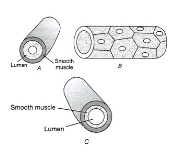
Identify $A, B$ and $C$ in the given diagram.
A
$A-$Artery,$B-$Capillary,$C-$Vein
B
$A-$Artery,$B-$Vein,$C-$Capillary
C
$A-$Vein,$B-$Artery,$C-$Capillary
D
$A-$Capillary,$B-$Artery,$C-$Vein
Solution
(A) Based on the structural characteristics shown in the diagram:
$1$. $A$ represents an artery,which has a thick wall and a relatively narrow lumen.
$2$. $B$ represents a capillary,which is composed of a single layer of endothelial cells and lacks smooth muscle.
$3$. $C$ represents a vein,which has a thinner wall and a wider lumen compared to an artery.
Therefore,the correct identification is $A-$Artery,$B-$Capillary,$C-$Vein.
$1$. $A$ represents an artery,which has a thick wall and a relatively narrow lumen.
$2$. $B$ represents a capillary,which is composed of a single layer of endothelial cells and lacks smooth muscle.
$3$. $C$ represents a vein,which has a thinner wall and a wider lumen compared to an artery.
Therefore,the correct identification is $A-$Artery,$B-$Capillary,$C-$Vein.
0 likes
View Solution94
MediumMCQ
Tunica externa is composed of
A
Endothelium
B
Connective tissue
C
Smooth muscles
D
Glycoproteins
Solution
(B) The wall of blood vessels (arteries and veins) consists of three layers:
$1$. Tunica intima (innermost layer,composed of endothelium).
$2$. Tunica media (middle layer,composed of smooth muscles and elastic fibers).
$3$. Tunica externa (outermost layer,composed of fibrous connective tissue with collagen fibers).
Therefore,Tunica externa is composed of connective tissue.
$1$. Tunica intima (innermost layer,composed of endothelium).
$2$. Tunica media (middle layer,composed of smooth muscles and elastic fibers).
$3$. Tunica externa (outermost layer,composed of fibrous connective tissue with collagen fibers).
Therefore,Tunica externa is composed of connective tissue.
0 likes
View Solution95
MediumMCQ
Match column $I$ with column $II$.
Select the alternative which shows the correct matching.
| Column-$I$ | Column-$II$ |
| $a.$ Capillaries | $(i)$ Valves |
| $b.$ Veins | $(ii)$ Smooth muscles |
| $c.$ Aorta | $(iii)$ Narrowest blood vessels |
| $d.$ Tunica media | $(iv)$ Elastic artery |
Select the alternative which shows the correct matching.
A
$a(iv), b(iii), c(i), d(ii)$
B
$a(iii), b(iv), c(ii), d(i)$
C
$a(iii), b(i), c(iv), d(ii)$
D
$a(ii), b(i), c(iv), d(iii)$
Solution
(C) The correct matching is as follows:
$a.$ Capillaries are the narrowest blood vessels, which allow the exchange of gases and nutrients between the blood and tissue fluid. Thus, $a-(iii)$.
$b.$ Veins contain valves to prevent the backflow of blood, ensuring unidirectional flow towards the heart. Thus, $b-(i)$.
$c.$ The Aorta is the largest artery in the body and is classified as an elastic artery due to its thick, elastic walls. Thus, $c-(iv)$.
$d.$ Tunica media is the middle layer of the blood vessel wall, which is primarily composed of smooth muscles and elastic fibers. Thus, $d-(ii)$.
Therefore, the correct sequence is $a-(iii), b-(i), c-(iv), d-(ii)$.
$a.$ Capillaries are the narrowest blood vessels, which allow the exchange of gases and nutrients between the blood and tissue fluid. Thus, $a-(iii)$.
$b.$ Veins contain valves to prevent the backflow of blood, ensuring unidirectional flow towards the heart. Thus, $b-(i)$.
$c.$ The Aorta is the largest artery in the body and is classified as an elastic artery due to its thick, elastic walls. Thus, $c-(iv)$.
$d.$ Tunica media is the middle layer of the blood vessel wall, which is primarily composed of smooth muscles and elastic fibers. Thus, $d-(ii)$.
Therefore, the correct sequence is $a-(iii), b-(i), c-(iv), d-(ii)$.
0 likes
View Solution96
MediumMCQ
Muscle pump is
A
Beating of heart
B
Squeezing effect of muscles upon veins
C
Peristaltic wave that travel along the alimentary canal
D
None of the above
Solution
(B) The contraction of skeletal muscle fibres in the legs is responsible for the movement of blood upwards against gravity,acting as a pump in $VEINS$.
0 likes
View Solution97
MediumMCQ
Interstitial fluid is released from which of the following?
A
Artery
B
Vein
C
Capillary
D
Heart
Solution
(C) Interstitial fluid (also known as tissue fluid) is the fluid present between the cells of a tissue.
It is formed by the filtration of blood plasma through the thin walls of the capillaries.
As blood flows through the capillaries,water and small solutes are pushed out into the interstitial spaces due to hydrostatic pressure,while blood cells and large proteins remain inside the vessels.
Therefore,the correct answer is $C$ (Capillary).
It is formed by the filtration of blood plasma through the thin walls of the capillaries.
As blood flows through the capillaries,water and small solutes are pushed out into the interstitial spaces due to hydrostatic pressure,while blood cells and large proteins remain inside the vessels.
Therefore,the correct answer is $C$ (Capillary).
0 likes
View Solution98
EasyMCQ
Identify the layers of a blood vessel in order from the inside to the outside.
A
Tunica intima $\rightarrow$ Tunica media $\rightarrow$ Tunica externa
B
Tunica externa $\rightarrow$ Tunica media $\rightarrow$ Tunica intima
C
Tunica media $\rightarrow$ Tunica intima $\rightarrow$ Tunica externa
D
Tunica externa $\rightarrow$ Tunica intima $\rightarrow$ Tunica media
Solution
(A) The wall of a blood vessel (artery or vein) consists of three distinct layers:
$1$. The innermost layer is the $Tunica \ intima$,which is composed of a lining of squamous endothelium.
$2$. The middle layer is the $Tunica \ media$,which consists of smooth muscle and elastic fibers.
$3$. The outermost layer is the $Tunica \ externa$,which is composed of fibrous connective tissue with collagen fibers.
Therefore,the correct order from inside to outside is $Tunica \ intima \rightarrow Tunica \ media \rightarrow Tunica \ externa$.
$1$. The innermost layer is the $Tunica \ intima$,which is composed of a lining of squamous endothelium.
$2$. The middle layer is the $Tunica \ media$,which consists of smooth muscle and elastic fibers.
$3$. The outermost layer is the $Tunica \ externa$,which is composed of fibrous connective tissue with collagen fibers.
Therefore,the correct order from inside to outside is $Tunica \ intima \rightarrow Tunica \ media \rightarrow Tunica \ externa$.
0 likes
View SolutionBody Fluids and Circulations — Blood vessel · Frequently Asked Questions
1Are these Body Fluids and Circulations questions useful for JEE and NEET?
Yes. All questions in this section are mapped to JEE Main and NEET exam patterns. Previous year questions from JEE Main, NEET, GUJCET and state-level exams are included with full solutions.
2Can I switch to Hindi or Gujarati for these questions?
Yes. Use the language tabs in the hero section or the sidebar to view the same questions and solutions in English, Hindi or Gujarati.
3How do I generate a question paper from this subtopic?
Use the Vedclass Exam Paper Generator — select the chapter and subtopic, set difficulty, and generate Sets A, B, C, D automatically. First 3 chapters of every subject are free.
Vedclass Products
For Students
Vedclass Test Series
Mock tests in real JEE/NEET style with performance analysis. 5-day free trial.
Start Free TrialFor Teachers
Exam Paper Generator
Generate Set A/B/C/D papers from this chapter in 2 minutes. 3 chapters free.
Try FreeFor Institutes
Online Exam Module
Live online exams with unlimited students, 360° analytics & white-label branding.
See DemoFor Teachers & Institutes
Generate a Body Fluids and Circulations Exam Paper in 2 Minutes
Select subtopic & difficulty — Sets A, B, C, D auto-generated with No Repeat logic.
First 3 chapters of every subject are free — no payment required.