
A English
Ideal gas equation and Related gas laws Questions in English
Class 11 Chemistry · States of Matter · Ideal gas equation and Related gas laws
576+
Questions
English
Language
100%
With Solutions
Showing 24 of 576 questions in English
551
MediumMCQ
For a fixed mass of an ideal gas, which of the following is a correct representation?
A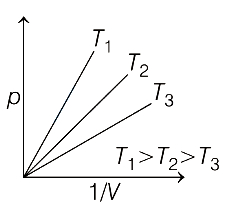
B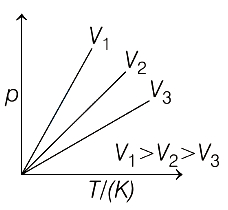
C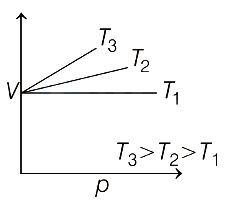
D
None of these
Solution
(A) For a fixed mass $(m)$ of an ideal gas, the ideal gas equation is $pV = nRT$, where $n$ is constant.
$(A)$ For $p$ vs $1/V$ (Boyle's Law): $p = (nRT) \times (1/V)$. The slope is $nRT$. Since $T_1 > T_2 > T_3$, the slope $T_1 > T_2 > T_3$. This graph is correct.
$(B)$ For $p$ vs $T$ (Gay-Lussac's Law): $p = (nR/V) \times T$. The slope is $nR/V$. Since $V_1 > V_2 > V_3$, the slope $1/V_1 < 1/V_2 < 1/V_3$. Thus, the order of slopes should be $V_3 > V_2 > V_1$. The provided graph shows $V_1 > V_2 > V_3$, which is incorrect.
$(C)$ For $V$ vs $p$ (Boyle's Law): $V = (nRT) \times (1/p)$. This is a rectangular hyperbola, not a straight line passing through the origin. The provided graph is incorrect.
Therefore, the correct representation is $(A)$.
$(A)$ For $p$ vs $1/V$ (Boyle's Law): $p = (nRT) \times (1/V)$. The slope is $nRT$. Since $T_1 > T_2 > T_3$, the slope $T_1 > T_2 > T_3$. This graph is correct.
$(B)$ For $p$ vs $T$ (Gay-Lussac's Law): $p = (nR/V) \times T$. The slope is $nR/V$. Since $V_1 > V_2 > V_3$, the slope $1/V_1 < 1/V_2 < 1/V_3$. Thus, the order of slopes should be $V_3 > V_2 > V_1$. The provided graph shows $V_1 > V_2 > V_3$, which is incorrect.
$(C)$ For $V$ vs $p$ (Boyle's Law): $V = (nRT) \times (1/p)$. This is a rectangular hyperbola, not a straight line passing through the origin. The provided graph is incorrect.
Therefore, the correct representation is $(A)$.
0 likes
View Solution552
MediumMCQ
$A$ certain mass of a gas occupies a volume of $2 \,L$ at $STP$. To what temperature must the gas be heated to double its volume, keeping the pressure constant?
A
$100 \,K$
B
$273 \,K$
C
$273^{\circ} C$
D
$546^{\circ} C$
Solution
(C) According to Charles's Law, at constant pressure, $\frac{V_1}{T_1} = \frac{V_2}{T_2}$.
Given: $V_1 = 2 \,L$, $T_1 = 273 \,K$ (at $STP$), $V_2 = 4 \,L$.
Substituting the values: $\frac{2}{273} = \frac{4}{T_2}$.
$T_2 = \frac{273 \times 4}{2} = 546 \,K$.
Converting to Celsius: $546 \,K - 273 = 273^{\circ} C$.
Given: $V_1 = 2 \,L$, $T_1 = 273 \,K$ (at $STP$), $V_2 = 4 \,L$.
Substituting the values: $\frac{2}{273} = \frac{4}{T_2}$.
$T_2 = \frac{273 \times 4}{2} = 546 \,K$.
Converting to Celsius: $546 \,K - 273 = 273^{\circ} C$.
0 likes
View Solution553
DifficultMCQ
$4 \ g$ of an ideal gas occupies $5.6035 \ L$ of volume at $546 \ K$ and $2 \ atm$ pressure. What is its molecular weight?
A
$4$
B
$16$
C
$32$
D
$64$
Solution
(B) Given: $W = 4 \ g$, $V = 5.6035 \ L$, $T = 546 \ K$, $P = 2 \ atm$.
Using the ideal gas equation: $PV = nRT$, where $n = \frac{W}{M}$.
$PV = \frac{W}{M} RT$
$M = \frac{WRT}{PV}$
Substituting the values: $M = \frac{4 \times 0.0821 \times 546}{2 \times 5.6035}$
$M = \frac{179.3304}{11.207} \approx 16 \ g/mol$.
Using the ideal gas equation: $PV = nRT$, where $n = \frac{W}{M}$.
$PV = \frac{W}{M} RT$
$M = \frac{WRT}{PV}$
Substituting the values: $M = \frac{4 \times 0.0821 \times 546}{2 \times 5.6035}$
$M = \frac{179.3304}{11.207} \approx 16 \ g/mol$.
0 likes
View Solution554
MediumMCQ
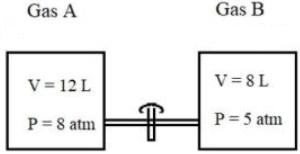
Two vessels are filled with ideal gases $A$ and $B$ and are connected through a pipe of zero volume as shown in the figure. The stop cock is opened and the gases are allowed to mix homogeneously and the temperature is kept constant. The partial pressures of $A$ and $B$ respectively (in $atm$) are:
A
$8.0, 5.0$
B
$9.6, 4.0$
C
$6.4, 4.0$
D
$4.8, 2.0$
Solution
(D) Initial state for gas $A$: $P_1 = 8 \ atm$, $V_1 = 12 \ L$. Total volume after opening the stop cock: $V_{total} = 12 \ L + 8 \ L = 20 \ L$.
Since the temperature is constant, we use Boyle's Law $(P_1V_1 = P_2V_2)$ for each gas independently.
For gas $A$: $8 \ atm \times 12 \ L = P_A \times 20 \ L \implies P_A = \frac{96}{20} = 4.8 \ atm$.
For gas $B$: $5 \ atm \times 8 \ L = P_B \times 20 \ L \implies P_B = \frac{40}{20} = 2.0 \ atm$.
Thus, the partial pressures of $A$ and $B$ are $4.8 \ atm$ and $2.0 \ atm$ respectively.
Since the temperature is constant, we use Boyle's Law $(P_1V_1 = P_2V_2)$ for each gas independently.
For gas $A$: $8 \ atm \times 12 \ L = P_A \times 20 \ L \implies P_A = \frac{96}{20} = 4.8 \ atm$.
For gas $B$: $5 \ atm \times 8 \ L = P_B \times 20 \ L \implies P_B = \frac{40}{20} = 2.0 \ atm$.
Thus, the partial pressures of $A$ and $B$ are $4.8 \ atm$ and $2.0 \ atm$ respectively.
0 likes
View Solution555
MediumMCQ
$A$ vessel of volume $24.6 \ L$ contains $1.5 \ moles$ of $H_2$ and $2.5 \ moles$ of $N_2$ at $300 \ K$. Calculate the partial pressure of $N_2$ in the vessel. (in $atm$)
A
$1.5$
B
$2.0$
C
$2.5$
D
$3.0$
Solution
(C) The partial pressure of a gas in a mixture is the pressure it would exert if it alone occupied the entire volume of the container at the same temperature.
Using the ideal gas equation, $PV = nRT$, the partial pressure of $N_2$ $(p_{N_2})$ is given by $p_{N_2} = \frac{n_{N_2} R T}{V}$.
Given:
$n_{N_2} = 2.5 \ mol$
$V = 24.6 \ L$
$T = 300 \ K$
$R = 0.0821 \ L \ atm \ K^{-1} \ mol^{-1}$
Substituting the values:
$p_{N_2} = \frac{2.5 \ mol \times 0.0821 \ L \ atm \ K^{-1} \ mol^{-1} \times 300 \ K}{24.6 \ L}$
$p_{N_2} = \frac{61.575}{24.6} \ atm$
$p_{N_2} = 2.5 \ atm$.
Using the ideal gas equation, $PV = nRT$, the partial pressure of $N_2$ $(p_{N_2})$ is given by $p_{N_2} = \frac{n_{N_2} R T}{V}$.
Given:
$n_{N_2} = 2.5 \ mol$
$V = 24.6 \ L$
$T = 300 \ K$
$R = 0.0821 \ L \ atm \ K^{-1} \ mol^{-1}$
Substituting the values:
$p_{N_2} = \frac{2.5 \ mol \times 0.0821 \ L \ atm \ K^{-1} \ mol^{-1} \times 300 \ K}{24.6 \ L}$
$p_{N_2} = \frac{61.575}{24.6} \ atm$
$p_{N_2} = 2.5 \ atm$.
0 likes
View Solution556
DifficultMCQ
How many times the volume of a diatomic gas should be increased reversibly and adiabatically in order to reduce its $RMS$ velocity to half of its initial value?
A
$4$
B
$8$
C
$16$
D
$32$
Solution
(D) The $RMS$ velocity of a gas is given by $v_{rms} = \sqrt{\frac{3RT}{M}}$.
Since $v_{rms} \propto \sqrt{T}$, reducing the $RMS$ velocity to half means the final temperature $T_f$ must be $\frac{1}{4}$ of the initial temperature $T_i$ $(T_f = \frac{T_i}{4})$.
For a reversible adiabatic process, $T_i V_i^{\gamma-1} = T_f V_f^{\gamma-1}$.
For a diatomic gas, $\gamma = \frac{7}{5}$, so $\gamma - 1 = \frac{2}{5}$.
Substituting the values: $T_i V_i^{2/5} = (\frac{T_i}{4}) V_f^{2/5}$.
This simplifies to $4 = (\frac{V_f}{V_i})^{2/5}$.
Raising both sides to the power of $\frac{5}{2}$: $4^{5/2} = \frac{V_f}{V_i}$.
$V_f / V_i = (2^2)^{5/2} = 2^5 = 32$.
Since $v_{rms} \propto \sqrt{T}$, reducing the $RMS$ velocity to half means the final temperature $T_f$ must be $\frac{1}{4}$ of the initial temperature $T_i$ $(T_f = \frac{T_i}{4})$.
For a reversible adiabatic process, $T_i V_i^{\gamma-1} = T_f V_f^{\gamma-1}$.
For a diatomic gas, $\gamma = \frac{7}{5}$, so $\gamma - 1 = \frac{2}{5}$.
Substituting the values: $T_i V_i^{2/5} = (\frac{T_i}{4}) V_f^{2/5}$.
This simplifies to $4 = (\frac{V_f}{V_i})^{2/5}$.
Raising both sides to the power of $\frac{5}{2}$: $4^{5/2} = \frac{V_f}{V_i}$.
$V_f / V_i = (2^2)^{5/2} = 2^5 = 32$.
0 likes
View Solution557
MediumMCQ
At $400 \ K$, an ideal gas is enclosed in a $0.5 \ m^3$ vessel at a pressure of $203 \ kPa$. What is the change in temperature required (in $K$), if it occupies a volume of $0.2 \ m^3$ under a pressure of $304 \ kPa$? (Nearest integer)
A
$240$
B
$160$
C
$120$
D
$80$
Solution
(B) Using the ideal gas law for a fixed amount of gas: $\frac{P_1 V_1}{T_1} = \frac{P_2 V_2}{T_2}$
Given: $P_1 = 203 \ kPa$, $V_1 = 0.5 \ m^3$, $T_1 = 400 \ K$
$P_2 = 304 \ kPa$, $V_2 = 0.2 \ m^3$
Substituting the values: $\frac{203 \times 0.5}{400} = \frac{304 \times 0.2}{T_2}$
$T_2 = \frac{304 \times 0.2 \times 400}{203 \times 0.5} = \frac{24320}{101.5} \approx 239.6 \ K$
Change in temperature $\Delta T = |T_2 - T_1| = |239.6 - 400| = 160.4 \ K$
The nearest integer is $160 \ K$.
Given: $P_1 = 203 \ kPa$, $V_1 = 0.5 \ m^3$, $T_1 = 400 \ K$
$P_2 = 304 \ kPa$, $V_2 = 0.2 \ m^3$
Substituting the values: $\frac{203 \times 0.5}{400} = \frac{304 \times 0.2}{T_2}$
$T_2 = \frac{304 \times 0.2 \times 400}{203 \times 0.5} = \frac{24320}{101.5} \approx 239.6 \ K$
Change in temperature $\Delta T = |T_2 - T_1| = |239.6 - 400| = 160.4 \ K$
The nearest integer is $160 \ K$.
0 likes
View Solution558
MediumMCQ
If $2.5$ moles of an ideal gas at a certain temperature are allowed to expand isothermally and reversibly from an initial volume of $2$ $dm^3$ to $20$ $dm^3$, the work done by the gas is $-16.5$ $kJ$. The temperature (in $K$) of the gas is (Round off to the nearest value). $(R = 8.314 \ J \ K^{-1} \ mol^{-1})$
A
$445$
B
$245$
C
$345$
D
$745$
Solution
(C) The formula for reversible isothermal work is: $W = -2.303 nRT \log \left(\frac{V_2}{V_1}\right)$
Given: $n = 2.5 \ mol$, $V_1 = 2 \ dm^3$, $V_2 = 20 \ dm^3$, $W = -16.5 \ kJ = -16500 \ J$, $R = 8.314 \ J \ K^{-1} \ mol^{-1}$
Substituting the values: $-16500 = -2.303 \times 2.5 \times 8.314 \times T \times \log \left(\frac{20}{2}\right)$
$-16500 = -2.303 \times 2.5 \times 8.314 \times T \times \log(10)$
Since $\log(10) = 1$, we have: $-16500 = -2.303 \times 2.5 \times 8.314 \times T$
$-16500 = -47.87 \times T$
$T = \frac{16500}{47.87} \approx 344.68 \ K$
Rounding to the nearest value, $T \approx 345 \ K$.
Given: $n = 2.5 \ mol$, $V_1 = 2 \ dm^3$, $V_2 = 20 \ dm^3$, $W = -16.5 \ kJ = -16500 \ J$, $R = 8.314 \ J \ K^{-1} \ mol^{-1}$
Substituting the values: $-16500 = -2.303 \times 2.5 \times 8.314 \times T \times \log \left(\frac{20}{2}\right)$
$-16500 = -2.303 \times 2.5 \times 8.314 \times T \times \log(10)$
Since $\log(10) = 1$, we have: $-16500 = -2.303 \times 2.5 \times 8.314 \times T$
$-16500 = -47.87 \times T$
$T = \frac{16500}{47.87} \approx 344.68 \ K$
Rounding to the nearest value, $T \approx 345 \ K$.
0 likes
View Solution559
EasyMCQ
An air bag on adiabatic expansion undergoes $5 \%$ increase in its volume. The percentage change in pressure is $\left[\gamma_{air}=1.4\right]$ (in $\%$)
A
$5$
B
$6$
C
$7$
D
$9$
Solution
(C) For an adiabatic process, the relation between pressure and volume is $Pv^{\gamma} = K$.
Differentiating both sides, we get $v^{\gamma} dP + P \gamma v^{\gamma-1} dv = 0$.
Rearranging the terms, we get $\frac{dP}{P} = -\gamma \frac{dv}{v}$.
To find the percentage change, multiply both sides by $100$:
$\frac{dP}{P} \times 100 = -\gamma \left( \frac{dv}{v} \times 100 \right)$.
Given $\gamma = 1.4$ and $\frac{dv}{v} \times 100 = 5 \%$, we substitute these values:
$\text{Percentage change in pressure} = -1.4 \times 5 = -7 \%$.
The negative sign indicates a decrease in pressure. Thus, the magnitude of the percentage change is $7 \%$.
Differentiating both sides, we get $v^{\gamma} dP + P \gamma v^{\gamma-1} dv = 0$.
Rearranging the terms, we get $\frac{dP}{P} = -\gamma \frac{dv}{v}$.
To find the percentage change, multiply both sides by $100$:
$\frac{dP}{P} \times 100 = -\gamma \left( \frac{dv}{v} \times 100 \right)$.
Given $\gamma = 1.4$ and $\frac{dv}{v} \times 100 = 5 \%$, we substitute these values:
$\text{Percentage change in pressure} = -1.4 \times 5 = -7 \%$.
The negative sign indicates a decrease in pressure. Thus, the magnitude of the percentage change is $7 \%$.
0 likes
View Solution560
DifficultMCQ
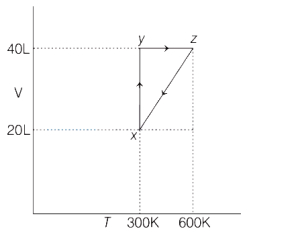
The following graph shows a system containing $1 \ mole$ of gas undergoing various steps. When it moves from $z$ to $x$, the type of process is:
A
cyclic
B
isothermal
C
isochoric
D
isobaric
Solution
(D) From the graph, at point $x$: $T_1 = 300 \ K, V_1 = 20 \ L$.
At point $z$: $T_2 = 600 \ K, V_2 = 40 \ L$.
According to the ideal gas law, $pV = nRT$, which implies $\frac{pV}{T} = nR$.
Since $n$ and $R$ are constants, $\frac{p_1V_1}{T_1} = \frac{p_2V_2}{T_2}$.
Substituting the values: $\frac{p_1 \times 20}{300} = \frac{p_2 \times 40}{600}$.
$\frac{p_1}{15} = \frac{p_2}{15}$, which gives $p_1 = p_2$.
Since the pressure remains constant during the process from $z$ to $x$, it is an isobaric process.
At point $z$: $T_2 = 600 \ K, V_2 = 40 \ L$.
According to the ideal gas law, $pV = nRT$, which implies $\frac{pV}{T} = nR$.
Since $n$ and $R$ are constants, $\frac{p_1V_1}{T_1} = \frac{p_2V_2}{T_2}$.
Substituting the values: $\frac{p_1 \times 20}{300} = \frac{p_2 \times 40}{600}$.
$\frac{p_1}{15} = \frac{p_2}{15}$, which gives $p_1 = p_2$.
Since the pressure remains constant during the process from $z$ to $x$, it is an isobaric process.
0 likes
View Solution561
EasyMCQ
Avogadro's law is valid for
A
all gases
B
ideal gas
C
Van der Waals gas
D
real gas
Solution
(B) Avogadro's law states that equal volumes of all gases at the same temperature and pressure contain an equal number of molecules. This law is strictly applicable only to $ideal$ gases, as it assumes that gas molecules have negligible volume and no intermolecular forces of attraction, which are the fundamental postulates of the kinetic molecular theory of gases.
0 likes
View Solution562
MediumMCQ
An $LPG$ (Liquefied Petroleum Gas) cylinder weighs $15.0 \ kg$ when empty. When full, it weighs $30.0 \ kg$ and shows a pressure of $3.0 \ atm$. In the course of usage at $27^{\circ}C$, the mass of the full cylinder is reduced to $24.2 \ kg$. The volume of the used gas in cubic metre at the normal usage condition ($1 \ atm$ and $27^{\circ}C$) is (assume $LPG$ to be normal butane and it behaves ideally). (in $m^3$)
A
$24.6$
B
$246$
C
$0.246$
D
$2.46$
Solution
(D) Mass of gas initially $= 30.0 \ kg - 15.0 \ kg = 15.0 \ kg$.
Mass of gas remaining $= 24.2 \ kg - 15.0 \ kg = 9.2 \ kg$.
Mass of gas used $= 15.0 \ kg - 9.2 \ kg = 5.8 \ kg = 5800 \ g$.
Molar mass of butane $(C_4H_{10})$ $= 4 \times 12 + 10 \times 1 = 58 \ g/mol$.
Number of moles of gas used $(n)$ $= \frac{5800 \ g}{58 \ g/mol} = 100 \ mol$.
Using the ideal gas equation $PV = nRT$ at $1 \ atm$ and $27^{\circ}C$ $(300 \ K)$:
$V = \frac{nRT}{P} = \frac{100 \ mol \times 0.0821 \ L \cdot atm \cdot K^{-1} \cdot mol^{-1} \times 300 \ K}{1 \ atm} = 2463 \ L$.
Since $1 \ m^3 = 1000 \ L$, the volume in cubic metres is $\frac{2463}{1000} \ m^3 = 2.463 \ m^3$.
Mass of gas remaining $= 24.2 \ kg - 15.0 \ kg = 9.2 \ kg$.
Mass of gas used $= 15.0 \ kg - 9.2 \ kg = 5.8 \ kg = 5800 \ g$.
Molar mass of butane $(C_4H_{10})$ $= 4 \times 12 + 10 \times 1 = 58 \ g/mol$.
Number of moles of gas used $(n)$ $= \frac{5800 \ g}{58 \ g/mol} = 100 \ mol$.
Using the ideal gas equation $PV = nRT$ at $1 \ atm$ and $27^{\circ}C$ $(300 \ K)$:
$V = \frac{nRT}{P} = \frac{100 \ mol \times 0.0821 \ L \cdot atm \cdot K^{-1} \cdot mol^{-1} \times 300 \ K}{1 \ atm} = 2463 \ L$.
Since $1 \ m^3 = 1000 \ L$, the volume in cubic metres is $\frac{2463}{1000} \ m^3 = 2.463 \ m^3$.
0 likes
View Solution563
EasyMCQ
At $273 \ K$ temperature and $76 \ cm \ Hg$ pressure, the density of a gas is $1.964 \ g \ L^{-1}$. The gas is
A
$CH_4$
B
$CO$
C
$He$
D
$CO_2$
Solution
(D) The ideal gas equation is given by $PV = nRT = \frac{w}{M} RT$.
Rearranging for density $(d = \frac{w}{V})$, we get $d = \frac{PM}{RT}$.
Thus, the molar mass $M = \frac{dRT}{P}$.
Given: $d = 1.964 \ g \ L^{-1}$, $T = 273 \ K$, $P = 76 \ cm \ Hg = 1 \ atm$, and $R = 0.0821 \ L \ atm \ K^{-1} \ mol^{-1}$.
Substituting the values: $M = \frac{1.964 \times 0.0821 \times 273}{1} \approx 44 \ g \ mol^{-1}$.
The molar mass of $CO_2$ is $12 + 2 \times 16 = 44 \ g \ mol^{-1}$.
Therefore, the gas is $CO_2$.
Rearranging for density $(d = \frac{w}{V})$, we get $d = \frac{PM}{RT}$.
Thus, the molar mass $M = \frac{dRT}{P}$.
Given: $d = 1.964 \ g \ L^{-1}$, $T = 273 \ K$, $P = 76 \ cm \ Hg = 1 \ atm$, and $R = 0.0821 \ L \ atm \ K^{-1} \ mol^{-1}$.
Substituting the values: $M = \frac{1.964 \times 0.0821 \times 273}{1} \approx 44 \ g \ mol^{-1}$.
The molar mass of $CO_2$ is $12 + 2 \times 16 = 44 \ g \ mol^{-1}$.
Therefore, the gas is $CO_2$.
0 likes
View Solution564
DifficultMCQ
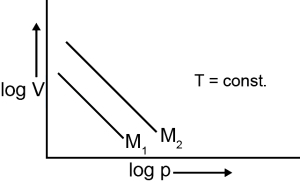
For the same mass of two different ideal gases of molecular weights $M_{1}$ and $M_{2}$, plots of $\log V$ vs $\log p$ at a given constant temperature are shown. Identify the correct option.
A
$M_{1} > M_{2}$
B
$M_{1} = M_{2}$
C
$M_{1} < M_{2}$
D
Can be predicted only if temperature is known
Solution
(A) For an ideal gas, the ideal gas equation is $pV = \frac{w}{M}RT$, where $w$ is the mass, $M$ is the molecular weight, $R$ is the gas constant, and $T$ is the temperature.
Since $w$, $R$, and $T$ are constant, let $wRT = K$. Then $pV = \frac{K}{M}$, or $V = \frac{K}{Mp}$.
Taking the logarithm on both sides: $\log V = \log \left( \frac{K}{M} \right) - \log p$.
This is in the form of $y = mx + c$, where $y = \log V$, $x = \log p$, $m = -1$, and the intercept $c = \log \left( \frac{K}{M} \right)$.
From the graph, the intercept for $M_{2}$ is higher than the intercept for $M_{1}$.
Therefore, $\log \left( \frac{K}{M_{2}} \right) > \log \left( \frac{K}{M_{1}} \right)$.
This implies $\frac{K}{M_{2}} > \frac{K}{M_{1}}$, which means $M_{1} > M_{2}$.
Since $w$, $R$, and $T$ are constant, let $wRT = K$. Then $pV = \frac{K}{M}$, or $V = \frac{K}{Mp}$.
Taking the logarithm on both sides: $\log V = \log \left( \frac{K}{M} \right) - \log p$.
This is in the form of $y = mx + c$, where $y = \log V$, $x = \log p$, $m = -1$, and the intercept $c = \log \left( \frac{K}{M} \right)$.
From the graph, the intercept for $M_{2}$ is higher than the intercept for $M_{1}$.
Therefore, $\log \left( \frac{K}{M_{2}} \right) > \log \left( \frac{K}{M_{1}} \right)$.
This implies $\frac{K}{M_{2}} > \frac{K}{M_{1}}$, which means $M_{1} > M_{2}$.
0 likes
View Solution565
DifficultMCQ
During a reversible adiabatic process, the pressure of a gas is found to be proportional to the cube of its absolute temperature. The ratio $\frac{C_p}{C_V}$ for the gas is:
A
$\frac{3}{2}$
B
$\frac{7}{2}$
C
$\frac{5}{3}$
D
$\frac{9}{7}$
Solution
(A) For a reversible adiabatic process, the relation between pressure $(P)$ and temperature $(T)$ is given by $P^{1-\gamma} T^\gamma = \text{constant}$.
This can be rearranged as $P \propto T^{\frac{\gamma}{\gamma-1}}$.
Given: $P \propto T^3$.
Therefore, $\frac{\gamma}{\gamma-1} = 3$.
$\gamma = 3\gamma - 3$.
$2\gamma = 3$.
$\gamma = \frac{3}{2}$.
Since $\gamma = \frac{C_p}{C_V}$, the ratio is $\frac{3}{2}$.
This can be rearranged as $P \propto T^{\frac{\gamma}{\gamma-1}}$.
Given: $P \propto T^3$.
Therefore, $\frac{\gamma}{\gamma-1} = 3$.
$\gamma = 3\gamma - 3$.
$2\gamma = 3$.
$\gamma = \frac{3}{2}$.
Since $\gamma = \frac{C_p}{C_V}$, the ratio is $\frac{3}{2}$.
0 likes
View Solution566
MediumMCQ
For one mole of an ideal gas, the slope of $V$ vs. $T$ curve at a constant pressure of $2 \ atm$ is $X \ L \ mol^{-1} \ K^{-1}$. The value of the ideal universal gas constant '$R$' in terms of $X$ is
A
$X \ L \ atm \ mol^{-1} \ K^{-1}$
B
$\frac{X}{2} \ L \ atm \ mol^{-1} \ K^{-1}$
C
$2 \times X \ L \ atm \ mol^{-1} \ K^{-1}$
D
$2 \ X \ atm \ L \ mol^{-1} \ K^{-1}$
Solution
(C) The ideal gas equation is $pV = nRT$.
For $n = 1 \ mol$, the equation becomes $V = (\frac{R}{p})T$.
Comparing this with the equation of a straight line $y = mx + c$, where $y = V$ and $x = T$, the slope $m$ is given by $\frac{R}{p}$.
Given that the slope is $X$ at a pressure $p = 2 \ atm$, we have $X = \frac{R}{2}$.
Therefore, $R = 2X \ L \ atm \ mol^{-1} \ K^{-1}$.
For $n = 1 \ mol$, the equation becomes $V = (\frac{R}{p})T$.
Comparing this with the equation of a straight line $y = mx + c$, where $y = V$ and $x = T$, the slope $m$ is given by $\frac{R}{p}$.
Given that the slope is $X$ at a pressure $p = 2 \ atm$, we have $X = \frac{R}{2}$.
Therefore, $R = 2X \ L \ atm \ mol^{-1} \ K^{-1}$.
0 likes
View Solution567
DifficultMCQ
$A$ syringe has a volume of $10.0 \text{ cm}^3$ at a pressure of $1 \text{ atm}$. If the end is sealed and the plunger is pushed down at a constant temperature, what will be the final volume when the pressure becomes $3.5 \text{ atm}$ (in $\text{ cm}^3$)?
A
$35.0$
B
$86$
C
$2.86$
D
$50$
Solution
(C) According to Boyle's Law, for a fixed amount of gas at constant temperature, $P_1V_1 = P_2V_2$.
Given: $P_1 = 1 \text{ atm}$, $V_1 = 10.0 \text{ cm}^3$, $P_2 = 3.5 \text{ atm}$.
Substituting the values: $1 \text{ atm} \times 10.0 \text{ cm}^3 = 3.5 \text{ atm} \times V_2$.
$V_2 = \frac{10.0 \text{ cm}^3 \times 1 \text{ atm}}{3.5 \text{ atm}}$.
$V_2 \approx 2.86 \text{ cm}^3$.
Given: $P_1 = 1 \text{ atm}$, $V_1 = 10.0 \text{ cm}^3$, $P_2 = 3.5 \text{ atm}$.
Substituting the values: $1 \text{ atm} \times 10.0 \text{ cm}^3 = 3.5 \text{ atm} \times V_2$.
$V_2 = \frac{10.0 \text{ cm}^3 \times 1 \text{ atm}}{3.5 \text{ atm}}$.
$V_2 \approx 2.86 \text{ cm}^3$.
0 likes
View Solution568
DifficultMCQ
Calculate the temperature of $2 \text{ moles}$ of gas occupying a volume of $5.0 \text{ L}$ at a pressure of $24.6 \text{ atm}$. (Given: $R = 0.0821 \text{ L atm K}^{-1} \text{ mol}^{-1}$) (in $^\circ \text{C}$)
A
$476$
B
$480$
C
$440$
D
$450$
Solution
(A) Using the ideal gas equation: $PV = nRT$
Given: $P = 24.6 \text{ atm}$, $V = 5.0 \text{ L}$, $n = 2 \text{ mol}$, $R = 0.0821 \text{ L atm K}^{-1} \text{ mol}^{-1}$
Substitute the values: $24.6 \times 5.0 = 2 \times 0.0821 \times T$
$123 = 0.1642 \times T$
$T = 123 / 0.1642 \approx 749.08 \text{ K}$
Convert to Celsius: $T(^\circ \text{C}) = T(\text{K}) - 273.15$
$T \approx 749.08 - 273.15 = 475.93^\circ \text{C} \approx 476^\circ \text{C}$
Given: $P = 24.6 \text{ atm}$, $V = 5.0 \text{ L}$, $n = 2 \text{ mol}$, $R = 0.0821 \text{ L atm K}^{-1} \text{ mol}^{-1}$
Substitute the values: $24.6 \times 5.0 = 2 \times 0.0821 \times T$
$123 = 0.1642 \times T$
$T = 123 / 0.1642 \approx 749.08 \text{ K}$
Convert to Celsius: $T(^\circ \text{C}) = T(\text{K}) - 273.15$
$T \approx 749.08 - 273.15 = 475.93^\circ \text{C} \approx 476^\circ \text{C}$
0 likes
View Solution569
DifficultMCQ
$A$ gas occupies a volume of $0.35 \ dm^3$ at $290 \ K$ and $2 \ atm$ pressure. Calculate the volume of the gas at $STP$. (in $dm^3$)
A
$11$
B
$0.66$
C
$0.11$
D
$5$
Solution
(B) Given: $P_1 = 2 \ atm$, $V_1 = 0.35 \ dm^3$, $T_1 = 290 \ K$.
At $STP$: $P_2 = 1 \ atm$, $T_2 = 273.15 \ K$ (commonly taken as $273 \ K$).
Using the combined gas law: $\frac{P_1V_1}{T_1} = \frac{P_2V_2}{T_2}$.
Substituting the values: $\frac{2 \times 0.35}{290} = \frac{1 \times V_2}{273}$.
$V_2 = \frac{0.7 \times 273}{290} \approx 0.659 \ dm^3$.
Rounding to two decimal places, $V_2 \approx 0.66 \ dm^3$.
At $STP$: $P_2 = 1 \ atm$, $T_2 = 273.15 \ K$ (commonly taken as $273 \ K$).
Using the combined gas law: $\frac{P_1V_1}{T_1} = \frac{P_2V_2}{T_2}$.
Substituting the values: $\frac{2 \times 0.35}{290} = \frac{1 \times V_2}{273}$.
$V_2 = \frac{0.7 \times 273}{290} \approx 0.659 \ dm^3$.
Rounding to two decimal places, $V_2 \approx 0.66 \ dm^3$.
0 likes
View Solution570
DifficultMCQ
Calculate the new pressure of a gas enclosed in a cylinder when it is compressed from $5 \text{ L}$ to $2 \text{ L}$ at an initial pressure of $1 \text{ atm}$ and temperature of $300 \text{ K}$. The final temperature in this process is $500 \text{ K}$. (in $\text{ atm}$)
A
$4.17$
B
$12$
C
$5$
D
$16$
Solution
(A) Using the combined gas law: $\frac{P_1V_1}{T_1} = \frac{P_2V_2}{T_2}$
Given: $P_1 = 1 \text{ atm}$, $V_1 = 5 \text{ L}$, $T_1 = 300 \text{ K}$, $V_2 = 2 \text{ L}$, $T_2 = 500 \text{ K}$.
Substitute the values: $\frac{1 \times 5}{300} = \frac{P_2 \times 2}{500}$
$P_2 = \frac{1 \times 5 \times 500}{300 \times 2} = \frac{2500}{600} = \frac{25}{6} \approx 4.17 \text{ atm}$.
Given: $P_1 = 1 \text{ atm}$, $V_1 = 5 \text{ L}$, $T_1 = 300 \text{ K}$, $V_2 = 2 \text{ L}$, $T_2 = 500 \text{ K}$.
Substitute the values: $\frac{1 \times 5}{300} = \frac{P_2 \times 2}{500}$
$P_2 = \frac{1 \times 5 \times 500}{300 \times 2} = \frac{2500}{600} = \frac{25}{6} \approx 4.17 \text{ atm}$.
0 likes
View Solution571
DifficultMCQ
At constant temperature, a gas occupies a volume of $200 \text{ mL}$ at a pressure of $500 \text{ mm Hg}$. What will be its volume at $800 \text{ mm Hg}$ pressure (in $\text{ mL}$)?
A
$280$
B
$125$
C
$100$
D
$350$
Solution
(B) According to Boyle's Law, at constant temperature, $P_1V_1 = P_2V_2$.
Given: $P_1 = 500 \text{ mm Hg}$, $V_1 = 200 \text{ mL}$, $P_2 = 800 \text{ mm Hg}$.
Substituting the values: $500 \times 200 = 800 \times V_2$.
$V_2 = \frac{500 \times 200}{800} \text{ mL}$.
$V_2 = \frac{100000}{800} \text{ mL} = 125 \text{ mL}$.
Given: $P_1 = 500 \text{ mm Hg}$, $V_1 = 200 \text{ mL}$, $P_2 = 800 \text{ mm Hg}$.
Substituting the values: $500 \times 200 = 800 \times V_2$.
$V_2 = \frac{500 \times 200}{800} \text{ mL}$.
$V_2 = \frac{100000}{800} \text{ mL} = 125 \text{ mL}$.
0 likes
View Solution572
MediumMCQ
$V_0$ and $V_t$ are the volumes of a fixed mass of an ideal gas at $0^\circ \text{C}$ and $t^\circ \text{C}$ respectively at constant pressure. Find the ratio $V_t / V_0$.
A
$1 + t/273$
B
$1 - t/273$
C
$(273 + t) / 273$
D
$273 / (273 + t)$
Solution
(C) According to Charles' Law, for a fixed mass of gas at constant pressure, the volume is directly proportional to the absolute temperature.
$V_t = V_0 \left(1 + \frac{t}{273.15}\right)$.
Using the approximation $273$ for $273.15$:
$V_t = V_0 \left(1 + \frac{t}{273}\right)$.
$V_t = V_0 \left(\frac{273 + t}{273}\right)$.
Therefore, the ratio $\frac{V_t}{V_0} = \frac{273 + t}{273}$.
$V_t = V_0 \left(1 + \frac{t}{273.15}\right)$.
Using the approximation $273$ for $273.15$:
$V_t = V_0 \left(1 + \frac{t}{273}\right)$.
$V_t = V_0 \left(\frac{273 + t}{273}\right)$.
Therefore, the ratio $\frac{V_t}{V_0} = \frac{273 + t}{273}$.
0 likes
View Solution573
DifficultMCQ
Find the number of moles of $CO_2$ present in a sample occupying $4 \times 10^{-3} \text{ m}^3$ at $1.104 \times 10^5 \text{ Nm}^{-2}$ pressure. Given: $R \times T = 2208 \text{ J mol}^{-1}$. (in $\text{ mole}$)
A
$0.1$
B
$0.2$
C
$0.3$
D
$0.4$
Solution
(B) Using the ideal gas equation: $PV = nRT$
Rearranging for $n$: $n = \frac{PV}{RT}$
Given: $P = 1.104 \times 10^5 \text{ Nm}^{-2}$, $V = 4 \times 10^{-3} \text{ m}^3$, and $RT = 2208 \text{ J mol}^{-1}$.
Substituting the values: $n = \frac{(1.104 \times 10^5) \times (4 \times 10^{-3})}{2208}$
$n = \frac{110400 \times 0.004}{2208}$
$n = \frac{441.6}{2208} = 0.2 \text{ mole}$.
Rearranging for $n$: $n = \frac{PV}{RT}$
Given: $P = 1.104 \times 10^5 \text{ Nm}^{-2}$, $V = 4 \times 10^{-3} \text{ m}^3$, and $RT = 2208 \text{ J mol}^{-1}$.
Substituting the values: $n = \frac{(1.104 \times 10^5) \times (4 \times 10^{-3})}{2208}$
$n = \frac{110400 \times 0.004}{2208}$
$n = \frac{441.6}{2208} = 0.2 \text{ mole}$.
0 likes
View Solution574
DifficultMCQ
$A$ gas at $10^{\circ}C$ occupies a volume of $283 \text{ mL}$. If it is heated to $20^{\circ}C$ at constant pressure, what is the new volume of the gas (in $\text{ mL}$)?
A
$566$
B
$450$
C
$350$
D
$293$
Solution
(D) According to Charles's Law, for a fixed mass of gas at constant pressure, $V \propto T$ (where $T$ is in Kelvin).
Step $1$: Convert temperatures to Kelvin: $T_1 = 10 + 273 = 283 \text{ K}$ and $T_2 = 20 + 273 = 293 \text{ K}$.
Step $2$: Use the formula $\frac{V_1}{T_1} = \frac{V_2}{T_2}$.
Step $3$: Substitute the values: $\frac{283 \text{ mL}}{283 \text{ K}} = \frac{V_2}{293 \text{ K}}$.
Step $4$: Solve for $V_2$: $V_2 = \frac{283 \times 293}{283} = 293 \text{ mL}$.
Step $1$: Convert temperatures to Kelvin: $T_1 = 10 + 273 = 283 \text{ K}$ and $T_2 = 20 + 273 = 293 \text{ K}$.
Step $2$: Use the formula $\frac{V_1}{T_1} = \frac{V_2}{T_2}$.
Step $3$: Substitute the values: $\frac{283 \text{ mL}}{283 \text{ K}} = \frac{V_2}{293 \text{ K}}$.
Step $4$: Solve for $V_2$: $V_2 = \frac{283 \times 293}{283} = 293 \text{ mL}$.
0 likes
View SolutionStates of Matter — Ideal gas equation and Related gas laws · Frequently Asked Questions
1Are these States of Matter questions useful for JEE and NEET?
Yes. All questions in this section are mapped to JEE Main and NEET exam patterns. Previous year questions from JEE Main, NEET, GUJCET and state-level exams are included with full solutions.
2Can I switch to Hindi or Gujarati for these questions?
Yes. Use the language tabs in the hero section or the sidebar to view the same questions and solutions in English, Hindi or Gujarati.
3How do I generate a question paper from this subtopic?
Use the Vedclass Exam Paper Generator — select the chapter and subtopic, set difficulty, and generate Sets A, B, C, D automatically. First 3 chapters of every subject are free.
Vedclass Products
For Students
Vedclass Test Series
Mock tests in real JEE/NEET style with performance analysis. 5-day free trial.
Start Free TrialFor Teachers
Exam Paper Generator
Generate Set A/B/C/D papers from this chapter in 2 minutes. 3 chapters free.
Try FreeFor Institutes
Online Exam Module
Live online exams with unlimited students, 360° analytics & white-label branding.
See DemoFor Teachers & Institutes
Generate a States of Matter Exam Paper in 2 Minutes
Select subtopic & difficulty — Sets A, B, C, D auto-generated with No Repeat logic.
First 3 chapters of every subject are free — no payment required.