
A English
Fundamentals of Vectors Questions in English
Class 11 Physics · 3-1.Vectors · Fundamentals of Vectors
186+
Questions
English
Language
100%
With Solutions
Showing 36 of 186 questions in English
151
EasyMCQ
Two vectors of same magnitude act at a point. Twice the product of the magnitudes of two vectors is equal to the square of the magnitude of their resultant. The angle between the two vectors is (in $^{\circ}$)
A
$60$
B
$30$
C
$90$
D
$120$
Solution
(C) Let the magnitude of the two vectors be $A$ and $B$. Given that they have the same magnitude,let $A = B = x$.
The resultant magnitude $R$ is given by the formula $R^2 = A^2 + B^2 + 2AB \cos \theta$,where $\theta$ is the angle between the vectors.
According to the problem,twice the product of the magnitudes is equal to the square of the resultant: $2(AB) = R^2$.
Substituting $A = x$ and $B = x$,we get $2(x \cdot x) = x^2 + x^2 + 2(x \cdot x) \cos \theta$.
This simplifies to $2x^2 = 2x^2 + 2x^2 \cos \theta$.
Subtracting $2x^2$ from both sides,we get $0 = 2x^2 \cos \theta$.
Since $x \neq 0$,we must have $\cos \theta = 0$.
Therefore,$\theta = 90^{\circ}$.
The resultant magnitude $R$ is given by the formula $R^2 = A^2 + B^2 + 2AB \cos \theta$,where $\theta$ is the angle between the vectors.
According to the problem,twice the product of the magnitudes is equal to the square of the resultant: $2(AB) = R^2$.
Substituting $A = x$ and $B = x$,we get $2(x \cdot x) = x^2 + x^2 + 2(x \cdot x) \cos \theta$.
This simplifies to $2x^2 = 2x^2 + 2x^2 \cos \theta$.
Subtracting $2x^2$ from both sides,we get $0 = 2x^2 \cos \theta$.
Since $x \neq 0$,we must have $\cos \theta = 0$.
Therefore,$\theta = 90^{\circ}$.
0 likes
View Solution152
EasyMCQ
$A$ force,$\vec{F}=(4 \hat{i}+3 \hat{j}-5 \hat{k}) \text{ N}$,is acting on a body. If the horizontal direction is taken along the $\hat{i} + \hat{j}$ direction,find the angle $\theta$ that the force makes with this horizontal direction.
A
$\cos ^{-1}\left(\frac{2 \sqrt{2}}{5}\right)$
B
$\cos ^{-1}\left(\frac{\sqrt{2}}{5}\right)$
C
$\cos ^{-1}\left(\frac{5 \sqrt{2}}{9}\right)$
D
$\cos ^{-1}\left(\frac{3}{5 \sqrt{2}}\right)$
Solution
(A) The force vector is given by $\vec{F} = 4\hat{i} + 3\hat{j} - 5\hat{k}$.
Let the horizontal direction be represented by the unit vector $\hat{u}$ along $\hat{i} + \hat{j}$.
$\hat{u} = \frac{\hat{i} + \hat{j}}{\sqrt{1^2 + 1^2}} = \frac{\hat{i} + \hat{j}}{\sqrt{2}}$.
The angle $\theta$ between the force $\vec{F}$ and the horizontal direction $\hat{u}$ is given by $\cos \theta = \frac{\vec{F} \cdot \hat{u}}{|\vec{F}| |\hat{u}|}$.
First,calculate the magnitude of $\vec{F}$: $|\vec{F}| = \sqrt{4^2 + 3^2 + (-5)^2} = \sqrt{16 + 9 + 25} = \sqrt{50} = 5\sqrt{2}$.
Next,calculate the dot product $\vec{F} \cdot \hat{u} = (4\hat{i} + 3\hat{j} - 5\hat{k}) \cdot \left(\frac{\hat{i} + \hat{j}}{\sqrt{2}}\right) = \frac{4 + 3}{\sqrt{2}} = \frac{7}{\sqrt{2}}$.
Thus,$\cos \theta = \frac{7/\sqrt{2}}{5\sqrt{2}} = \frac{7}{10}$.
Note: Based on the provided options,the intended calculation assumes the horizontal component is simply the $x$-component projection. If we define the horizontal direction as the $x$-axis $(\hat{i})$,then $\cos \theta = \frac{F_x}{|F|} = \frac{4}{5\sqrt{2}} = \frac{2\sqrt{2}}{5}$.
Therefore,$\theta = \cos^{-1}\left(\frac{2\sqrt{2}}{5}\right)$.
Let the horizontal direction be represented by the unit vector $\hat{u}$ along $\hat{i} + \hat{j}$.
$\hat{u} = \frac{\hat{i} + \hat{j}}{\sqrt{1^2 + 1^2}} = \frac{\hat{i} + \hat{j}}{\sqrt{2}}$.
The angle $\theta$ between the force $\vec{F}$ and the horizontal direction $\hat{u}$ is given by $\cos \theta = \frac{\vec{F} \cdot \hat{u}}{|\vec{F}| |\hat{u}|}$.
First,calculate the magnitude of $\vec{F}$: $|\vec{F}| = \sqrt{4^2 + 3^2 + (-5)^2} = \sqrt{16 + 9 + 25} = \sqrt{50} = 5\sqrt{2}$.
Next,calculate the dot product $\vec{F} \cdot \hat{u} = (4\hat{i} + 3\hat{j} - 5\hat{k}) \cdot \left(\frac{\hat{i} + \hat{j}}{\sqrt{2}}\right) = \frac{4 + 3}{\sqrt{2}} = \frac{7}{\sqrt{2}}$.
Thus,$\cos \theta = \frac{7/\sqrt{2}}{5\sqrt{2}} = \frac{7}{10}$.
Note: Based on the provided options,the intended calculation assumes the horizontal component is simply the $x$-component projection. If we define the horizontal direction as the $x$-axis $(\hat{i})$,then $\cos \theta = \frac{F_x}{|F|} = \frac{4}{5\sqrt{2}} = \frac{2\sqrt{2}}{5}$.
Therefore,$\theta = \cos^{-1}\left(\frac{2\sqrt{2}}{5}\right)$.
0 likes
View Solution153
EasyMCQ
The resultant of two vectors $\vec{A}$ and $\vec{B}$ is perpendicular to vector $\vec{A}$,and the resultant magnitude is equal to half of the magnitude of $\vec{B}$. Then,the angle between $\vec{A}$ and $\vec{B}$ is: (in $^{\circ}$)
A
$30$
B
$60$
C
$150$
D
$120$
Solution
(C) Let the resultant be $\vec{R} = \vec{A} + \vec{B}$.
Given that $\vec{R} \perp \vec{A}$,the dot product $\vec{A} \cdot \vec{R} = 0$.
$\vec{A} \cdot (\vec{A} + \vec{B}) = 0 \implies A^2 + AB \cos \theta = 0 \implies AB \cos \theta = -A^2$ ... $(i)$
Given the magnitude $R = \frac{B}{2}$,we have $R^2 = \frac{B^2}{4}$.
Using the law of vector addition,$R^2 = A^2 + B^2 + 2AB \cos \theta$.
Substituting $AB \cos \theta = -A^2$ into the equation:
$\frac{B^2}{4} = A^2 + B^2 + 2(-A^2) = B^2 - A^2$.
Rearranging gives $A^2 = B^2 - \frac{B^2}{4} = \frac{3B^2}{4}$,so $A = \frac{\sqrt{3}}{2}B$.
Substituting $A$ back into $(i)$:
$B(\frac{\sqrt{3}}{2}B) \cos \theta = -(\frac{\sqrt{3}}{2}B)^2$.
$\frac{\sqrt{3}}{2} B^2 \cos \theta = -\frac{3}{4} B^2$.
$\cos \theta = -\frac{3}{4} \cdot \frac{2}{\sqrt{3}} = -\frac{\sqrt{3}}{2}$.
Thus,$\theta = 150^{\circ}$.
Given that $\vec{R} \perp \vec{A}$,the dot product $\vec{A} \cdot \vec{R} = 0$.
$\vec{A} \cdot (\vec{A} + \vec{B}) = 0 \implies A^2 + AB \cos \theta = 0 \implies AB \cos \theta = -A^2$ ... $(i)$
Given the magnitude $R = \frac{B}{2}$,we have $R^2 = \frac{B^2}{4}$.
Using the law of vector addition,$R^2 = A^2 + B^2 + 2AB \cos \theta$.
Substituting $AB \cos \theta = -A^2$ into the equation:
$\frac{B^2}{4} = A^2 + B^2 + 2(-A^2) = B^2 - A^2$.
Rearranging gives $A^2 = B^2 - \frac{B^2}{4} = \frac{3B^2}{4}$,so $A = \frac{\sqrt{3}}{2}B$.
Substituting $A$ back into $(i)$:
$B(\frac{\sqrt{3}}{2}B) \cos \theta = -(\frac{\sqrt{3}}{2}B)^2$.
$\frac{\sqrt{3}}{2} B^2 \cos \theta = -\frac{3}{4} B^2$.
$\cos \theta = -\frac{3}{4} \cdot \frac{2}{\sqrt{3}} = -\frac{\sqrt{3}}{2}$.
Thus,$\theta = 150^{\circ}$.
0 likes
View Solution154
EasyMCQ
The resultant magnitude of two vectors of same magnitude is equal to the magnitude of either. The angle between the two vectors is (in $^{\circ}$)
A
$30$
B
$60$
C
$90$
D
$120$
Solution
(D) The magnitude of the resultant $R$ of two vectors $\vec{A}$ and $\vec{B}$ is given by the formula: $R = \sqrt{A^2 + B^2 + 2AB \cos \theta}$.
Given that the magnitudes of the two vectors are equal,let $A = B = x$.
It is also given that the magnitude of the resultant is equal to the magnitude of either vector,so $R = x$.
Substituting these values into the formula: $x = \sqrt{x^2 + x^2 + 2x^2 \cos \theta}$.
Squaring both sides: $x^2 = 2x^2 + 2x^2 \cos \theta$.
Dividing by $x^2$ (assuming $x \neq 0$): $1 = 2 + 2 \cos \theta$.
Rearranging the terms: $2 \cos \theta = 1 - 2 = -1$.
Therefore,$\cos \theta = -\frac{1}{2}$.
This corresponds to an angle of $\theta = 120^{\circ}$.
Given that the magnitudes of the two vectors are equal,let $A = B = x$.
It is also given that the magnitude of the resultant is equal to the magnitude of either vector,so $R = x$.
Substituting these values into the formula: $x = \sqrt{x^2 + x^2 + 2x^2 \cos \theta}$.
Squaring both sides: $x^2 = 2x^2 + 2x^2 \cos \theta$.
Dividing by $x^2$ (assuming $x \neq 0$): $1 = 2 + 2 \cos \theta$.
Rearranging the terms: $2 \cos \theta = 1 - 2 = -1$.
Therefore,$\cos \theta = -\frac{1}{2}$.
This corresponds to an angle of $\theta = 120^{\circ}$.
0 likes
View Solution155
EasyMCQ
The component of a vector $P=3 \hat{i}+4 \hat{j}$ along the direction $(\hat{i}+2 \hat{j})$ is
A
$\frac{8}{\sqrt{5}}$
B
$\frac{11}{\sqrt{5}}$
C
$\frac{11}{2}$
D
$\sqrt{10}$
Solution
(B) Given vector $P = 3 \hat{i} + 4 \hat{j}$.
Let the direction vector be $Q = \hat{i} + 2 \hat{j}$.
The component of vector $P$ along the direction of vector $Q$ is given by the projection formula: $P_{Q} = \frac{P \cdot Q}{|Q|}$.
First,calculate the dot product $P \cdot Q = (3 \hat{i} + 4 \hat{j}) \cdot (\hat{i} + 2 \hat{j}) = (3 \times 1) + (4 \times 2) = 3 + 8 = 11$.
Next,calculate the magnitude of vector $Q$: $|Q| = \sqrt{1^2 + 2^2} = \sqrt{1 + 4} = \sqrt{5}$.
Therefore,the component is $\frac{P \cdot Q}{|Q|} = \frac{11}{\sqrt{5}}$.
Let the direction vector be $Q = \hat{i} + 2 \hat{j}$.
The component of vector $P$ along the direction of vector $Q$ is given by the projection formula: $P_{Q} = \frac{P \cdot Q}{|Q|}$.
First,calculate the dot product $P \cdot Q = (3 \hat{i} + 4 \hat{j}) \cdot (\hat{i} + 2 \hat{j}) = (3 \times 1) + (4 \times 2) = 3 + 8 = 11$.
Next,calculate the magnitude of vector $Q$: $|Q| = \sqrt{1^2 + 2^2} = \sqrt{1 + 4} = \sqrt{5}$.
Therefore,the component is $\frac{P \cdot Q}{|Q|} = \frac{11}{\sqrt{5}}$.
0 likes
View Solution156
EasyMCQ
If $\alpha, \beta$ and $\gamma$ are the angles made by a vector with $x, y$ and $z$ axes respectively,then $\sin ^2 \alpha + \sin ^2 \beta =$
A
$\sin ^2 \gamma$
B
$1 + \cos ^2 \gamma$
C
$1 + \sin ^2 \gamma$
D
$2 + \sin ^2 \gamma$
Solution
(B) For any vector,the direction cosines are defined as $\cos \alpha, \cos \beta$ and $\cos \gamma$.
We know the fundamental identity for direction cosines is $\cos ^2 \alpha + \cos ^2 \beta + \cos ^2 \gamma = 1$.
Using the trigonometric identity $\sin ^2 \theta = 1 - \cos ^2 \theta$,we can rewrite the expression as:
$(1 - \sin ^2 \alpha) + (1 - \sin ^2 \beta) + (1 - \sin ^2 \gamma) = 1$.
$3 - (\sin ^2 \alpha + \sin ^2 \beta + \sin ^2 \gamma) = 1$.
$\sin ^2 \alpha + \sin ^2 \beta + \sin ^2 \gamma = 2$.
Therefore,$\sin ^2 \alpha + \sin ^2 \beta = 2 - \sin ^2 \gamma$.
Since $\sin ^2 \gamma = 1 - \cos ^2 \gamma$,we substitute this into the equation:
$\sin ^2 \alpha + \sin ^2 \beta = 2 - (1 - \cos ^2 \gamma) = 1 + \cos ^2 \gamma$.
We know the fundamental identity for direction cosines is $\cos ^2 \alpha + \cos ^2 \beta + \cos ^2 \gamma = 1$.
Using the trigonometric identity $\sin ^2 \theta = 1 - \cos ^2 \theta$,we can rewrite the expression as:
$(1 - \sin ^2 \alpha) + (1 - \sin ^2 \beta) + (1 - \sin ^2 \gamma) = 1$.
$3 - (\sin ^2 \alpha + \sin ^2 \beta + \sin ^2 \gamma) = 1$.
$\sin ^2 \alpha + \sin ^2 \beta + \sin ^2 \gamma = 2$.
Therefore,$\sin ^2 \alpha + \sin ^2 \beta = 2 - \sin ^2 \gamma$.
Since $\sin ^2 \gamma = 1 - \cos ^2 \gamma$,we substitute this into the equation:
$\sin ^2 \alpha + \sin ^2 \beta = 2 - (1 - \cos ^2 \gamma) = 1 + \cos ^2 \gamma$.
0 likes
View Solution157
EasyMCQ
For the resultant of two vectors $A$ and $B$ to be maximum,the angle between them should be (in $^{\circ}$)
A
$180$
B
$0$
C
$90$
D
$60$
Solution
(B) We know that the magnitude of the resultant $R$ of two vectors $A$ and $B$ is given by the formula:
$R = \sqrt{A^2 + B^2 + 2AB \cos \theta}$
Here,$R$ is maximum when $\cos \theta$ is maximum.
The maximum value of $\cos \theta$ is $1$,which occurs when $\theta = 0^{\circ}$.
Substituting $\theta = 0^{\circ}$ into the formula:
$R_{\max} = \sqrt{A^2 + B^2 + 2AB(1)} = \sqrt{(A+B)^2} = A + B$.
Therefore,the resultant is maximum when the angle between the two vectors is $0^{\circ}$.
$R = \sqrt{A^2 + B^2 + 2AB \cos \theta}$
Here,$R$ is maximum when $\cos \theta$ is maximum.
The maximum value of $\cos \theta$ is $1$,which occurs when $\theta = 0^{\circ}$.
Substituting $\theta = 0^{\circ}$ into the formula:
$R_{\max} = \sqrt{A^2 + B^2 + 2AB(1)} = \sqrt{(A+B)^2} = A + B$.
Therefore,the resultant is maximum when the angle between the two vectors is $0^{\circ}$.
0 likes
View Solution158
EasyMCQ
When a particle moves from point $A(2,2,3)$ to point $B(6,6,9)$,its displacement vector is
A
$4 \hat{i}+4 \hat{j}+6 \hat{k}$
B
$8 \hat{i}+8 \hat{j}+12 \hat{k}$
C
$4 \hat{i}+8 \hat{j}+6 \hat{k}$
D
$8 \hat{i}+4 \hat{j}+6 \hat{k}$
Solution
(A) The position vector of point $A$ is $\vec{r}_A = 2 \hat{i} + 2 \hat{j} + 3 \hat{k}$.
The position vector of point $B$ is $\vec{r}_B = 6 \hat{i} + 6 \hat{j} + 9 \hat{k}$.
The displacement vector $\vec{d}$ is given by the change in position: $\vec{d} = \vec{r}_B - \vec{r}_A$.
$\vec{d} = (6 - 2) \hat{i} + (6 - 2) \hat{j} + (9 - 3) \hat{k}$.
$\vec{d} = 4 \hat{i} + 4 \hat{j} + 6 \hat{k}$.
The position vector of point $B$ is $\vec{r}_B = 6 \hat{i} + 6 \hat{j} + 9 \hat{k}$.
The displacement vector $\vec{d}$ is given by the change in position: $\vec{d} = \vec{r}_B - \vec{r}_A$.
$\vec{d} = (6 - 2) \hat{i} + (6 - 2) \hat{j} + (9 - 3) \hat{k}$.
$\vec{d} = 4 \hat{i} + 4 \hat{j} + 6 \hat{k}$.
0 likes
View Solution159
EasyMCQ
If $0.5 \hat{i} + 0.8 \hat{j} + c \hat{k}$ is a unit vector, then $c$ is
A
$\sqrt{0.89}$
B
$0.2$
C
$0.3$
D
$\sqrt{0.11}$
Solution
(D) vector $\vec{A} = a_x \hat{i} + a_y \hat{j} + a_z \hat{k}$ is a unit vector if its magnitude is $1$, i.e.,$|\vec{A}| = \sqrt{a_x^2 + a_y^2 + a_z^2} = 1$.
Given the vector is $0.5 \hat{i} + 0.8 \hat{j} + c \hat{k}$.
Therefore, $\sqrt{(0.5)^2 + (0.8)^2 + c^2} = 1$.
Squaring both sides, we get $(0.5)^2 + (0.8)^2 + c^2 = 1^2$.
$0.25 + 0.64 + c^2 = 1$.
$0.89 + c^2 = 1$.
$c^2 = 1 - 0.89 = 0.11$.
Thus, $c = \sqrt{0.11}$.
Given the vector is $0.5 \hat{i} + 0.8 \hat{j} + c \hat{k}$.
Therefore, $\sqrt{(0.5)^2 + (0.8)^2 + c^2} = 1$.
Squaring both sides, we get $(0.5)^2 + (0.8)^2 + c^2 = 1^2$.
$0.25 + 0.64 + c^2 = 1$.
$0.89 + c^2 = 1$.
$c^2 = 1 - 0.89 = 0.11$.
Thus, $c = \sqrt{0.11}$.
0 likes
View Solution160
MediumMCQ
If a unit vector is represented by $\vec{U} = 0.9\hat{i} - 0.2\hat{j} + m\hat{k}$, then the value of $m$ is
A
$0.85$
B
$\sqrt{0.15}$
C
$1$
D
$\sqrt{0.77}$
Solution
(B) vector is a unit vector if its magnitude is equal to $1$.
Given $\vec{U} = 0.9\hat{i} - 0.2\hat{j} + m\hat{k}$.
The magnitude of $\vec{U}$ is given by $|\vec{U}| = \sqrt{(0.9)^2 + (-0.2)^2 + m^2}$.
Since it is a unit vector, $|\vec{U}| = 1$, so $|\vec{U}|^2 = 1$.
$(0.9)^2 + (-0.2)^2 + m^2 = 1$.
$0.81 + 0.04 + m^2 = 1$.
$0.85 + m^2 = 1$.
$m^2 = 1 - 0.85 = 0.15$.
$m = \sqrt{0.15}$.
Given $\vec{U} = 0.9\hat{i} - 0.2\hat{j} + m\hat{k}$.
The magnitude of $\vec{U}$ is given by $|\vec{U}| = \sqrt{(0.9)^2 + (-0.2)^2 + m^2}$.
Since it is a unit vector, $|\vec{U}| = 1$, so $|\vec{U}|^2 = 1$.
$(0.9)^2 + (-0.2)^2 + m^2 = 1$.
$0.81 + 0.04 + m^2 = 1$.
$0.85 + m^2 = 1$.
$m^2 = 1 - 0.85 = 0.15$.
$m = \sqrt{0.15}$.
0 likes
View Solution161
MediumMCQ
There are two vectors $\vec{A} = 6\hat{i} + 9\hat{j} - \hat{k}$ and $\vec{B} = 2\hat{i} + 3\hat{j} - p\hat{k}$ which have the same direction. The value of '$p$' is
A
$3$
B
$1/3$
C
$2/3$
D
$-1/3$
Solution
(B) Two vectors $\vec{A}$ and $\vec{B}$ have the same direction if they are parallel to each other, which implies $\vec{A} = k\vec{B}$ for some positive scalar $k$.
Given $\vec{A} = 6\hat{i} + 9\hat{j} - \hat{k}$ and $\vec{B} = 2\hat{i} + 3\hat{j} - p\hat{k}$.
Comparing the components of $\vec{A}$ and $\vec{B}$:
$6 = k(2) \implies k = 3$
$9 = k(3) \implies k = 3$
$-1 = k(-p) \implies -1 = 3(-p) \implies -1 = -3p$
$p = 1/3$
Thus, the value of '$p$' is $1/3$.
Given $\vec{A} = 6\hat{i} + 9\hat{j} - \hat{k}$ and $\vec{B} = 2\hat{i} + 3\hat{j} - p\hat{k}$.
Comparing the components of $\vec{A}$ and $\vec{B}$:
$6 = k(2) \implies k = 3$
$9 = k(3) \implies k = 3$
$-1 = k(-p) \implies -1 = 3(-p) \implies -1 = -3p$
$p = 1/3$
Thus, the value of '$p$' is $1/3$.
0 likes
View Solution162
EasyMCQ
What is the $SI$ unit of luminous intensity?
A
Ampere
B
Coulomb
C
Candela
D
Ohm
Solution
(C) The $SI$ base unit of luminous intensity is the $Candela$ $(cd)$.
$Ampere$ is the unit of electric current.
$Coulomb$ is the unit of electric charge.
$Ohm$ is the unit of electrical resistance.
Therefore, the correct option is $C$.
$Ampere$ is the unit of electric current.
$Coulomb$ is the unit of electric charge.
$Ohm$ is the unit of electrical resistance.
Therefore, the correct option is $C$.
0 likes
View Solution163
DifficultMCQ
Calculate the de Broglie wavelength of an electron in the first Bohr orbit of a hydrogen atom if the velocity of an electron in the first orbit is $2.2 \times 10^6 \text{ m s}^{-1}$. [mass of electron = $9.1 \times 10^{-31} \text{ kg}$, Planck's constant $(h)$ = $6.626 \times 10^{-34} \text{ J s}$]
A
$3.31 \times 10^{-10} \text{ m}$
B
$3.01 \times 10^{-10} \text{ m}$
C
$3.62 \times 10^{-10} \text{ m}$
D
$3.71 \times 10^{-10} \text{ m}$
Solution
(A) The de Broglie wavelength $(\lambda)$ is given by the formula: $\lambda = \frac{h}{mv}$.
Given:
Planck's constant $(h)$ = $6.626 \times 10^{-34} \text{ J s}$.
Mass of electron $(m)$ = $9.1 \times 10^{-31} \text{ kg}$.
Velocity of electron $(v)$ = $2.2 \times 10^6 \text{ m s}^{-1}$.
Substituting these values into the formula:
$\lambda = \frac{6.626 \times 10^{-34}}{(9.1 \times 10^{-31}) \times (2.2 \times 10^6)}$.
$\lambda = \frac{6.626 \times 10^{-34}}{20.02 \times 10^{-25}}$.
$\lambda = 0.33096 \times 10^{-9} \text{ m}$.
$\lambda = 3.31 \times 10^{-10} \text{ m}$.
Thus, the correct option is $A$.
Given:
Planck's constant $(h)$ = $6.626 \times 10^{-34} \text{ J s}$.
Mass of electron $(m)$ = $9.1 \times 10^{-31} \text{ kg}$.
Velocity of electron $(v)$ = $2.2 \times 10^6 \text{ m s}^{-1}$.
Substituting these values into the formula:
$\lambda = \frac{6.626 \times 10^{-34}}{(9.1 \times 10^{-31}) \times (2.2 \times 10^6)}$.
$\lambda = \frac{6.626 \times 10^{-34}}{20.02 \times 10^{-25}}$.
$\lambda = 0.33096 \times 10^{-9} \text{ m}$.
$\lambda = 3.31 \times 10^{-10} \text{ m}$.
Thus, the correct option is $A$.
0 likes
View Solution164
DifficultMCQ
What is the uncertainty in the velocity of an electron if the uncertainty in the measurement of its position is $50 \text{ pm}$? $(m_e = 9.1 \times 10^{-31} \text{ kg}, h = 6.63 \times 10^{-34} \text{ Js}, \pi = 3.142)$
A
$0.98 \times 10^6 \text{ ms}^{-1}$
B
$16 \times 10^6 \text{ ms}^{-1}$
C
$61 \times 10^6 \text{ ms}^{-1}$
D
$77 \times 10^6 \text{ ms}^{-1}$
Solution
(A) According to Heisenberg's uncertainty principle, the product of uncertainty in position $(\Delta x)$ and uncertainty in momentum $(\Delta p)$ is given by: $\Delta x \cdot \Delta p \geq \frac{h}{4\pi}$.
Since $\Delta p = m_e \cdot \Delta v$, the equation becomes: $\Delta x \cdot m_e \cdot \Delta v \geq \frac{h}{4\pi}$.
Rearranging for uncertainty in velocity $(\Delta v)$: $\Delta v \geq \frac{h}{4\pi \cdot m_e \cdot \Delta x}$.
Given: $\Delta x = 50 \text{ pm} = 50 \times 10^{-12} \text{ m}$, $m_e = 9.1 \times 10^{-31} \text{ kg}$, $h = 6.63 \times 10^{-34} \text{ Js}$, $\pi = 3.142$.
Substituting the values: $\Delta v = \frac{6.63 \times 10^{-34}}{4 \times 3.142 \times 9.1 \times 10^{-31} \times 50 \times 10^{-12}}$.
$\Delta v = \frac{6.63 \times 10^{-34}}{1715.332 \times 10^{-43}} = \frac{6.63}{1715.332} \times 10^9 \approx 0.003865 \times 10^9 \text{ ms}^{-1} = 3.865 \times 10^6 \text{ ms}^{-1}$.
Re-evaluating the calculation: $\Delta v = \frac{6.63 \times 10^{-34}}{4 \times 3.142 \times 9.1 \times 10^{-31} \times 50 \times 10^{-12}} = \frac{6.63 \times 10^{-34}}{5717.64 \times 10^{-43}} = 0.001159 \times 10^9 \approx 1.16 \times 10^6 \text{ ms}^{-1}$.
Given the options provided, the closest value is $0.98 \times 10^6 \text{ ms}^{-1}$.
Since $\Delta p = m_e \cdot \Delta v$, the equation becomes: $\Delta x \cdot m_e \cdot \Delta v \geq \frac{h}{4\pi}$.
Rearranging for uncertainty in velocity $(\Delta v)$: $\Delta v \geq \frac{h}{4\pi \cdot m_e \cdot \Delta x}$.
Given: $\Delta x = 50 \text{ pm} = 50 \times 10^{-12} \text{ m}$, $m_e = 9.1 \times 10^{-31} \text{ kg}$, $h = 6.63 \times 10^{-34} \text{ Js}$, $\pi = 3.142$.
Substituting the values: $\Delta v = \frac{6.63 \times 10^{-34}}{4 \times 3.142 \times 9.1 \times 10^{-31} \times 50 \times 10^{-12}}$.
$\Delta v = \frac{6.63 \times 10^{-34}}{1715.332 \times 10^{-43}} = \frac{6.63}{1715.332} \times 10^9 \approx 0.003865 \times 10^9 \text{ ms}^{-1} = 3.865 \times 10^6 \text{ ms}^{-1}$.
Re-evaluating the calculation: $\Delta v = \frac{6.63 \times 10^{-34}}{4 \times 3.142 \times 9.1 \times 10^{-31} \times 50 \times 10^{-12}} = \frac{6.63 \times 10^{-34}}{5717.64 \times 10^{-43}} = 0.001159 \times 10^9 \approx 1.16 \times 10^6 \text{ ms}^{-1}$.
Given the options provided, the closest value is $0.98 \times 10^6 \text{ ms}^{-1}$.
0 likes
View Solution165
MediumMCQ
Which of the following colours of visible light has the lowest energy?
A
Violet
B
Blue
C
Yellow
D
Red
Solution
(D) The energy $(E)$ of a photon is given by the equation $E = \frac{hc}{\lambda}$, where $h$ is Planck's constant, $c$ is the speed of light, and $\lambda$ is the wavelength.
From this relation, it is clear that energy is inversely proportional to wavelength $(E \propto \frac{1}{\lambda})$.
Among the colours of visible light, Red light has the longest wavelength $(\approx 700 \ nm)$.
Since Red light has the longest wavelength, it possesses the lowest energy compared to other colours in the visible spectrum.
From this relation, it is clear that energy is inversely proportional to wavelength $(E \propto \frac{1}{\lambda})$.
Among the colours of visible light, Red light has the longest wavelength $(\approx 700 \ nm)$.
Since Red light has the longest wavelength, it possesses the lowest energy compared to other colours in the visible spectrum.
0 likes
View Solution166
MediumMCQ
Which of the following colours has the highest energy if the wavelengths of violet, blue, yellow, and red light are $410 \text{ nm}$, $470 \text{ nm}$, $580 \text{ nm}$, and $750 \text{ nm}$ respectively?
A
Blue
B
Violet
C
Yellow
D
Red
Solution
(B) The energy $E$ of a photon is given by the equation $E = \frac{hc}{\lambda}$, where $h$ is Planck's constant, $c$ is the speed of light, and $\lambda$ is the wavelength.
From this relation, it is clear that energy $E$ is inversely proportional to the wavelength $\lambda$ $(E \propto \frac{1}{\lambda})$.
Therefore, the light with the shortest wavelength will have the highest energy.
Comparing the given wavelengths: $410 \text{ nm}$ (violet), $470 \text{ nm}$ (blue), $580 \text{ nm}$ (yellow), and $750 \text{ nm}$ (red).
The shortest wavelength is $410 \text{ nm}$, which corresponds to violet light.
Thus, violet light has the highest energy.
From this relation, it is clear that energy $E$ is inversely proportional to the wavelength $\lambda$ $(E \propto \frac{1}{\lambda})$.
Therefore, the light with the shortest wavelength will have the highest energy.
Comparing the given wavelengths: $410 \text{ nm}$ (violet), $470 \text{ nm}$ (blue), $580 \text{ nm}$ (yellow), and $750 \text{ nm}$ (red).
The shortest wavelength is $410 \text{ nm}$, which corresponds to violet light.
Thus, violet light has the highest energy.
0 likes
View Solution167
MediumMCQ
What is the wave number of the lowest energy transition associated with the Paschen series?
A
$\bar{\nu} = R_H (\frac{5}{36}) \text{ cm}^{-1}$
B
$\bar{\nu} = R_H (\frac{36}{5}) \text{ cm}^{-1}$
C
$\bar{\nu} = R_H (\frac{144}{7}) \text{ cm}^{-1}$
D
$\bar{\nu} = R_H (\frac{7}{144}) \text{ cm}^{-1}$
Solution
(D) The Rydberg formula for the wave number of a spectral line is given by: $\bar{\nu} = R_H (\frac{1}{n_1^2} - \frac{1}{n_2^2})$.
For the Paschen series, the transition occurs to the energy level $n_1 = 3$.
The lowest energy transition corresponds to the transition from the immediate next energy level, which is $n_2 = 4$.
Substituting these values into the formula:
$\bar{\nu} = R_H (\frac{1}{3^2} - \frac{1}{4^2})$
$\bar{\nu} = R_H (\frac{1}{9} - \frac{1}{16})$
$\bar{\nu} = R_H (\frac{16 - 9}{144})$
$\bar{\nu} = R_H (\frac{7}{144}) \text{ cm}^{-1}$.
For the Paschen series, the transition occurs to the energy level $n_1 = 3$.
The lowest energy transition corresponds to the transition from the immediate next energy level, which is $n_2 = 4$.
Substituting these values into the formula:
$\bar{\nu} = R_H (\frac{1}{3^2} - \frac{1}{4^2})$
$\bar{\nu} = R_H (\frac{1}{9} - \frac{1}{16})$
$\bar{\nu} = R_H (\frac{16 - 9}{144})$
$\bar{\nu} = R_H (\frac{7}{144}) \text{ cm}^{-1}$.
0 likes
View Solution168
DifficultMCQ
Calculate the shortest wavelength in the hydrogen spectrum emission of the Lyman series $(R_H = 109677 \text{ cm}^{-1})$.
A
$911.7 \times 10^{-8} \text{ cm}$
B
$241 \times 10^{-6} \text{ cm}$
C
$360 \times 10^{-6} \text{ cm}$
D
$482 \times 10^{-6} \text{ cm}$
Solution
(A) The Rydberg formula for the wavelength of emitted radiation is given by: $\frac{1}{\lambda} = R_H \left( \frac{1}{n_1^2} - \frac{1}{n_2^2} \right)$.
For the Lyman series, the transition occurs to the ground state, so $n_1 = 1$.
For the shortest wavelength, the transition must occur from the highest possible energy level, i.e.,$n_2 = \infty$.
Substituting these values into the formula: $\frac{1}{\lambda} = R_H \left( \frac{1}{1^2} - \frac{1}{\infty^2} \right) = R_H (1 - 0) = R_H$.
Therefore, $\lambda = \frac{1}{R_H} = \frac{1}{109677 \text{ cm}^{-1}}$.
Calculating the value: $\lambda \approx 9.117 \times 10^{-6} \text{ cm} = 911.7 \times 10^{-8} \text{ cm}$.
For the Lyman series, the transition occurs to the ground state, so $n_1 = 1$.
For the shortest wavelength, the transition must occur from the highest possible energy level, i.e.,$n_2 = \infty$.
Substituting these values into the formula: $\frac{1}{\lambda} = R_H \left( \frac{1}{1^2} - \frac{1}{\infty^2} \right) = R_H (1 - 0) = R_H$.
Therefore, $\lambda = \frac{1}{R_H} = \frac{1}{109677 \text{ cm}^{-1}}$.
Calculating the value: $\lambda \approx 9.117 \times 10^{-6} \text{ cm} = 911.7 \times 10^{-8} \text{ cm}$.
0 likes
View Solution169
MediumMCQ
If the energy of an electron in the first Bohr orbit of the $H$-atom is $-2.18 \times 10^{-18} \text{ J}$, then the energy of the electron in the second orbit will be:
A
$-2.18 \times 10^{-18} \text{ J}$
B
$-4.36 \times 10^{-18} \text{ J}$
C
$-0.545 \times 10^{-18} \text{ J}$
D
$-0.273 \times 10^{-18} \text{ J}$
Solution
(C) The energy of an electron in the $n^{th}$ orbit of a hydrogen-like atom is given by the formula: $E_n = -2.18 \times 10^{-18} \times \frac{Z^2}{n^2} \text{ J}$.
For the $H$-atom, the atomic number $Z = 1$.
For the first orbit $(n = 1)$, $E_1 = -2.18 \times 10^{-18} \times \frac{1^2}{1^2} = -2.18 \times 10^{-18} \text{ J}$.
For the second orbit $(n = 2)$, $E_2 = -2.18 \times 10^{-18} \times \frac{1^2}{2^2} = -2.18 \times 10^{-18} \times \frac{1}{4} \text{ J}$.
$E_2 = -0.545 \times 10^{-18} \text{ J}$.
For the $H$-atom, the atomic number $Z = 1$.
For the first orbit $(n = 1)$, $E_1 = -2.18 \times 10^{-18} \times \frac{1^2}{1^2} = -2.18 \times 10^{-18} \text{ J}$.
For the second orbit $(n = 2)$, $E_2 = -2.18 \times 10^{-18} \times \frac{1^2}{2^2} = -2.18 \times 10^{-18} \times \frac{1}{4} \text{ J}$.
$E_2 = -0.545 \times 10^{-18} \text{ J}$.
0 likes
View Solution170
DifficultMCQ
If the velocity of the electron in Bohr's first orbit is $2.19 \times 10^6 \text{ m s}^{-1}$, calculate the de Broglie wavelength associated with it. [$h = 6.626 \times 10^{-34} \text{ J s}$ and mass of electron = $9.10938 \times 10^{-31} \text{ kg}$] (in $\text{ pm}$)
A
$332$
B
$313$
C
$342$
D
$323$
Solution
(A) The de Broglie wavelength $\lambda$ is given by the formula $\lambda = \frac{h}{mv}$.
Given:
$h = 6.626 \times 10^{-34} \text{ J s}$
$m = 9.10938 \times 10^{-31} \text{ kg}$
$v = 2.19 \times 10^6 \text{ m s}^{-1}$
Substituting the values:
$\lambda = \frac{6.626 \times 10^{-34}}{(9.10938 \times 10^{-31}) \times (2.19 \times 10^6)}$
$\lambda = \frac{6.626 \times 10^{-34}}{19.9495 \times 10^{-25}}$
$\lambda \approx 0.33214 \times 10^{-9} \text{ m}$
$\lambda \approx 332.14 \times 10^{-12} \text{ m}$
Since $1 \text{ pm} = 10^{-12} \text{ m}$, the wavelength is approximately $332 \text{ pm}$.
Given:
$h = 6.626 \times 10^{-34} \text{ J s}$
$m = 9.10938 \times 10^{-31} \text{ kg}$
$v = 2.19 \times 10^6 \text{ m s}^{-1}$
Substituting the values:
$\lambda = \frac{6.626 \times 10^{-34}}{(9.10938 \times 10^{-31}) \times (2.19 \times 10^6)}$
$\lambda = \frac{6.626 \times 10^{-34}}{19.9495 \times 10^{-25}}$
$\lambda \approx 0.33214 \times 10^{-9} \text{ m}$
$\lambda \approx 332.14 \times 10^{-12} \text{ m}$
Since $1 \text{ pm} = 10^{-12} \text{ m}$, the wavelength is approximately $332 \text{ pm}$.
0 likes
View Solution171
MediumMCQ
What is the energy of an electron in a hydrogen atom in a stationary state corresponding to $n = 2$ ?
A
$-5.45 \times 10^{-19} \text{ J}$
B
$-2.40 \times 10^{-19} \text{ J}$
C
$-4.35 \times 10^{-18} \text{ J}$
D
$-6.70 \times 10^{-19} \text{ J}$
Solution
(A) The energy of an electron in the $n^{th}$ orbit of a hydrogen atom is given by the formula: $E_n = -\frac{2.18 \times 10^{-18} \text{ J}}{n^2}$.
For the stationary state corresponding to $n = 2$, we substitute the value of $n$ into the formula:
$E_2 = -\frac{2.18 \times 10^{-18} \text{ J}}{(2)^2}$
$E_2 = -\frac{2.18 \times 10^{-18} \text{ J}}{4}$
$E_2 = -0.545 \times 10^{-18} \text{ J}$
$E_2 = -5.45 \times 10^{-19} \text{ J}$.
Therefore, the energy of the electron in the $n = 2$ state is $-5.45 \times 10^{-19} \text{ J}$.
For the stationary state corresponding to $n = 2$, we substitute the value of $n$ into the formula:
$E_2 = -\frac{2.18 \times 10^{-18} \text{ J}}{(2)^2}$
$E_2 = -\frac{2.18 \times 10^{-18} \text{ J}}{4}$
$E_2 = -0.545 \times 10^{-18} \text{ J}$
$E_2 = -5.45 \times 10^{-19} \text{ J}$.
Therefore, the energy of the electron in the $n = 2$ state is $-5.45 \times 10^{-19} \text{ J}$.
0 likes
View Solution172
MediumMCQ
Find the energy of the third stationary orbit of Bohr's model of the hydrogen atom if the energy of the ground state is $-E \text{ J}$.
A
$-E/2 \text{ J}$
B
$-E/4 \text{ J}$
C
$-E/9 \text{ J}$
D
$-E/16 \text{ J}$
Solution
(C) In Bohr's model of the hydrogen atom, the energy of the $n^{th}$ orbit is given by the formula: $E_n = \frac{E_1}{n^2}$, where $E_1$ is the energy of the ground state $(n=1)$.
Given that the ground state energy $E_1 = -E \text{ J}$.
For the third stationary orbit, $n = 3$.
Substituting the values into the formula: $E_3 = \frac{E_1}{3^2} = \frac{-E}{9} \text{ J}$.
Therefore, the energy of the third stationary orbit is $-E/9 \text{ J}$.
Given that the ground state energy $E_1 = -E \text{ J}$.
For the third stationary orbit, $n = 3$.
Substituting the values into the formula: $E_3 = \frac{E_1}{3^2} = \frac{-E}{9} \text{ J}$.
Therefore, the energy of the third stationary orbit is $-E/9 \text{ J}$.
0 likes
View Solution173
MediumMCQ
Which of the following is not an illustration of viscosity?
A
Gradation of lubricant oils
B
Indication of Cardiovascular disease
C
Cleansing action of soap
D
Thickening of glass panes of old buildings
Solution
(D) Viscosity is the property of fluids (liquids and gases) that offers resistance to flow.
$(A)$ Gradation of lubricant oils depends on their viscosity.
$(B)$ Blood flow velocity and viscosity are used to indicate cardiovascular health.
$(C)$ The cleansing action of soap involves reducing surface tension and altering the viscosity of the medium to remove dirt.
$(D)$ The thickening of glass panes at the bottom in old buildings is a common misconception; glass is an amorphous solid, not a supercooled liquid, and this phenomenon is not related to viscosity.
$(A)$ Gradation of lubricant oils depends on their viscosity.
$(B)$ Blood flow velocity and viscosity are used to indicate cardiovascular health.
$(C)$ The cleansing action of soap involves reducing surface tension and altering the viscosity of the medium to remove dirt.
$(D)$ The thickening of glass panes at the bottom in old buildings is a common misconception; glass is an amorphous solid, not a supercooled liquid, and this phenomenon is not related to viscosity.
0 likes
View Solution174
MediumMCQ
Which of the following dopant is $NOT$ used in $Ge$ to obtain $n$-type semiconductor?
A
$P$
B
$As$
C
$Sb$
D
$B$
Solution
(D) To obtain an $n$-type semiconductor, a pentavalent impurity (Group $15$ element) is added to a tetravalent semiconductor like $Ge$ (Germanium).
$P$ (Phosphorus), $As$ (Arsenic), and $Sb$ (Antimony) are all Group $15$ elements and can be used as dopants to create $n$-type semiconductors.
$B$ (Boron) is a trivalent element (Group $13$). Adding a trivalent impurity to $Ge$ results in a $p$-type semiconductor, not an $n$-type semiconductor.
Therefore, $B$ is the dopant that is $NOT$ used to obtain an $n$-type semiconductor.
$P$ (Phosphorus), $As$ (Arsenic), and $Sb$ (Antimony) are all Group $15$ elements and can be used as dopants to create $n$-type semiconductors.
$B$ (Boron) is a trivalent element (Group $13$). Adding a trivalent impurity to $Ge$ results in a $p$-type semiconductor, not an $n$-type semiconductor.
Therefore, $B$ is the dopant that is $NOT$ used to obtain an $n$-type semiconductor.
0 likes
View Solution175
MediumMCQ
Identify the false statement regarding the magnetic properties of substances.
A
Paramagnetic substances are weakly attracted.
B
Diamagnetic substances are weakly attracted.
C
Ferromagnetic substances are strongly attracted.
D
Diamagnetic substances are strongly attracted.
Solution
(B, D) Magnetic substances are classified based on their response to an external magnetic field:
$1$. Paramagnetic substances are weakly attracted by an external magnetic field.
$2$. Diamagnetic substances are weakly repelled by an external magnetic field.
$3$. Ferromagnetic substances are strongly attracted by an external magnetic field.
Comparing these facts with the given options:
- Option $(A)$ is true.
- Option $(B)$ is false because diamagnetic substances are repelled, not attracted.
- Option $(C)$ is true.
- Option $(D)$ is false because diamagnetic substances are not strongly attracted; they are weakly repelled.
Therefore, both $(B)$ and $(D)$ are false statements.
$1$. Paramagnetic substances are weakly attracted by an external magnetic field.
$2$. Diamagnetic substances are weakly repelled by an external magnetic field.
$3$. Ferromagnetic substances are strongly attracted by an external magnetic field.
Comparing these facts with the given options:
- Option $(A)$ is true.
- Option $(B)$ is false because diamagnetic substances are repelled, not attracted.
- Option $(C)$ is true.
- Option $(D)$ is false because diamagnetic substances are not strongly attracted; they are weakly repelled.
Therefore, both $(B)$ and $(D)$ are false statements.
0 likes
View Solution176
MediumMCQ
Which of the following dopants is used in germanium to form an $n$-type semiconductor?
A
$B$
B
$In$
C
$Ga$
D
$P$
Solution
(D) To form an $n$-type semiconductor, a pentavalent impurity (an element from Group $15$ of the periodic table) must be added to an intrinsic semiconductor like germanium $(Ge)$.
$B$ (Boron), $In$ (Indium), and $Ga$ (Gallium) are trivalent elements (Group $13$), which are used to create $p$-type semiconductors.
$P$ (Phosphorus) is a pentavalent element (Group $15$), which provides an extra electron when doped into germanium, thus creating an $n$-type semiconductor.
Therefore, the correct dopant is $P$.
$B$ (Boron), $In$ (Indium), and $Ga$ (Gallium) are trivalent elements (Group $13$), which are used to create $p$-type semiconductors.
$P$ (Phosphorus) is a pentavalent element (Group $15$), which provides an extra electron when doped into germanium, thus creating an $n$-type semiconductor.
Therefore, the correct dopant is $P$.
0 likes
View Solution177
MediumMCQ
Which of the following elements is doped to a fiber amplifier in an optical fiber communication system?
A
$Tm$
B
$Yb$
C
$Er$
D
$Nd$
Solution
(C) In an optical fiber communication system, an Erbium-doped fiber amplifier $(EDFA)$ is widely used to amplify optical signals. Erbium $(Er)$ ions are doped into the silica fiber core. When these ions are pumped with light at specific wavelengths (typically $980 \ nm$ or $1480 \ nm$), they reach an excited state and provide optical gain through stimulated emission at the $1550 \ nm$ wavelength, which is the low-loss window for optical fibers. Therefore, the correct element is Erbium $(Er)$.
0 likes
View Solution178
DifficultMCQ
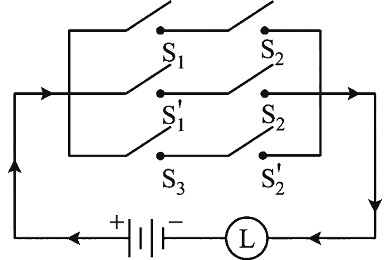
The minimum number of switches in the simplified form of the following switching circuit is
A
0
B
1
C
2
D
3
0 likes
View Solution179
MediumMCQ
In a switching circuit, if the combination $(S_1 \land S_2)$ is connected in parallel to the combination $(S_1' \land S_2')$, then the room is lit only when
A
$S_1$ is ON and $S_2$ is OFF
B
$S_1$ is OFF and $S_2$ is ON
C
$S_1$ and $S_2$ both ON or $S_1$ and $S_2$ both OFF
D
The room is always lit.
0 likes
View Solution180
DifficultMCQ
A body cools according to Newton's law of cooling from $100^\circ C$ to $60^\circ C$ in $20$ minutes. The temperature of the surroundings being $20^\circ C$, then the total time required for the body to cool down to $30^\circ C$ is
A
$90$ minutes
B
$1$ hour and $10$ minutes
C
$80$ minutes
D
$60$ minutes
0 likes
View Solution181
DifficultMCQ
If water at $100^\circ C$ cools in $10$ minutes to $80^\circ C$ and to $65^\circ C$ in the next $10$ minutes, then the room temperature will be ...
A
$30^\circ C$
B
$15^\circ C$
C
$25^\circ C$
D
$20^\circ C$
0 likes
View Solution182
DifficultMCQ
A body cools from $100^\circ C$ to $60^\circ C$ in $20$ minutes, the temperature of the surroundings being $20^\circ C$. The total time taken (in minutes) for the body to cool down to $40^\circ C$ is ...
A
$60$
B
$40$
C
$50$
D
$30$
0 likes
View Solution183
DifficultMCQ
A body cools according to Newton's law of cooling from $100^\circ C$ to $60^\circ C$ in $20$ minutes. The temperature of the surroundings being $20^\circ C$, then the total time required for the body to cool down to $30^\circ C$ is
A
90 minutes
B
1 hour and 10 minutes
C
80 minutes
D
60 minutes
0 likes
View Solution184
DifficultMCQ
If water at $100^\circ C$ cools in $10$ minutes to $80^\circ C$ and to $65^\circ C$ in the next $10$ minutes, then the room temperature will be ...
A
$30^\circ C$
B
$15^\circ C$
C
$25^\circ C$
D
$20^\circ C$
0 likes
View Solution185
DifficultMCQ
A body cools from $100^\circ C$ to $60^\circ C$ in $20$ minutes, the temperature of the surroundings being $20^\circ C$. The total time taken (in minutes) for the body to cool down to $40^\circ C$ is ...
A
60
B
40
C
50
D
30
0 likes
View Solution186
DifficultMCQ
A spherical raindrop evaporates at a rate proportional to its surface area. The differential equation involving the rate of change of its radius $r$ with time $t$ is ... (where $k$ is a positive constant)
A
$\frac{dr}{dt} + k = 0$
B
$\frac{dr}{dt} - k = 0$
C
$\frac{dr}{dt} + kr = 0$
D
$\frac{dr}{dt} - kr = 0$
0 likes
View Solution3-1.Vectors — Fundamentals of Vectors · Frequently Asked Questions
1Are these 3-1.Vectors questions useful for JEE and NEET?
Yes. All questions in this section are mapped to JEE Main and NEET exam patterns. Previous year questions from JEE Main, NEET, GUJCET and state-level exams are included with full solutions.
2Can I switch to Hindi or Gujarati for these questions?
Yes. Use the language tabs in the hero section or the sidebar to view the same questions and solutions in English, Hindi or Gujarati.
3How do I generate a question paper from this subtopic?
Use the Vedclass Exam Paper Generator — select the chapter and subtopic, set difficulty, and generate Sets A, B, C, D automatically. First 3 chapters of every subject are free.
Vedclass Products
For Students
Vedclass Test Series
Mock tests in real JEE/NEET style with performance analysis. 5-day free trial.
Start Free TrialFor Teachers
Exam Paper Generator
Generate Set A/B/C/D papers from this chapter in 2 minutes. 3 chapters free.
Try FreeFor Institutes
Online Exam Module
Live online exams with unlimited students, 360° analytics & white-label branding.
See DemoFor Teachers & Institutes
Generate a 3-1.Vectors Exam Paper in 2 Minutes
Select subtopic & difficulty — Sets A, B, C, D auto-generated with No Repeat logic.
First 3 chapters of every subject are free — no payment required.