
A English
Viscosity and Stoke's Law and Terminal Velocity Questions in English
Class 11 Physics · Fluid Mechanics and Surface Tension · Viscosity and Stoke's Law and Terminal Velocity
202+
Questions
English
Language
100%
With Solutions
Showing 2 of 202 questions in English
201
MediumMCQ
$A$ spherical object is falling under gravity through a viscous fluid. The sphere attains the terminal velocity when
A
viscous force is zero.
B
buoyant force is equal to force due to gravity
C
viscous force plus force of gravity becomes equal to buoyant force.
D
buoyant force plus viscous force becomes equal to force due to gravity.
Solution
(D) When a spherical object falls through a viscous fluid, it experiences three forces: the gravitational force $(F_g)$ acting downwards, the buoyant force $(F_b)$ acting upwards, and the viscous drag force $(F_v)$ acting upwards.
As the velocity of the sphere increases, the viscous force increases. Terminal velocity is reached when the net force on the sphere becomes zero, meaning the object stops accelerating.
At this point, the downward force is balanced by the sum of the upward forces:
$F_g = F_b + F_v$
Therefore, the buoyant force plus the viscous force becomes equal to the force due to gravity.
As the velocity of the sphere increases, the viscous force increases. Terminal velocity is reached when the net force on the sphere becomes zero, meaning the object stops accelerating.
At this point, the downward force is balanced by the sum of the upward forces:
$F_g = F_b + F_v$
Therefore, the buoyant force plus the viscous force becomes equal to the force due to gravity.
0 likes
View Solution202
MediumMCQ
$A$ small metal sphere is falling through a viscous liquid. The variation of velocity $(V)$ with time $(t)$ is shown correctly in which graph?
A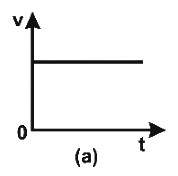
B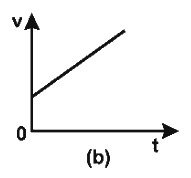
C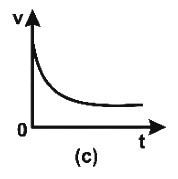
D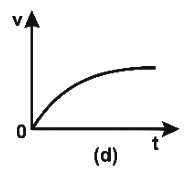
Solution
(D) When a small metal sphere falls through a viscous liquid, it experiences three forces: gravitational force $(mg)$ acting downwards, buoyant force $(F_B)$ acting upwards, and viscous drag force $(F_v = 6\pi\eta rv)$ acting upwards.
The net force is $F_{net} = mg - F_B - 6\pi\eta rv = ma$.
Initially, the velocity $(v)$ is zero, so the viscous drag is zero, and the acceleration is maximum. As the velocity increases, the viscous drag force increases, causing the net force and acceleration to decrease.
Eventually, the net force becomes zero when the viscous drag balances the effective weight, and the sphere attains a constant velocity known as terminal velocity. This behavior is represented by a curve that starts from the origin, increases with a decreasing slope, and approaches a horizontal asymptote, which corresponds to graph $(d)$.
The net force is $F_{net} = mg - F_B - 6\pi\eta rv = ma$.
Initially, the velocity $(v)$ is zero, so the viscous drag is zero, and the acceleration is maximum. As the velocity increases, the viscous drag force increases, causing the net force and acceleration to decrease.
Eventually, the net force becomes zero when the viscous drag balances the effective weight, and the sphere attains a constant velocity known as terminal velocity. This behavior is represented by a curve that starts from the origin, increases with a decreasing slope, and approaches a horizontal asymptote, which corresponds to graph $(d)$.
0 likes
View SolutionFluid Mechanics and Surface Tension — Viscosity and Stoke's Law and Terminal Velocity · Frequently Asked Questions
1Are these Fluid Mechanics and Surface Tension questions useful for JEE and NEET?
Yes. All questions in this section are mapped to JEE Main and NEET exam patterns. Previous year questions from JEE Main, NEET, GUJCET and state-level exams are included with full solutions.
2Can I switch to Hindi or Gujarati for these questions?
Yes. Use the language tabs in the hero section or the sidebar to view the same questions and solutions in English, Hindi or Gujarati.
3How do I generate a question paper from this subtopic?
Use the Vedclass Exam Paper Generator — select the chapter and subtopic, set difficulty, and generate Sets A, B, C, D automatically. First 3 chapters of every subject are free.
Vedclass Products
For Students
Vedclass Test Series
Mock tests in real JEE/NEET style with performance analysis. 5-day free trial.
Start Free TrialFor Teachers
Exam Paper Generator
Generate Set A/B/C/D papers from this chapter in 2 minutes. 3 chapters free.
Try FreeFor Institutes
Online Exam Module
Live online exams with unlimited students, 360° analytics & white-label branding.
See DemoFor Teachers & Institutes
Generate a Fluid Mechanics and Surface Tension Exam Paper in 2 Minutes
Select subtopic & difficulty — Sets A, B, C, D auto-generated with No Repeat logic.
First 3 chapters of every subject are free — no payment required.