
A English
Properties of Phenols Questions in English
Class 12 Chemistry · Alcohols, Phenols and Ethers · Properties of Phenols
763+
Questions
English
Language
100%
With Solutions
Showing 13 of 763 questions in English
751
MediumMCQ
The functional group that can be identified through the phthalein dye test is:
A
$(1)$ Carboxylic acid
B
$(2)$ Alcohol
C
$(3)$ Aldehyde
D
$(4)$ Phenolic
Solution
(D) The phthalein dye test is a characteristic chemical test used to identify the presence of phenolic groups.
In this test, a phenol reacts with phthalic anhydride in the presence of concentrated sulphuric acid $(H_2SO_4)$ as a dehydrating agent.
This reaction results in the formation of a phthalein dye (such as phenolphthalein), which exhibits a distinct color change in an alkaline medium.
Therefore, the correct functional group identified by this test is the phenolic group.
In this test, a phenol reacts with phthalic anhydride in the presence of concentrated sulphuric acid $(H_2SO_4)$ as a dehydrating agent.
This reaction results in the formation of a phthalein dye (such as phenolphthalein), which exhibits a distinct color change in an alkaline medium.
Therefore, the correct functional group identified by this test is the phenolic group.
0 likes
View Solution752
MediumMCQ
Which of the following is the correct decreasing order of acidic strength for the compounds listed below?
$I$: $p$-chlorophenol
$II$: $p$-Cresol
$III$: $p$-nitrophenol
$IV$: $p$-methoxyphenol
$I$: $p$-chlorophenol
$II$: $p$-Cresol
$III$: $p$-nitrophenol
$IV$: $p$-methoxyphenol
A
$II > IV > I > III$
B
$I > II > III > IV$
C
$III > I > II > IV$
D
$IV > III > I > II$
Solution
(C) $1$. Acidic strength of phenols depends on the stability of the phenoxide ion formed after the loss of a proton.
$2$. Electron-withdrawing groups $(-EWG)$ increase acidic strength by stabilizing the phenoxide ion, while electron-donating groups $(-EDG)$ decrease it.
$3$. The substituents at the $p$-position are:
- $p$-nitrophenol $(III)$: $-NO_2$ is a strong $-I$ and $-M$ group (strongest acid).
- $p$-chlorophenol $(I)$: $-Cl$ is $-I$ (electron-withdrawing) but $+M$ (electron-donating). The $-I$ effect dominates, making it more acidic than phenol.
- $p$-Cresol $(II)$: $-CH_3$ is $+I$ and hyperconjugation (weakly electron-donating).
- $p$-methoxyphenol $(IV)$: $-OCH_3$ is $-I$ but strong $+M$ (strongly electron-donating).
$4$. The order of electron-donating/withdrawing ability is: $-NO_2$ $(-M)$ > $-Cl$ $(-I > +M)$ > $-CH_3$ $(+I)$ > $-OCH_3$ $(+M)$.
$5$. Thus, the decreasing order of acidic strength is: $III > I > II > IV$.
$2$. Electron-withdrawing groups $(-EWG)$ increase acidic strength by stabilizing the phenoxide ion, while electron-donating groups $(-EDG)$ decrease it.
$3$. The substituents at the $p$-position are:
- $p$-nitrophenol $(III)$: $-NO_2$ is a strong $-I$ and $-M$ group (strongest acid).
- $p$-chlorophenol $(I)$: $-Cl$ is $-I$ (electron-withdrawing) but $+M$ (electron-donating). The $-I$ effect dominates, making it more acidic than phenol.
- $p$-Cresol $(II)$: $-CH_3$ is $+I$ and hyperconjugation (weakly electron-donating).
- $p$-methoxyphenol $(IV)$: $-OCH_3$ is $-I$ but strong $+M$ (strongly electron-donating).
$4$. The order of electron-donating/withdrawing ability is: $-NO_2$ $(-M)$ > $-Cl$ $(-I > +M)$ > $-CH_3$ $(+I)$ > $-OCH_3$ $(+M)$.
$5$. Thus, the decreasing order of acidic strength is: $III > I > II > IV$.
0 likes
View Solution753
EasyMCQ
Identify the trihydric phenol from the following.
A
Hydroquinone
B
Catechol
C
$o$-Cresol
D
Pyrogallol
Solution
(D) $1$. $A$ trihydric phenol is a benzene ring substituted with three hydroxyl $(-OH)$ groups.
$2$. Hydroquinone is a dihydric phenol ($1,4$-dihydroxybenzene).
$3$. Catechol is a dihydric phenol ($1,2$-dihydroxybenzene).
$4$. $o$-Cresol is a monohydric phenol ($2$-methylphenol).
$5$. Pyrogallol is a trihydric phenol ($1,2,3$-trihydroxybenzene).
$6$. Therefore, the correct option is $D$.
$2$. Hydroquinone is a dihydric phenol ($1,4$-dihydroxybenzene).
$3$. Catechol is a dihydric phenol ($1,2$-dihydroxybenzene).
$4$. $o$-Cresol is a monohydric phenol ($2$-methylphenol).
$5$. Pyrogallol is a trihydric phenol ($1,2,3$-trihydroxybenzene).
$6$. Therefore, the correct option is $D$.
0 likes
View Solution754
MediumMCQ
Which among the following compounds has the highest solubility in water?
A
Phenol
B
p-Cresol
C
o-Nitrophenol
D
p-Nitrophenol
Solution
(D) $1$. Solubility in water depends on the ability of the compound to form hydrogen bonds with water molecules.
$2$. $o-Nitrophenol$ exhibits intramolecular hydrogen bonding, which reduces its ability to form intermolecular hydrogen bonds with water.
$3$. $p-Nitrophenol$ exhibits intermolecular hydrogen bonding with water molecules due to the presence of the polar $-NO_2$ group and the $-OH$ group, making it more soluble than the others.
$4$. Phenol and $p-Cresol$ have hydrophobic hydrocarbon parts that limit their solubility compared to $p-Nitrophenol$.
$2$. $o-Nitrophenol$ exhibits intramolecular hydrogen bonding, which reduces its ability to form intermolecular hydrogen bonds with water.
$3$. $p-Nitrophenol$ exhibits intermolecular hydrogen bonding with water molecules due to the presence of the polar $-NO_2$ group and the $-OH$ group, making it more soluble than the others.
$4$. Phenol and $p-Cresol$ have hydrophobic hydrocarbon parts that limit their solubility compared to $p-Nitrophenol$.
0 likes
View Solution755
MediumMCQ
Which among the following has the highest melting point?
A
Phenol
B
o-Nitrophenol
C
p-Nitrophenol
D
p-Cresol
Solution
(C) $1$. $o-Nitrophenol$ exhibits intramolecular hydrogen bonding, which reduces the intermolecular forces of attraction.
$2$. $p-Nitrophenol$ exhibits strong intermolecular hydrogen bonding, leading to the association of molecules.
$3$. Due to this strong intermolecular association, $p-Nitrophenol$ requires more energy to break the lattice structure, resulting in a significantly higher melting point compared to $Phenol$, $o-Nitrophenol$, and $p-Cresol$.
$2$. $p-Nitrophenol$ exhibits strong intermolecular hydrogen bonding, leading to the association of molecules.
$3$. Due to this strong intermolecular association, $p-Nitrophenol$ requires more energy to break the lattice structure, resulting in a significantly higher melting point compared to $Phenol$, $o-Nitrophenol$, and $p-Cresol$.
0 likes
View Solution756
EasyMCQ
What happens when $phenol$ reacts with bromine water?
A
Brown coloured liquid is obtained
B
Colourless gas evolves
C
White precipitate formed
D
Pink colored solution is obtained
Solution
(C) When $phenol$ reacts with bromine water, it undergoes electrophilic substitution at all ortho and para positions simultaneously.
This results in the formation of $2,4,6-tribromophenol$, which appears as a white precipitate.
The chemical equation is: $C_6H_5OH + 3Br_2(aq) \rightarrow C_6H_2Br_3OH + 3HBr$.
This results in the formation of $2,4,6-tribromophenol$, which appears as a white precipitate.
The chemical equation is: $C_6H_5OH + 3Br_2(aq) \rightarrow C_6H_2Br_3OH + 3HBr$.
0 likes
View Solution757
MediumMCQ
An organic compound with the molecular formula $C_6H_6O$ dissolves in $NaOH$, gives a characteristic colour with neutral $FeCl_3$ and on treatment with bromine water gives a tri-bromo derivative. Which is that compound among the following?
A
Alcohol
B
Ether
C
Ketone
D
Phenol
Solution
(D) $1$. The molecular formula $C_6H_6O$ corresponds to the degree of unsaturation $U = 6 - \frac{6}{2} + 1 = 4$, which suggests an aromatic ring.
$2$. The compound dissolves in $NaOH$, indicating it is acidic in nature.
$3$. It gives a characteristic violet colour with neutral $FeCl_3$, which is a standard test for phenolic groups.
$4$. It reacts with bromine water to form a tri-bromo derivative $(2,4,6-\text{tribromophenol})$, which is characteristic of phenol due to the strong activating effect of the $-OH$ group.
$5$. Therefore, the compound is phenol.
$2$. The compound dissolves in $NaOH$, indicating it is acidic in nature.
$3$. It gives a characteristic violet colour with neutral $FeCl_3$, which is a standard test for phenolic groups.
$4$. It reacts with bromine water to form a tri-bromo derivative $(2,4,6-\text{tribromophenol})$, which is characteristic of phenol due to the strong activating effect of the $-OH$ group.
$5$. Therefore, the compound is phenol.
0 likes
View Solution758
DifficultMCQ
In the following sequence of the reaction, the final product "$C$" is:
$Phenol \xrightarrow[NaOH]{CHCl_3} A \xrightarrow[H_3O^+]{} B \xrightarrow[Oxidation]{} C$
$Phenol \xrightarrow[NaOH]{CHCl_3} A \xrightarrow[H_3O^+]{} B \xrightarrow[Oxidation]{} C$
A
B
C
D
Solution
(B) The given reaction sequence is the Reimer-Tiemann reaction followed by oxidation:
$1$. $Phenol$ reacts with $CHCl_3$ and $NaOH$ to form $o-hydroxybenzaldehyde$ (Salicylaldehyde) as the major product $(A)$.
$2$. The intermediate $A$ is already $Salicylaldehyde$. The step $\xrightarrow[H_3O^+]{} B$ typically refers to the acidification of the phenoxide intermediate to obtain the final aldehyde product $B$.
$3$. Oxidation of $Salicylaldehyde$ $(B)$ using an oxidizing agent converts the $-CHO$ group into a $-COOH$ group, resulting in $Salicylic \ acid$ $(C)$.
Therefore, the final product $C$ is $Salicylic \ acid$.
$1$. $Phenol$ reacts with $CHCl_3$ and $NaOH$ to form $o-hydroxybenzaldehyde$ (Salicylaldehyde) as the major product $(A)$.
$2$. The intermediate $A$ is already $Salicylaldehyde$. The step $\xrightarrow[H_3O^+]{} B$ typically refers to the acidification of the phenoxide intermediate to obtain the final aldehyde product $B$.
$3$. Oxidation of $Salicylaldehyde$ $(B)$ using an oxidizing agent converts the $-CHO$ group into a $-COOH$ group, resulting in $Salicylic \ acid$ $(C)$.
Therefore, the final product $C$ is $Salicylic \ acid$.
0 likes
View Solution759
EasyMCQ
Identify the name of the reaction when phenol reacts with chloroform in the presence of aqueous $NaOH$.
A
Kolbe's reaction
B
Reimer-Tiemann reaction
C
Williamson synthesis
D
Friedel-Crafts acylation
Solution
(B) Step $1$: The reaction of phenol with chloroform $(CHCl_3)$ in the presence of aqueous sodium hydroxide $(NaOH)$ at $340 \text{ K}$ followed by hydrolysis leads to the formation of salicylaldehyde (o-hydroxybenzaldehyde).
Step $2$: This specific chemical reaction is known as the Reimer-Tiemann reaction.
Step $3$: The electrophile involved in this reaction is dichlorocarbene $(:CCl_2)$.
Step $2$: This specific chemical reaction is known as the Reimer-Tiemann reaction.
Step $3$: The electrophile involved in this reaction is dichlorocarbene $(:CCl_2)$.
0 likes
View Solution760
MediumMCQ
Identify '$Z$' in the following reaction: $Ar-OH + Cl-C(=O)-R \xrightarrow{\text{Pyridine}} Z + HCl$
A
$Ar-O-R$
B
$Ar-O-C(=O)-R$
C
$R-C(=O)-O-Ar$
D
$Ar-C(=O)-R$
Solution
(B) Step $1$: The reaction between a phenol $(Ar-OH)$ and an acid chloride $(R-COCl)$ in the presence of a base like pyridine is known as the Schotten-Baumann reaction.
Step $2$: The lone pair on the oxygen atom of the phenol attacks the electrophilic carbonyl carbon of the acid chloride.
Step $3$: The chloride ion $(Cl^-)$ acts as a leaving group, and the pyridine neutralizes the $HCl$ produced to drive the reaction forward.
Step $4$: The product formed is an ester, specifically an aryl ester, with the structure $Ar-O-C(=O)-R$.
Step $2$: The lone pair on the oxygen atom of the phenol attacks the electrophilic carbonyl carbon of the acid chloride.
Step $3$: The chloride ion $(Cl^-)$ acts as a leaving group, and the pyridine neutralizes the $HCl$ produced to drive the reaction forward.
Step $4$: The product formed is an ester, specifically an aryl ester, with the structure $Ar-O-C(=O)-R$.
0 likes
View Solution761
MediumMCQ
Identify the product $P$ obtained in the following reaction: $C_6H_5OH + HCHO \xrightarrow{\text{Acid}} P$
A
B
C
D
Solution
(D) The reaction between phenol $(C_6H_5OH)$ and formaldehyde $(HCHO)$ in the presence of an acid catalyst is an electrophilic aromatic substitution reaction.
Phenol is an ortho/para-directing group due to the electron-donating $-OH$ group.
Formaldehyde acts as an electrophile in the presence of acid.
The reaction leads to the formation of hydroxybenzyl alcohol (also known as saligenin) as the major product, specifically the ortho-isomer ($o$-hydroxybenzyl alcohol).
Thus, the product $P$ is $o$-hydroxybenzyl alcohol.
Phenol is an ortho/para-directing group due to the electron-donating $-OH$ group.
Formaldehyde acts as an electrophile in the presence of acid.
The reaction leads to the formation of hydroxybenzyl alcohol (also known as saligenin) as the major product, specifically the ortho-isomer ($o$-hydroxybenzyl alcohol).
Thus, the product $P$ is $o$-hydroxybenzyl alcohol.
0 likes
View Solution762
MediumMCQ
In the following reaction, condition '$A$' is -
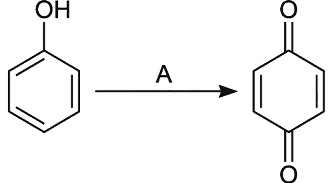
A
Reduction with Zinc dust
B
Dehydration with $H_2SO_4 / 443 \text{ K}$
C
Treatment with $CS_2 / \text{low temperature}$
D
Oxidation with $CrO_3$
Solution
(D) The reaction shows the oxidation of phenol to $p$-benzoquinone.
Phenol undergoes oxidation in the presence of chromic acid ($CrO_3$ in acidic medium) to form a conjugated diketone known as $p$-benzoquinone.
Therefore, the correct condition '$A$' is oxidation with $CrO_3$.
Phenol undergoes oxidation in the presence of chromic acid ($CrO_3$ in acidic medium) to form a conjugated diketone known as $p$-benzoquinone.
Therefore, the correct condition '$A$' is oxidation with $CrO_3$.
0 likes
View Solution763
MediumMCQ
Select the correct decreasing order of acid strength for the following compounds: $(a)$ $Ethanol$ $(b)$ $2-Methylpropan-2-ol$ $(c)$ $Phenol$ $(d)$ $p-Nitrophenol$.
A
$a > b > c > d$
B
$c > d > b > a$
C
$d > c > a > b$
D
$d > b > c > a$
Solution
(C) $1$. Acid strength depends on the stability of the conjugate base formed after the loss of a proton $(H^+)$.
$2$. $p-Nitrophenol$ $(d)$ is the strongest acid because the $-NO_2$ group exerts a strong $-I$ and $-M$ effect, which stabilizes the phenoxide ion significantly.
$3$. $Phenol$ $(c)$ is more acidic than alcohols because the phenoxide ion is stabilized by resonance.
$4$. Among alcohols, $Ethanol$ $(a)$ is more acidic than $2-Methylpropan-2-ol$ $(b)$ because the electron-donating inductive effect $(+I)$ of the three methyl groups in $2-Methylpropan-2-ol$ destabilizes the alkoxide ion more than the single methyl group in $Ethanol$.
$5$. Thus, the decreasing order of acid strength is $d > c > a > b$.
$2$. $p-Nitrophenol$ $(d)$ is the strongest acid because the $-NO_2$ group exerts a strong $-I$ and $-M$ effect, which stabilizes the phenoxide ion significantly.
$3$. $Phenol$ $(c)$ is more acidic than alcohols because the phenoxide ion is stabilized by resonance.
$4$. Among alcohols, $Ethanol$ $(a)$ is more acidic than $2-Methylpropan-2-ol$ $(b)$ because the electron-donating inductive effect $(+I)$ of the three methyl groups in $2-Methylpropan-2-ol$ destabilizes the alkoxide ion more than the single methyl group in $Ethanol$.
$5$. Thus, the decreasing order of acid strength is $d > c > a > b$.
0 likes
View SolutionAlcohols, Phenols and Ethers — Properties of Phenols · Frequently Asked Questions
1Are these Alcohols, Phenols and Ethers questions useful for JEE and NEET?
Yes. All questions in this section are mapped to JEE Main and NEET exam patterns. Previous year questions from JEE Main, NEET, GUJCET and state-level exams are included with full solutions.
2Can I switch to Hindi or Gujarati for these questions?
Yes. Use the language tabs in the hero section or the sidebar to view the same questions and solutions in English, Hindi or Gujarati.
3How do I generate a question paper from this subtopic?
Use the Vedclass Exam Paper Generator — select the chapter and subtopic, set difficulty, and generate Sets A, B, C, D automatically. First 3 chapters of every subject are free.
Vedclass Products
For Students
Vedclass Test Series
Mock tests in real JEE/NEET style with performance analysis. 5-day free trial.
Start Free TrialFor Teachers
Exam Paper Generator
Generate Set A/B/C/D papers from this chapter in 2 minutes. 3 chapters free.
Try FreeFor Institutes
Online Exam Module
Live online exams with unlimited students, 360° analytics & white-label branding.
See DemoFor Teachers & Institutes
Generate a Alcohols, Phenols and Ethers Exam Paper in 2 Minutes
Select subtopic & difficulty — Sets A, B, C, D auto-generated with No Repeat logic.
First 3 chapters of every subject are free — no payment required.