
A English
Amino Acids and Proteins Questions in English
Class 12 Chemistry · Biomolecules · Amino Acids and Proteins
535+
Questions
English
Language
100%
With Solutions
Showing 35 of 535 questions in English
501
MediumMCQ
Assertion $(A)$: The denaturation of proteins can destroy all $1^{\circ}, 2^{\circ}$ and $3^{\circ}$ protein structures.
Reason $(R)$: Curdling of milk is due to denaturation of proteins.
The correct option among the following is
Reason $(R)$: Curdling of milk is due to denaturation of proteins.
The correct option among the following is
A
$(A)$ is true,$(R)$ is true and $(R)$ is the correct explanation for $(A)$
B
$(A)$ is true,$(R)$ is true but $(R)$ is not the correct explanation for $(A)$
C
$(A)$ is true but $(R)$ is false
D
$(A)$ is false but $(R)$ is true
Solution
(D) protein in its native state possesses a unique three-dimensional structure and biological activity. When subjected to physical changes (e.g.,temperature) or chemical changes (e.g.,$pH$),the hydrogen bonds are disrupted,causing the protein to lose its biological activity; this process is known as denaturation.
During denaturation,the secondary and tertiary structures of the protein are destroyed,but the primary structure (the sequence of amino acids) remains intact.
Therefore,the statement that denaturation destroys all $1^{\circ}, 2^{\circ}$ and $3^{\circ}$ structures is false.
Curdling of milk is a classic example of protein denaturation caused by the formation of lactic acid by bacteria.
Thus,$(A)$ is false but $(R)$ is true.
During denaturation,the secondary and tertiary structures of the protein are destroyed,but the primary structure (the sequence of amino acids) remains intact.
Therefore,the statement that denaturation destroys all $1^{\circ}, 2^{\circ}$ and $3^{\circ}$ structures is false.
Curdling of milk is a classic example of protein denaturation caused by the formation of lactic acid by bacteria.
Thus,$(A)$ is false but $(R)$ is true.
0 likes
View Solution502
EasyMCQ
$A$ polypeptide can be called a protein when its mass is
A
$> 10,000 \ u$
B
$5,000 \ u$ to $6,000 \ u$
C
$7,000 \ u$ to $8,000 \ u$
D
$4,000 \ u$ to $5,000 \ u$
Solution
(A) Peptides containing more than $10$ amino acids are called polypeptides.
Polypeptides are formed by the linear sequence of amino acids.
Some proteins are composed of two or more polypeptide chains.
Relatively shorter peptides are known as oligopeptides,whereas longer polymers are called polypeptides.
Polypeptides containing more than $100$ amino acids and having a molecular mass higher than $10,000 \ u$ are generally called proteins.
However,the distinction between a polypeptide and a protein is not sharp.
Polypeptides are formed by the linear sequence of amino acids.
Some proteins are composed of two or more polypeptide chains.
Relatively shorter peptides are known as oligopeptides,whereas longer polymers are called polypeptides.
Polypeptides containing more than $100$ amino acids and having a molecular mass higher than $10,000 \ u$ are generally called proteins.
However,the distinction between a polypeptide and a protein is not sharp.
0 likes
View Solution503
EasyMCQ
The dipeptide given below is used as:
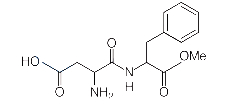
A
Detergent
B
Preservative
C
Sweetening agent
D
Antioxidant (Drug)
Solution
(C) The given dipeptide is an artificial sweetening agent known as $Aspartame$.
It is the methyl ester of a dipeptide derivative,formed from $L-aspartic$ acid and $L-phenylalanine$.
It is approximately $150-200$ times sweeter than sucrose,but it is unstable at cooking temperatures.
Therefore,it is used as a sweetening agent in cold foods and soft drinks.
Hence,the correct answer is option $(C)$.
It is the methyl ester of a dipeptide derivative,formed from $L-aspartic$ acid and $L-phenylalanine$.
It is approximately $150-200$ times sweeter than sucrose,but it is unstable at cooking temperatures.
Therefore,it is used as a sweetening agent in cold foods and soft drinks.
Hence,the correct answer is option $(C)$.
0 likes
View Solution504
DifficultMCQ
Identify the correct set of functional groups present in aspartame,an artificial sweetener.
A
$-COOCH_3, -NH_2, -CONH-, -COOC_2H_5$
B
$-COOH, -NH_2, -CONH-, -COOCH_3$
C
$-CONH_2, -NH-, -CO-, -COOH$
D
$-CHO, -CN, -OH, -COOCH_3$
Solution
(B) Aspartame is the methyl ester of the dipeptide formed from aspartic acid and phenylalanine. Its chemical structure is $H_2N-CH(CH_2COOH)-CONH-CH(CH_2C_6H_5)-COOCH_3$.
By analyzing the structure,we can identify the following functional groups:
$1$. Carboxylic acid group $(-COOH)$
$2$. Amine group $(-NH_2)$
$3$. Amide linkage $(-CONH-)$
$4$. Ester group $(-COOCH_3)$
Thus,the correct set of functional groups is $-COOH, -NH_2, -CONH-, -COOCH_3$.
By analyzing the structure,we can identify the following functional groups:
$1$. Carboxylic acid group $(-COOH)$
$2$. Amine group $(-NH_2)$
$3$. Amide linkage $(-CONH-)$
$4$. Ester group $(-COOCH_3)$
Thus,the correct set of functional groups is $-COOH, -NH_2, -CONH-, -COOCH_3$.
0 likes
View Solution505
EasyMCQ
The Zwitter ion among the following is
A
$R-CH(NH_2)-COOH$
B
$R-CH(NH^-)-C(OH_2)^+$
C
$R-CH(NH_3^+)-C(O^-)=OH^+$
D
$R-CH(NH_3^+)-COO^-$
Solution
(D) Zwitter ion is a dipolar ion that contains both a positively charged group and a negatively charged group within the same molecule,resulting in a net neutral charge.
In amino acids,the amino group $(-NH_2)$ acts as a base and accepts a proton to become $-NH_3^+$,while the carboxylic acid group $(-COOH)$ acts as an acid and donates a proton to become $-COO^-$.
Thus,the structure $R-CH(NH_3^+)-COO^-$ represents the Zwitter ion form of an amino acid.
In amino acids,the amino group $(-NH_2)$ acts as a base and accepts a proton to become $-NH_3^+$,while the carboxylic acid group $(-COOH)$ acts as an acid and donates a proton to become $-COO^-$.
Thus,the structure $R-CH(NH_3^+)-COO^-$ represents the Zwitter ion form of an amino acid.
0 likes
View Solution506
EasyMCQ
The number of amino acids and number of peptide bonds in a linear tetrapeptide (made of different amino acids) are respectively
A
$4$ and $4$
B
$5$ and $5$
C
$5$ and $4$
D
$4$ and $3$
Solution
(D) tetrapeptide is formed by the condensation of $4$ amino acid units.
In a linear polypeptide chain, the number of peptide bonds is always one less than the number of amino acid units.
Therefore, for a tetrapeptide, the number of amino acids = $4$ and the number of peptide bonds = $4 - 1 = 3$.
In a linear polypeptide chain, the number of peptide bonds is always one less than the number of amino acid units.
Therefore, for a tetrapeptide, the number of amino acids = $4$ and the number of peptide bonds = $4 - 1 = 3$.
0 likes
View Solution507
EasyMCQ
The correct structure of the dipeptide gly-ala is
A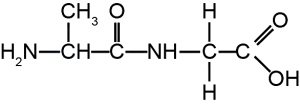
B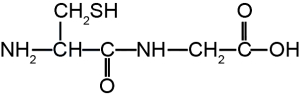
C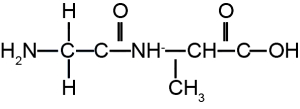
D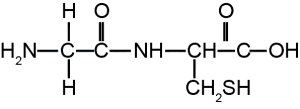
Solution
(C) dipeptide is formed by the condensation of two amino acids, where the carboxyl group $(-COOH)$ of one amino acid reacts with the amino group $(-NH_2)$ of another to form a peptide bond $(-CO-NH-)$.
For the dipeptide gly-ala (Glycine-Alanine):
$1$. Glycine $(NH_2-CH_2-COOH)$ is the $N$-terminal amino acid.
$2$. Alanine $(NH_2-CH(CH_3)-COOH)$ is the $C$-terminal amino acid.
$3$. The peptide bond is formed between the $-COOH$ of Glycine and the $-NH_2$ of Alanine.
$4$. The resulting structure is $NH_2-CH_2-CO-NH-CH(CH_3)-COOH$.
For the dipeptide gly-ala (Glycine-Alanine):
$1$. Glycine $(NH_2-CH_2-COOH)$ is the $N$-terminal amino acid.
$2$. Alanine $(NH_2-CH(CH_3)-COOH)$ is the $C$-terminal amino acid.
$3$. The peptide bond is formed between the $-COOH$ of Glycine and the $-NH_2$ of Alanine.
$4$. The resulting structure is $NH_2-CH_2-CO-NH-CH(CH_3)-COOH$.
0 likes
View Solution508
DifficultMCQ
An electric current is passed through an aqueous solution of a mixture of alanine (isoelectric point $6.0$), glutamic acid $(3.2)$, and arginine $(10.7)$ buffered at $pH$ $6.0$. What is the fate of the three amino acids?
A
Glutamic acid migrates to the anode at $pH$ $6.0$. Arginine is present as a cation and migrates to the cathode. Alanine exists as a zwitterion and remains uniformly distributed in the solution.
B
Glutamic acid migrates to the cathode and others remain uniformly distributed in the solution.
C
All three remain uniformly distributed in the solution.
D
All three move to the cathode.
Solution
(A) The behavior of amino acids in an electric field depends on their net charge at a given $pH$ relative to their isoelectric point $(pI)$.
$1$. For glutamic acid $(pI = 3.2)$, at $pH = 6.0$ $(pH > pI)$, it exists as an anion and migrates to the anode.
$2$. For arginine $(pI = 10.7)$, at $pH = 6.0$ $(pH < pI)$, it exists as a cation and migrates to the cathode.
$3$. For alanine $(pI = 6.0)$, at $pH = 6.0$ $(pH = pI)$, it exists as a zwitterion (dipolar ion) with a net charge of zero and does not migrate to either electrode, remaining uniformly distributed.
$1$. For glutamic acid $(pI = 3.2)$, at $pH = 6.0$ $(pH > pI)$, it exists as an anion and migrates to the anode.
$2$. For arginine $(pI = 10.7)$, at $pH = 6.0$ $(pH < pI)$, it exists as a cation and migrates to the cathode.
$3$. For alanine $(pI = 6.0)$, at $pH = 6.0$ $(pH = pI)$, it exists as a zwitterion (dipolar ion) with a net charge of zero and does not migrate to either electrode, remaining uniformly distributed.
0 likes
View Solution509
MediumMCQ
$1.$ Glycylglycine
$2.$ Alanylalanine
$3.$ Glycylalanine
$4.$ Alanylglycine
The dipeptides which may be obtained from the amino acids glycine and alanine are
$2.$ Alanylalanine
$3.$ Glycylalanine
$4.$ Alanylglycine
The dipeptides which may be obtained from the amino acids glycine and alanine are
A
only $1$
B
only $2$
C
both $1$ and $2$
D
all of them
Solution
(D) When two different amino acids, glycine $(G)$ and alanine $(A)$, react to form dipeptides, they can combine in different sequences to form different products.
The possible combinations are:
$1.$ Glycine + Glycine $\rightarrow$ Glycylglycine $(G-G)$
$2.$ Alanine + Alanine $\rightarrow$ Alanylalanine $(A-A)$
$3.$ Glycine + Alanine $\rightarrow$ Glycylalanine $(G-A)$
$4.$ Alanine + Glycine $\rightarrow$ Alanylglycine $(A-G)$
Since the question asks for dipeptides obtained from glycine and alanine, it implies all combinations involving these two amino acids (including self-condensation). Thus, all four listed dipeptides can be formed.
The possible combinations are:
$1.$ Glycine + Glycine $\rightarrow$ Glycylglycine $(G-G)$
$2.$ Alanine + Alanine $\rightarrow$ Alanylalanine $(A-A)$
$3.$ Glycine + Alanine $\rightarrow$ Glycylalanine $(G-A)$
$4.$ Alanine + Glycine $\rightarrow$ Alanylglycine $(A-G)$
Since the question asks for dipeptides obtained from glycine and alanine, it implies all combinations involving these two amino acids (including self-condensation). Thus, all four listed dipeptides can be formed.
0 likes
View Solution510
DifficultMCQ
The total number of isomeric linear dipeptides which can be synthesised from racemic alanine is
A
$1$
B
$2$
C
$3$
D
$4$
Solution
(D) Alanine is a chiral amino acid with one chiral center. $A$ racemic mixture contains both $(R)$ and $(S)$ enantiomers.
When two alanine molecules combine to form a linear dipeptide, the resulting molecule has two chiral centers (one from each alanine residue).
Each chiral center can exist in either $(R)$ or $(S)$ configuration.
The possible combinations for the two chiral centers in the dipeptide are $(R, R)$, $(R, S)$, $(S, R)$, and $(S, S)$.
Since all these combinations represent distinct stereoisomers, there are $2^2 = 4$ possible isomeric linear dipeptides.
Therefore, the total number of isomeric linear dipeptides is $4$, and the correct option is $(d)$.
When two alanine molecules combine to form a linear dipeptide, the resulting molecule has two chiral centers (one from each alanine residue).
Each chiral center can exist in either $(R)$ or $(S)$ configuration.
The possible combinations for the two chiral centers in the dipeptide are $(R, R)$, $(R, S)$, $(S, R)$, and $(S, S)$.
Since all these combinations represent distinct stereoisomers, there are $2^2 = 4$ possible isomeric linear dipeptides.
Therefore, the total number of isomeric linear dipeptides is $4$, and the correct option is $(d)$.
0 likes
View Solution511
MediumMCQ
Within the list shown below, the correct pair of structures of alanine in $pH$ ranges $2-4$ and $9-11$ is:
$I$. $H_{3}N^{+}CH(CH_{3})COOH$
$II$. $H_{2}NCH(CH_{3})COO^{-}$
$III$. $H_{3}N^{+}CH(CH_{3})COO^{-}$
$IV$. $H_{2}NCH(CH_{3})COOH$
$I$. $H_{3}N^{+}CH(CH_{3})COOH$
$II$. $H_{2}NCH(CH_{3})COO^{-}$
$III$. $H_{3}N^{+}CH(CH_{3})COO^{-}$
$IV$. $H_{2}NCH(CH_{3})COOH$
A
$I$ and $II$
B
$I$ and $III$
C
$II$ and $III$
D
$III$ and $IV$
Solution
(A) Alanine is a neutral amino acid with an isoelectric point $(pI)$ of approximately $6.0$.
In an acidic medium ($pH$ $2-4$), which is below the $pI$, the amino group becomes protonated, and the molecule exists as a cation: $H_{3}N^{+}CH(CH_{3})COOH$ (Structure $I$).
In a basic medium ($pH$ $9-11$), which is above the $pI$, the carboxyl group becomes deprotonated, and the molecule exists as an anion: $H_{2}NCH(CH_{3})COO^{-}$ (Structure $II$).
Therefore, the correct pair is $I$ and $II$.
In an acidic medium ($pH$ $2-4$), which is below the $pI$, the amino group becomes protonated, and the molecule exists as a cation: $H_{3}N^{+}CH(CH_{3})COOH$ (Structure $I$).
In a basic medium ($pH$ $9-11$), which is above the $pI$, the carboxyl group becomes deprotonated, and the molecule exists as an anion: $H_{2}NCH(CH_{3})COO^{-}$ (Structure $II$).
Therefore, the correct pair is $I$ and $II$.
0 likes
View Solution512
DifficultMCQ
The number of possible tripeptides formed involving alanine $(ala)$, glycine $(gly)$, and valine $(val)$, where no amino acid has been used more than once is:
A
$6$
B
$3$
C
$4$
D
$8$
Solution
(A) tripeptide is formed by the combination of $3$ amino acids.
Since we have $3$ distinct amino acids ($ala$, $gly$, $val$) and each is used exactly once, the number of possible arrangements is given by the permutation of $3$ items taken $3$ at a time.
Number of arrangements = $3! = 3 \times 2 \times 1 = 6$.
The possible tripeptides are:
$1. Gly-ala-val$
$2. Gly-val-ala$
$3. Val-gly-ala$
$4. Val-ala-gly$
$5. Ala-val-gly$
$6. Ala-gly-val$
Total tripeptides = $6$.
Since we have $3$ distinct amino acids ($ala$, $gly$, $val$) and each is used exactly once, the number of possible arrangements is given by the permutation of $3$ items taken $3$ at a time.
Number of arrangements = $3! = 3 \times 2 \times 1 = 6$.
The possible tripeptides are:
$1. Gly-ala-val$
$2. Gly-val-ala$
$3. Val-gly-ala$
$4. Val-ala-gly$
$5. Ala-val-gly$
$6. Ala-gly-val$
Total tripeptides = $6$.
0 likes
View Solution513
DifficultMCQ
In the given pentapeptide, find out an essential amino acid $(Y)$ and the sequence present in the pentapeptide: Choose the correct answer from the options given below:
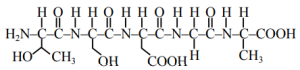
A
$(Y) = \text{Threonine}, (\text{Sequence}) = \text{Ser} - \text{Thr} - \text{Asp} - \text{Gly} - \text{Ala}$
B
$(Y) = \text{Serine}, (\text{Sequence}) = \text{Thr} - \text{Ser} - \text{Asp} - \text{Ala} - \text{Gly}$
C
$(Y) = \text{Threonine}, (\text{Sequence}) = \text{Thr} - \text{Ser} - \text{Asp} - \text{Gly} - \text{Ala}$
D
$(Y) = \text{Serine}, (\text{Sequence}) = \text{Ser} - \text{Asp} - \text{Thr} - \text{Ala} - \text{Gly}$
Solution
(C) By analyzing the structure of the pentapeptide, we can identify the individual amino acids by breaking the peptide bonds through hydrolysis. The amino acids present are:
$1$. $N$-terminal: $\text{Threonine} (\text{Thr})$
$2$. Second: $\text{Serine} (\text{Ser})$
$3$. Third: $\text{Aspartic acid} (\text{Asp})$
$4$. Fourth: $\text{Glycine} (\text{Gly})$
$5$. $C$-terminal: $\text{Alanine} (\text{Ala})$
Thus, the sequence is $\text{Thr} - \text{Ser} - \text{Asp} - \text{Gly} - \text{Ala}$.
Among these, $\text{Threonine}$ is an essential amino acid. Therefore, $(Y) = \text{Threonine}$ and the sequence is $\text{Thr} - \text{Ser} - \text{Asp} - \text{Gly} - \text{Ala}$.
$1$. $N$-terminal: $\text{Threonine} (\text{Thr})$
$2$. Second: $\text{Serine} (\text{Ser})$
$3$. Third: $\text{Aspartic acid} (\text{Asp})$
$4$. Fourth: $\text{Glycine} (\text{Gly})$
$5$. $C$-terminal: $\text{Alanine} (\text{Ala})$
Thus, the sequence is $\text{Thr} - \text{Ser} - \text{Asp} - \text{Gly} - \text{Ala}$.
Among these, $\text{Threonine}$ is an essential amino acid. Therefore, $(Y) = \text{Threonine}$ and the sequence is $\text{Thr} - \text{Ser} - \text{Asp} - \text{Gly} - \text{Ala}$.
0 likes
View Solution514
DifficultMCQ
The correct statements are:
$A$. Activation energy for enzyme catalysed hydrolysis of sucrose is lower than that of acid catalysed hydrolysis.
$B$. During denaturation, secondary and tertiary structures of a protein are destroyed but primary structure remains intact.
$C$. Nucleotides are joined together by phosphodiester linkage between $C_{3}$ and $C_{5}$ carbons of the pentose sugar.
$D$. Quaternary structure of proteins represents the spatial arrangement of two or more polypeptide chains.
Choose the correct answer from the options given below:
$A$. Activation energy for enzyme catalysed hydrolysis of sucrose is lower than that of acid catalysed hydrolysis.
$B$. During denaturation, secondary and tertiary structures of a protein are destroyed but primary structure remains intact.
$C$. Nucleotides are joined together by phosphodiester linkage between $C_{3}$ and $C_{5}$ carbons of the pentose sugar.
$D$. Quaternary structure of proteins represents the spatial arrangement of two or more polypeptide chains.
Choose the correct answer from the options given below:
A
$A, C$ and $D$ Only
B
$A, B$ and $D$ Only
C
$A$ and $B$ Only
D
$B$ and $C$ Only
Solution
(C) . Enzymes lower the activation energy of a reaction, making the hydrolysis of sucrose faster compared to acid catalysis. This statement is correct.
$B$. Denaturation disrupts the hydrogen bonds and other interactions that maintain the secondary and tertiary structures of a protein, but the primary structure (amino acid sequence) remains intact. This statement is correct.
$C$. Nucleotides are joined by phosphodiester linkages between the $C_{3}$ and $C_{5}$ carbons of the pentose sugar, not glycosidic linkages. This statement is incorrect.
$D$. Quaternary structure refers to the arrangement of multiple polypeptide subunits in a protein complex, not just the folding of a single chain. This statement is incorrect.
Therefore, only statements $A$ and $B$ are correct.
$B$. Denaturation disrupts the hydrogen bonds and other interactions that maintain the secondary and tertiary structures of a protein, but the primary structure (amino acid sequence) remains intact. This statement is correct.
$C$. Nucleotides are joined by phosphodiester linkages between the $C_{3}$ and $C_{5}$ carbons of the pentose sugar, not glycosidic linkages. This statement is incorrect.
$D$. Quaternary structure refers to the arrangement of multiple polypeptide subunits in a protein complex, not just the folding of a single chain. This statement is incorrect.
Therefore, only statements $A$ and $B$ are correct.
1 likes
View Solution515
EasyMCQ
Each polypeptide in a protein has amino acids linked with each other in a specific sequence. This sequence of amino acids is called . . . . . . structure of that protein.
A
Quaternary structure
B
Tertiary structure
C
Primary structure
D
Secondary structure
Solution
(C) The primary structure of a protein is defined by the specific linear sequence of amino acids in the polypeptide chain held together by peptide bonds. This sequence determines the further folding of the protein into higher-level structures (secondary, tertiary, quaternary).
0 likes
View Solution516
MediumMCQ
Match the $LIST$-$I$ with $LIST$-$II$:
| List-$I$ (Amino acid) | List-$II$ (Positive reaction/Test for functional group present in side chain of amino acid) |
| $A$. Glutamine | $I$. Hinsberg's test |
| $B$. Lysine | $II$. Neutral $FeCl_3$ test |
| $C$. Tyrosine | $III$. Ceric ammonium nitrate test |
| $D$. Serine | $IV$. Hoffman bromamide degradation |
A
$A-IV, B-I, C-II, D-III$
B
$A-IV, B-I, C-II, D-III$
C
$A-III, B-II, C-I, D-IV$
D
$A-IV, B-I, C-III, D-II$
Solution
(A) . Glutamine: Contains an amide group $(-CONH_2)$ in the side chain, which can undergo Hoffman bromamide degradation $(IV)$.
$B$. Lysine: Contains a primary amino group $(-NH_2)$ in the side chain, which reacts with benzenesulfonyl chloride in Hinsberg's test $(I)$.
$C$. Tyrosine: Contains a phenolic group ($-OH$ attached to a benzene ring), which gives a positive violet color with neutral $FeCl_3$ solution $(II)$.
$D$. Serine: Contains a primary alcohol group $(-CH_2OH)$ in the side chain, which gives a positive red color with Ceric ammonium nitrate test $(III)$.
Therefore, the correct matching is: $A-IV, B-I, C-II, D-III$.
$B$. Lysine: Contains a primary amino group $(-NH_2)$ in the side chain, which reacts with benzenesulfonyl chloride in Hinsberg's test $(I)$.
$C$. Tyrosine: Contains a phenolic group ($-OH$ attached to a benzene ring), which gives a positive violet color with neutral $FeCl_3$ solution $(II)$.
$D$. Serine: Contains a primary alcohol group $(-CH_2OH)$ in the side chain, which gives a positive red color with Ceric ammonium nitrate test $(III)$.
Therefore, the correct matching is: $A-IV, B-I, C-II, D-III$.
0 likes
View Solution517
MediumMCQ
Which of the following amino acids will give a violet-coloured complex with neutral ferric chloride solution?
A
Threonine
B
Serine
C
Tyrosine
D
Cysteine
Solution
(C) Amino acids containing a phenolic group give a characteristic violet color with neutral ferric chloride solution.
Tyrosine contains a phenolic side chain ($p-hydroxybenzyl$ group).
Therefore, Tyrosine reacts with neutral ferric chloride to form a violet-coloured complex.
Tyrosine contains a phenolic side chain ($p-hydroxybenzyl$ group).
Therefore, Tyrosine reacts with neutral ferric chloride to form a violet-coloured complex.
1 likes
View Solution518
MediumMCQ
Identify the incorrect statement about the tertiary structure of proteins.
A
They can be fibrous or globular in structure.
B
The main forces that stabilize the structure are hydrogen bonding, disulphide links, van der Waals and electrostatic forces of attraction.
C
The structure remains intact when exposed to pH changes.
D
$A$ linear polypeptide chain will convert to a secondary structure and then further folding of the secondary structure will convert to tertiary structure.
Solution
(C) The tertiary structure of a protein refers to the three-dimensional folding of the polypeptide chain.
This structure is sensitive to environmental changes like $pH$, temperature, or solvent polarity, which can lead to denaturation.
Statement $(C)$ claims that the structure remains intact when exposed to $pH$ changes, which is incorrect.
Changes in $pH$ alter the ionization states of side chains, disrupting electrostatic interactions and hydrogen bonds that stabilize the tertiary structure.
This structure is sensitive to environmental changes like $pH$, temperature, or solvent polarity, which can lead to denaturation.
Statement $(C)$ claims that the structure remains intact when exposed to $pH$ changes, which is incorrect.
Changes in $pH$ alter the ionization states of side chains, disrupting electrostatic interactions and hydrogen bonds that stabilize the tertiary structure.
0 likes
View Solution519
MediumMCQ
The correct statement about peptides and proteins is:
A
Tertiary structure of proteins has two or more polypeptide subunits.
B
Only the proteins having a quaternary structure are biologically active.
C
In $\beta$-pleated sheet structures, peptide chains are held together by intermolecular hydrogen bonds.
D
In $\alpha$-helices, the polypeptide chain is twisted into a left-handed screw (helix) through intramolecular hydrogen bonds.
Solution
(C) $1$. The $\alpha$-helix is a common secondary structure where the polypeptide chain is coiled into a right-handed screw (helix) stabilized by intramolecular hydrogen bonds between the $C=O$ and $N-H$ groups.
$2$. In $\beta$-pleated sheets, the polypeptide chains are laid side-by-side and held together by intermolecular hydrogen bonds, forming a sheet-like structure.
$3$. Tertiary structure refers to the overall folding of a single polypeptide chain, not necessarily involving multiple subunits.
$4$. Proteins can be biologically active in primary, secondary, tertiary, or quaternary structures; quaternary structure is not a requirement for biological activity.
$5$. Therefore, the statement regarding $\beta$-pleated sheets is the correct one.
$2$. In $\beta$-pleated sheets, the polypeptide chains are laid side-by-side and held together by intermolecular hydrogen bonds, forming a sheet-like structure.
$3$. Tertiary structure refers to the overall folding of a single polypeptide chain, not necessarily involving multiple subunits.
$4$. Proteins can be biologically active in primary, secondary, tertiary, or quaternary structures; quaternary structure is not a requirement for biological activity.
$5$. Therefore, the statement regarding $\beta$-pleated sheets is the correct one.
0 likes
View Solution520
MediumMCQ
The amino acid that gives a red-blood colour on treating its sodium fusion extract with sodium nitroprusside is
A
leucine
B
threonine
C
methionine
D
serine
Solution
(C) The sodium fusion test is used to detect elements like nitrogen, sulfur, and halogens in organic compounds.
When an organic compound containing both nitrogen $(N)$ and sulfur $(S)$ is fused with sodium metal, sodium thiocyanate $(NaSCN)$ is formed.
$Na + C + N + S \rightarrow NaSCN$
When this extract is treated with sodium nitroprusside $(Na_2[Fe(CN)_5NO])$, the thiocyanate ion $(SCN^-)$ reacts to form a blood-red colored complex, ferric thiocyanate ($Fe(SCN)_3$ or $[Fe(SCN)(H_2O)_5]^{2+}$).
Among the given amino acids, methionine is the only one that contains a sulfur atom in its structure.
Therefore, methionine is the amino acid that will give a positive test for sulfur, resulting in a blood-red color.
When an organic compound containing both nitrogen $(N)$ and sulfur $(S)$ is fused with sodium metal, sodium thiocyanate $(NaSCN)$ is formed.
$Na + C + N + S \rightarrow NaSCN$
When this extract is treated with sodium nitroprusside $(Na_2[Fe(CN)_5NO])$, the thiocyanate ion $(SCN^-)$ reacts to form a blood-red colored complex, ferric thiocyanate ($Fe(SCN)_3$ or $[Fe(SCN)(H_2O)_5]^{2+}$).
Among the given amino acids, methionine is the only one that contains a sulfur atom in its structure.
Therefore, methionine is the amino acid that will give a positive test for sulfur, resulting in a blood-red color.
0 likes
View Solution521
DifficultMCQ
$A$ protein undergoes reversible thermal denaturation from its initial state $N$ to denatured state $D$ according to $N \rightleftharpoons D$. At $60 ^\circ C$, the concentrations of both $N$ and $D$ are equal at equilibrium, and the standard enthalpy change of denaturation is $666 \text{ kJ mol}^{-1}$. The standard entropy change ($\Delta S^\circ$ in $\text{kJ K}^{-1} \text{mol}^{-1}$) of the protein upon denaturation at $60 ^\circ C$ is closest to
A
$2.0$
B
$2000.0$
C
$333.0$
D
$11.1$
Solution
(A) For the equilibrium $N \rightleftharpoons D$, the equilibrium constant $K_{eq}$ is given by $[D]/[N]$.
Since the concentrations of $N$ and $D$ are equal at equilibrium, $K_{eq} = 1$.
The relationship between the standard Gibbs free energy change and the equilibrium constant is $\Delta G^\circ = -RT \ln K_{eq}$.
Since $K_{eq} = 1$, $\ln(1) = 0$, therefore $\Delta G^\circ = 0$.
We also know that $\Delta G^\circ = \Delta H^\circ - T \Delta S^\circ$.
Given $\Delta G^\circ = 0$, we have $\Delta H^\circ = T \Delta S^\circ$, which implies $\Delta S^\circ = \Delta H^\circ / T$.
The temperature $T = 60 ^\circ C = 60 + 273.15 = 333.15 \text{ K}$.
Given $\Delta H^\circ = 666 \text{ kJ mol}^{-1}$.
Calculating $\Delta S^\circ = 666 / 333.15 \approx 1.999 \text{ kJ K}^{-1} \text{mol}^{-1}$.
Rounding to the nearest value, we get $2.0 \text{ kJ K}^{-1} \text{mol}^{-1}$.
Since the concentrations of $N$ and $D$ are equal at equilibrium, $K_{eq} = 1$.
The relationship between the standard Gibbs free energy change and the equilibrium constant is $\Delta G^\circ = -RT \ln K_{eq}$.
Since $K_{eq} = 1$, $\ln(1) = 0$, therefore $\Delta G^\circ = 0$.
We also know that $\Delta G^\circ = \Delta H^\circ - T \Delta S^\circ$.
Given $\Delta G^\circ = 0$, we have $\Delta H^\circ = T \Delta S^\circ$, which implies $\Delta S^\circ = \Delta H^\circ / T$.
The temperature $T = 60 ^\circ C = 60 + 273.15 = 333.15 \text{ K}$.
Given $\Delta H^\circ = 666 \text{ kJ mol}^{-1}$.
Calculating $\Delta S^\circ = 666 / 333.15 \approx 1.999 \text{ kJ K}^{-1} \text{mol}^{-1}$.
Rounding to the nearest value, we get $2.0 \text{ kJ K}^{-1} \text{mol}^{-1}$.
0 likes
View Solution522
EasyMCQ
The secondary structure of protein is determined by
A
$\text{co-ordinate bond}$
B
$\text{covalent bond}$
C
$\text{ionic bond}$
D
$\text{hydrogen bond}$
0 likes
View Solution523
EasyMCQ
Which one of the following is a globular protein?
A
$\text{Insulin}$
B
$\text{Myosin}$
C
$\text{Keratin in hair}$
D
$\text{Keratin in wool}$
0 likes
View Solution524
MediumMCQ
During denaturation, which level of protein structure remains unchanged?
A
$\text{primary}$
B
$\text{secondary}$
C
$\text{tertiary}$
D
$\text{quaternary}$
0 likes
View Solution525
EasyMCQ
Which from following is a protein of muscles?
A
$\text{Keratin}$
B
$\text{Myosin}$
C
$\text{Legumelin}$
D
$\text{Insulin}$
0 likes
View Solution526
EasyMCQ
Which from following is NOT a globular protein?
A
$\text{Serum albumin}$
B
$\text{Insulin}$
C
$\text{Egg albumin}$
D
$\text{Keratin}$
0 likes
View Solution527
EasyMCQ
Identify a protein present in nails
A
$\text{Legumelin}$
B
$\text{Keratin}$
C
$\text{Myosin}$
D
$\text{Insulin}$
0 likes
View Solution528
EasyMCQ
What type of compound the Legumelin is?
A
$\text{Carbohydrate}$
B
$\text{Globular protein}$
C
$\text{Fibrous protein}$
D
$\text{Enzyme}$
0 likes
View Solution529
DifficultMCQ
Which of the following statements are correct? A) $\alpha - \text{amino acids present in protein is L- amino acid.}$ B) $\text{Amino acids contain } NH_2 \text{ as well as COOH group.}$ C) $\text{Number of amino group and carboxylic group are same in amino acids always.}$ D) $\text{Tryosine was firstly obtained from cheese.}$ Choose the correct alternatives from below:
A
A and B
B
A, B and D
C
B, C and D
D
A, B and C
0 likes
View Solution530
MediumMCQ
Which of the following statements are correct?
$A$) $\alpha$-amino acids present in proteins are $L$-amino acids.
$B$) Amino acids contain both $-NH_2$ and $-COOH$ groups.
$C$) The number of amino groups and carboxylic groups is always the same in amino acids.
$D$) Tyrosine was first obtained from cheese.
Choose the correct alternatives from below:
$A$) $\alpha$-amino acids present in proteins are $L$-amino acids.
$B$) Amino acids contain both $-NH_2$ and $-COOH$ groups.
$C$) The number of amino groups and carboxylic groups is always the same in amino acids.
$D$) Tyrosine was first obtained from cheese.
Choose the correct alternatives from below:
A
$A$ and $B$
B
$A$, $B$ and $D$
C
$B$ and $C$
D
$A$, $B$ and $C$
Solution
(B) Step $1$: Statement $A$ is correct. Naturally occurring $\alpha$-amino acids in proteins are of the $L$-configuration.
Step $2$: Statement $B$ is correct. By definition, amino acids contain at least one amino group $(-NH_2)$ and one carboxylic acid group $(-COOH)$.
Step $3$: Statement $C$ is incorrect. Amino acids can be acidic (more $-COOH$ than $-NH_2$, e.g., aspartic acid) or basic (more $-NH_2$ than $-COOH$, e.g., lysine).
Step $4$: Statement $D$ is correct. The name 'Tyrosine' is derived from the Greek word 'tyros', meaning cheese, as it was first isolated from casein in cheese.
Step $5$: Therefore, statements $A$, $B$, and $D$ are correct.
Step $2$: Statement $B$ is correct. By definition, amino acids contain at least one amino group $(-NH_2)$ and one carboxylic acid group $(-COOH)$.
Step $3$: Statement $C$ is incorrect. Amino acids can be acidic (more $-COOH$ than $-NH_2$, e.g., aspartic acid) or basic (more $-NH_2$ than $-COOH$, e.g., lysine).
Step $4$: Statement $D$ is correct. The name 'Tyrosine' is derived from the Greek word 'tyros', meaning cheese, as it was first isolated from casein in cheese.
Step $5$: Therefore, statements $A$, $B$, and $D$ are correct.
0 likes
View Solution531
MediumMCQ
Which of the following molecules is capable of forming a Zwitter ion?
A
$NH_2CH_2COOH$
B
$CH_3CH_2NH_2$
C
$C_2Cl_3NO_2$
D
None of these
Solution
(A) $1$. $A$ Zwitter ion is a molecule that contains both a positive and a negative charge, making it electrically neutral overall.
$2$. Amino acids, which contain both an acidic carboxyl group $(-COOH)$ and a basic amino group $(-NH_2)$, are capable of internal proton transfer.
$3$. In $NH_2CH_2COOH$ (Glycine), the proton from the $-COOH$ group is transferred to the $-NH_2$ group, forming $^+NH_3CH_2COO^-$, which is a Zwitter ion.
$4$. $CH_3CH_2NH_2$ is a simple amine and $C_2Cl_3NO_2$ does not possess the required acidic and basic functional groups to form a Zwitter ion.
$2$. Amino acids, which contain both an acidic carboxyl group $(-COOH)$ and a basic amino group $(-NH_2)$, are capable of internal proton transfer.
$3$. In $NH_2CH_2COOH$ (Glycine), the proton from the $-COOH$ group is transferred to the $-NH_2$ group, forming $^+NH_3CH_2COO^-$, which is a Zwitter ion.
$4$. $CH_3CH_2NH_2$ is a simple amine and $C_2Cl_3NO_2$ does not possess the required acidic and basic functional groups to form a Zwitter ion.
0 likes
View Solution532
EasyMCQ
Which of the following amino acids does $NOT$ contain a chiral carbon?
A
Valine
B
Alanine
C
Glycine
D
Isoleucine
Solution
(C) $1$. $A$ chiral carbon is a carbon atom bonded to four different groups.
$2$. The general structure of an amino acid is $R-CH(NH_2)-COOH$.
$3$. For $Glycine$, the side chain $R$ is a hydrogen atom $(-H)$.
$4$. Thus, the structure of $Glycine$ is $H-CH(NH_2)-COOH$, which means the central carbon is bonded to two identical hydrogen atoms.
$5$. Since it does not have four different groups attached to the central carbon, $Glycine$ is achiral.
$2$. The general structure of an amino acid is $R-CH(NH_2)-COOH$.
$3$. For $Glycine$, the side chain $R$ is a hydrogen atom $(-H)$.
$4$. Thus, the structure of $Glycine$ is $H-CH(NH_2)-COOH$, which means the central carbon is bonded to two identical hydrogen atoms.
$5$. Since it does not have four different groups attached to the central carbon, $Glycine$ is achiral.
0 likes
View Solution533
MediumMCQ
Which of the following amino acids has a unique structure such that the side chain connects to the backbone of the amino acid at two points?
A
Histidine
B
Proline
C
Tryptophan
D
Tyrosine
Solution
(B) Step $1$: Analyze the structure of amino acids. Most amino acids have a primary amine group $(-NH_2)$ attached to the $\alpha$-carbon.
Step $2$: Identify the structure of $Proline$. $Proline$ is a cyclic amino acid where the side chain (the alkyl group) is bonded to both the $\alpha$-carbon and the nitrogen atom of the amino group.
Step $3$: This forms a five-membered pyrrolidine ring, effectively connecting the side chain to the backbone at two points (the $\alpha$-carbon and the nitrogen atom).
Step $4$: Therefore, $Proline$ is the unique amino acid described.
Step $2$: Identify the structure of $Proline$. $Proline$ is a cyclic amino acid where the side chain (the alkyl group) is bonded to both the $\alpha$-carbon and the nitrogen atom of the amino group.
Step $3$: This forms a five-membered pyrrolidine ring, effectively connecting the side chain to the backbone at two points (the $\alpha$-carbon and the nitrogen atom).
Step $4$: Therefore, $Proline$ is the unique amino acid described.
0 likes
View Solution534
EasyMCQ
Which of the following amino acids is an essential amino acid?
A
Phenylalanine
B
Tyrosine
C
Glutamine
D
Alanine
Solution
(A) Essential amino acids are those that cannot be synthesized by the human body and must be obtained through the diet. Among the given options, $Phenylalanine$ is an essential amino acid. $Tyrosine$, $Glutamine$, and $Alanine$ are non-essential amino acids as they can be synthesized by the body.
0 likes
View Solution535
MediumMCQ
Which of the following statements about $\alpha$-amino acids of proteins is incorrect?
A
Methionine is an essential amino acid
B
Glycine does not exhibit enantiomerism
C
Glycylalanylglutamine has three amide linkages
D
Zwitterion of valine exhibits amphoteric behaviour
Solution
(C) $1$. Methionine is an essential amino acid, which is correct.
$2$. Glycine $(H_2N-CH_2-COOH)$ has no chiral carbon atom, so it does not exhibit enantiomerism. This is correct.
$3$. Glycylalanylglutamine is a tripeptide formed by three amino acids (Glycine, Alanine, Glutamine). $A$ tripeptide contains only two peptide (amide) linkages. Thus, the statement that it has three amide linkages is incorrect.
$4$. Zwitterions of amino acids contain both acidic $(-COO^-)$ and basic $(-NH_3^+)$ groups, allowing them to act as amphoteric substances. This is correct.
$2$. Glycine $(H_2N-CH_2-COOH)$ has no chiral carbon atom, so it does not exhibit enantiomerism. This is correct.
$3$. Glycylalanylglutamine is a tripeptide formed by three amino acids (Glycine, Alanine, Glutamine). $A$ tripeptide contains only two peptide (amide) linkages. Thus, the statement that it has three amide linkages is incorrect.
$4$. Zwitterions of amino acids contain both acidic $(-COO^-)$ and basic $(-NH_3^+)$ groups, allowing them to act as amphoteric substances. This is correct.
0 likes
View SolutionBiomolecules — Amino Acids and Proteins · Frequently Asked Questions
1Are these Biomolecules questions useful for JEE and NEET?
Yes. All questions in this section are mapped to JEE Main and NEET exam patterns. Previous year questions from JEE Main, NEET, GUJCET and state-level exams are included with full solutions.
2Can I switch to Hindi or Gujarati for these questions?
Yes. Use the language tabs in the hero section or the sidebar to view the same questions and solutions in English, Hindi or Gujarati.
3How do I generate a question paper from this subtopic?
Use the Vedclass Exam Paper Generator — select the chapter and subtopic, set difficulty, and generate Sets A, B, C, D automatically. First 3 chapters of every subject are free.
Vedclass Products
For Students
Vedclass Test Series
Mock tests in real JEE/NEET style with performance analysis. 5-day free trial.
Start Free TrialFor Teachers
Exam Paper Generator
Generate Set A/B/C/D papers from this chapter in 2 minutes. 3 chapters free.
Try FreeFor Institutes
Online Exam Module
Live online exams with unlimited students, 360° analytics & white-label branding.
See DemoFor Teachers & Institutes
Generate a Biomolecules Exam Paper in 2 Minutes
Select subtopic & difficulty — Sets A, B, C, D auto-generated with No Repeat logic.
First 3 chapters of every subject are free — no payment required.