
A English
Only Inductor, Only Capacitor and Only Resistor Circuit Questions in English
Class 12 Physics · Alternating Current · Only Inductor, Only Capacitor and Only Resistor Circuit
172+
Questions
English
Language
100%
With Solutions
Showing 19 of 172 questions in English
151
EasyMCQ
The reactance of an inductor at $50 \, Hz$ is $10 \, \Omega$. The reactance of it at $200 \, Hz$ is
A
$10 \, \Omega$
B
$40 \, \Omega$
C
$2.5 \, \Omega$
D
$20 \, \Omega$
Solution
(B) Given: Initial frequency, $f_1 = 50 \, Hz$.
Initial reactance, $X_1 = 10 \, \Omega$.
Final frequency, $f_2 = 200 \, Hz$.
We know that the inductive reactance $X_L$ is given by $X_L = \omega L = 2 \pi f L$.
Since $L$ is constant, $X_L \propto f$.
Therefore, $\frac{X_2}{X_1} = \frac{f_2}{f_1}$.
Substituting the values: $\frac{X_2}{10} = \frac{200}{50}$.
$\frac{X_2}{10} = 4$.
$X_2 = 4 \times 10 = 40 \, \Omega$.
Initial reactance, $X_1 = 10 \, \Omega$.
Final frequency, $f_2 = 200 \, Hz$.
We know that the inductive reactance $X_L$ is given by $X_L = \omega L = 2 \pi f L$.
Since $L$ is constant, $X_L \propto f$.
Therefore, $\frac{X_2}{X_1} = \frac{f_2}{f_1}$.
Substituting the values: $\frac{X_2}{10} = \frac{200}{50}$.
$\frac{X_2}{10} = 4$.
$X_2 = 4 \times 10 = 40 \, \Omega$.
0 likes
View Solution152
DifficultMCQ
An $AC$ voltage of $10 \sin \omega t$ volt is applied to a pure inductor of inductance $10 \ H$. The current through the inductor in ampere is
A
$\frac{1}{\omega} \sin \left(\omega t-\frac{\pi}{2}\right)$
B
$\omega \sin \left(\omega t-\frac{\pi}{2}\right)$
C
$\frac{1}{\omega^2} \sin \left(\omega t-\frac{\pi}{2}\right)$
D
$\omega^2 \sin \left(\omega t-\frac{\pi}{2}\right)$
Solution
(A) Given,voltage $V = V_0 \sin \omega t$,where $V_0 = 10 \ V$ and inductance $L = 10 \ H$.
For a pure inductor,the induced $EMF$ is $E = -L \frac{di}{dt}$.
According to Kirchhoff's loop rule,$V + E = 0$,so $V = L \frac{di}{dt}$.
Rearranging for current $i$,we get $\frac{di}{dt} = \frac{V}{L} = \frac{V_0 \sin \omega t}{L}$.
Integrating with respect to time $t$:
$i = \int \frac{V_0}{L} \sin \omega t \ dt = \frac{V_0}{L} \left( -\frac{\cos \omega t}{\omega} \right) = -\frac{V_0}{\omega L} \cos \omega t$.
Using the trigonometric identity $-\cos \theta = \sin \left( \theta - \frac{\pi}{2} \right)$:
$i = \frac{V_0}{\omega L} \sin \left( \omega t - \frac{\pi}{2} \right)$.
Substituting the values $V_0 = 10$ and $L = 10$:
$i = \frac{10}{\omega \times 10} \sin \left( \omega t - \frac{\pi}{2} \right) = \frac{1}{\omega} \sin \left( \omega t - \frac{\pi}{2} \right)$.
For a pure inductor,the induced $EMF$ is $E = -L \frac{di}{dt}$.
According to Kirchhoff's loop rule,$V + E = 0$,so $V = L \frac{di}{dt}$.
Rearranging for current $i$,we get $\frac{di}{dt} = \frac{V}{L} = \frac{V_0 \sin \omega t}{L}$.
Integrating with respect to time $t$:
$i = \int \frac{V_0}{L} \sin \omega t \ dt = \frac{V_0}{L} \left( -\frac{\cos \omega t}{\omega} \right) = -\frac{V_0}{\omega L} \cos \omega t$.
Using the trigonometric identity $-\cos \theta = \sin \left( \theta - \frac{\pi}{2} \right)$:
$i = \frac{V_0}{\omega L} \sin \left( \omega t - \frac{\pi}{2} \right)$.
Substituting the values $V_0 = 10$ and $L = 10$:
$i = \frac{10}{\omega \times 10} \sin \left( \omega t - \frac{\pi}{2} \right) = \frac{1}{\omega} \sin \left( \omega t - \frac{\pi}{2} \right)$.
0 likes
View Solution153
EasyMCQ
Capacitive reactance of a capacitor in an $AC$ circuit is $6 \ k\Omega$. If the same capacitor is connected to an $AC$ source of double the frequency,the capacitive reactance will become
A
$6 \ k\Omega$
B
$3 \ k\Omega$
C
$1.5 \ k\Omega$
D
$8.5 \ k\Omega$
Solution
(B) The capacitive reactance $X_C$ of a capacitor is given by the formula $X_C = \frac{1}{2 \pi f C}$,where $f$ is the frequency of the $AC$ source and $C$ is the capacitance.
From this relation,we can see that $X_C \propto \frac{1}{f}$.
Let the initial frequency be $f_1$ and the initial reactance be $X_{C1} = 6 \ k\Omega$.
Let the new frequency be $f_2 = 2f_1$.
The new reactance $X_{C2}$ is given by the ratio:
$\frac{X_{C2}}{X_{C1}} = \frac{f_1}{f_2} = \frac{f_1}{2f_1} = \frac{1}{2}$.
Therefore,$X_{C2} = \frac{X_{C1}}{2} = \frac{6 \ k\Omega}{2} = 3 \ k\Omega$.
From this relation,we can see that $X_C \propto \frac{1}{f}$.
Let the initial frequency be $f_1$ and the initial reactance be $X_{C1} = 6 \ k\Omega$.
Let the new frequency be $f_2 = 2f_1$.
The new reactance $X_{C2}$ is given by the ratio:
$\frac{X_{C2}}{X_{C1}} = \frac{f_1}{f_2} = \frac{f_1}{2f_1} = \frac{1}{2}$.
Therefore,$X_{C2} = \frac{X_{C1}}{2} = \frac{6 \ k\Omega}{2} = 3 \ k\Omega$.
0 likes
View Solution154
EasyMCQ
In an $AC$-circuit containing only capacitance,the current
A
leads the voltage by $180^{\circ}$
B
remains in phase with the voltage
C
leads the voltage by $90^{\circ}$
D
lags the voltage by $90^{\circ}$
Solution
(C) In an $AC$-circuit containing only capacitance,the current always leads the voltage by a phase angle of $90^{\circ}$.
This occurs because the charge $q$ on the capacitor is related to the voltage $V$ by $q = CV$.
The current $I$ is the rate of change of charge,$I = dq/dt = C(dV/dt)$.
If $V = V_0 \sin(\omega t)$,then $I = C \omega V_0 \cos(\omega t) = I_0 \sin(\omega t + 90^{\circ})$.
Thus,the current leads the voltage by $90^{\circ}$.
This occurs because the charge $q$ on the capacitor is related to the voltage $V$ by $q = CV$.
The current $I$ is the rate of change of charge,$I = dq/dt = C(dV/dt)$.
If $V = V_0 \sin(\omega t)$,then $I = C \omega V_0 \cos(\omega t) = I_0 \sin(\omega t + 90^{\circ})$.
Thus,the current leads the voltage by $90^{\circ}$.
0 likes
View Solution155
EasyMCQ
The current and $EMF$ through an inductance differ in phase by
A
$\frac{\pi}{4}$
B
$\frac{\pi}{2}$
C
$\frac{\pi}{3}$
D
$\pi$
Solution
(B) In a pure inductive circuit,the alternating voltage is given by $V = V_0 \sin \omega t$.
The alternating current in the circuit is given by $I = I_0 \sin (\omega t - \frac{\pi}{2})$.
Comparing these two equations,we can see that the current lags behind the $EMF$ (voltage) by a phase angle of $\frac{\pi}{2}$.
Therefore,the current and $EMF$ differ in phase by $\frac{\pi}{2}$.
The alternating current in the circuit is given by $I = I_0 \sin (\omega t - \frac{\pi}{2})$.
Comparing these two equations,we can see that the current lags behind the $EMF$ (voltage) by a phase angle of $\frac{\pi}{2}$.
Therefore,the current and $EMF$ differ in phase by $\frac{\pi}{2}$.
0 likes
View Solution156
EasyMCQ
When a pure resistor is connected to an $AC$ source,the phase difference between the voltage and the current through the resistor is (in $^{\circ}$)
A
$90$
B
$180$
C
$45$
D
$0$
Solution
(D) In a purely resistive circuit,the alternating voltage $V = V_m \sin(\omega t)$ and the alternating current $I = I_m \sin(\omega t)$ are both in the same phase.
Since both reach their maximum and minimum values at the same time,the phase difference between the voltage and the current is $0^{\circ}$.
Since both reach their maximum and minimum values at the same time,the phase difference between the voltage and the current is $0^{\circ}$.
0 likes
View Solution157
MediumMCQ
$A$ capacitor of $50 \mu F$ is connected to a power source $V = 220 \sin 50 t$ (where $V$ is in volt and $t$ is in second). Find the value of the $rms$ current (in ampere).
A
$\frac{\sqrt{2}}{0.55} \text{ A}$
B
$0.55 \text{ A}$
C
$\sqrt{2} \text{ A}$
D
$\frac{0.55}{\sqrt{2}} \text{ A}$
Solution
(D) Given: Capacitance $C = 50 \mu F = 50 \times 10^{-6} \text{ F}$ and voltage $V = 220 \sin 50 t \text{ V}$.
Comparing this with the standard equation $V = V_0 \sin \omega t$,we get peak voltage $V_0 = 220 \text{ V}$ and angular frequency $\omega = 50 \text{ rad/s}$.
The capacitive reactance $X_C$ is given by $X_C = \frac{1}{\omega C} = \frac{1}{50 \times 50 \times 10^{-6}} = \frac{1}{2500 \times 10^{-6}} = \frac{10^6}{2500} = 400 \Omega$.
The peak current $i_0$ is $i_0 = \frac{V_0}{X_C} = \frac{220}{400} = 0.55 \text{ A}$.
The $rms$ current $i_{rms}$ is given by $i_{rms} = \frac{i_0}{\sqrt{2}} = \frac{0.55}{\sqrt{2}} \text{ A}$.
Comparing this with the standard equation $V = V_0 \sin \omega t$,we get peak voltage $V_0 = 220 \text{ V}$ and angular frequency $\omega = 50 \text{ rad/s}$.
The capacitive reactance $X_C$ is given by $X_C = \frac{1}{\omega C} = \frac{1}{50 \times 50 \times 10^{-6}} = \frac{1}{2500 \times 10^{-6}} = \frac{10^6}{2500} = 400 \Omega$.
The peak current $i_0$ is $i_0 = \frac{V_0}{X_C} = \frac{220}{400} = 0.55 \text{ A}$.
The $rms$ current $i_{rms}$ is given by $i_{rms} = \frac{i_0}{\sqrt{2}} = \frac{0.55}{\sqrt{2}} \text{ A}$.
0 likes
View Solution158
MediumMCQ
An inductor is connected to an $AC$ source of frequency $50 \ Hz$. The frequency of the instantaneous power developed in the circuit is (in $Hz$)
A
$25$
B
$50$
C
$100$
D
$200$
Solution
(C) For an $AC$ circuit containing an inductor only:
$I = I_0 \sin(\omega t)$
$V = V_0 \sin(\omega t + \frac{\pi}{2}) = V_0 \cos(\omega t)$
Instantaneous power $P = V \cdot I$
$P = (V_0 \cos(\omega t)) \cdot (I_0 \sin(\omega t))$
Using the trigonometric identity $\sin(2\theta) = 2 \sin(\theta) \cos(\theta)$:
$P = \frac{V_0 I_0}{2} \sin(2\omega t)$
The angular frequency of the power is $2\omega$. Since $\omega = 2\pi f$,the frequency of the power $f' = 2f$.
Given $f = 50 \ Hz$,the frequency of the instantaneous power is $f' = 2 \times 50 \ Hz = 100 \ Hz$.
$I = I_0 \sin(\omega t)$
$V = V_0 \sin(\omega t + \frac{\pi}{2}) = V_0 \cos(\omega t)$
Instantaneous power $P = V \cdot I$
$P = (V_0 \cos(\omega t)) \cdot (I_0 \sin(\omega t))$
Using the trigonometric identity $\sin(2\theta) = 2 \sin(\theta) \cos(\theta)$:
$P = \frac{V_0 I_0}{2} \sin(2\omega t)$
The angular frequency of the power is $2\omega$. Since $\omega = 2\pi f$,the frequency of the power $f' = 2f$.
Given $f = 50 \ Hz$,the frequency of the instantaneous power is $f' = 2 \times 50 \ Hz = 100 \ Hz$.
0 likes
View Solution159
DifficultMCQ
$A$ resistor of resistance $100 \Omega$ is connected to an $AC$ source $\varepsilon = 10 \sin (250 \pi t)$. The energy dissipated as heat during $t = 0$ to $t = 1 \text{ ms}$ is approximately.
A
$\frac{0.57}{\pi} \text{ mJ}$
B
$\frac{1.141}{\pi} \text{ mJ}$
C
$1 \text{ mJ}$
D
$0.5 \text{ mJ}$
Solution
(A) Given: Resistance $R = 100 \Omega$,$AC$ source $\varepsilon = 10 \sin (250 \pi t)$.
Comparing with $\varepsilon = \varepsilon_0 \sin (\omega t)$,we get $\varepsilon_0 = 10 \text{ V}$ and $\omega = 250 \pi \text{ rad/s}$.
The energy dissipated as heat $H$ is given by $H = \int_0^{t} \frac{\varepsilon^2}{R} dt$.
$H = \frac{1}{R} \int_0^{10^{-3}} (10 \sin (250 \pi t))^2 dt = \frac{100}{100} \int_0^{10^{-3}} \sin^2 (250 \pi t) dt$.
Using $\sin^2 \theta = \frac{1 - \cos 2\theta}{2}$,we get $H = \int_0^{10^{-3}} \frac{1 - \cos (500 \pi t)}{2} dt$.
$H = \frac{1}{2} \left[ t - \frac{\sin (500 \pi t)}{500 \pi} \right]_0^{10^{-3}}$.
$H = \frac{1}{2} \left[ 10^{-3} - \frac{\sin (500 \pi \times 10^{-3})}{500 \pi} \right] = \frac{1}{2} \left[ 10^{-3} - \frac{\sin (0.5 \pi)}{500 \pi} \right]$.
Since $\sin (0.5 \pi) = 1$,$H = \frac{1}{2} \left[ \frac{1}{1000} - \frac{1}{500 \pi} \right] = \frac{1}{2} \left[ \frac{\pi - 2}{1000 \pi} \right] = \frac{\pi - 2}{2000 \pi} \text{ J}$.
Approximating $\pi \approx 3.14$,$\pi - 2 \approx 1.14$. So $H \approx \frac{1.14}{2000 \pi} \text{ J} = \frac{0.57}{\pi} \times 10^{-3} \text{ J} = \frac{0.57}{\pi} \text{ mJ}$.
Comparing with $\varepsilon = \varepsilon_0 \sin (\omega t)$,we get $\varepsilon_0 = 10 \text{ V}$ and $\omega = 250 \pi \text{ rad/s}$.
The energy dissipated as heat $H$ is given by $H = \int_0^{t} \frac{\varepsilon^2}{R} dt$.
$H = \frac{1}{R} \int_0^{10^{-3}} (10 \sin (250 \pi t))^2 dt = \frac{100}{100} \int_0^{10^{-3}} \sin^2 (250 \pi t) dt$.
Using $\sin^2 \theta = \frac{1 - \cos 2\theta}{2}$,we get $H = \int_0^{10^{-3}} \frac{1 - \cos (500 \pi t)}{2} dt$.
$H = \frac{1}{2} \left[ t - \frac{\sin (500 \pi t)}{500 \pi} \right]_0^{10^{-3}}$.
$H = \frac{1}{2} \left[ 10^{-3} - \frac{\sin (500 \pi \times 10^{-3})}{500 \pi} \right] = \frac{1}{2} \left[ 10^{-3} - \frac{\sin (0.5 \pi)}{500 \pi} \right]$.
Since $\sin (0.5 \pi) = 1$,$H = \frac{1}{2} \left[ \frac{1}{1000} - \frac{1}{500 \pi} \right] = \frac{1}{2} \left[ \frac{\pi - 2}{1000 \pi} \right] = \frac{\pi - 2}{2000 \pi} \text{ J}$.
Approximating $\pi \approx 3.14$,$\pi - 2 \approx 1.14$. So $H \approx \frac{1.14}{2000 \pi} \text{ J} = \frac{0.57}{\pi} \times 10^{-3} \text{ J} = \frac{0.57}{\pi} \text{ mJ}$.
0 likes
View Solution160
DifficultMCQ
$A$ capacitor of $50 \mu F$ is connected to a power source $V = 220 \sin 50 t$ (where $V$ is in volts and $t$ is in seconds). The value of the rms current (in amperes) is:
A
$\frac{\sqrt{2}}{0.55} \text{ A}$
B
$0.55 \text{ A}$
C
$\sqrt{2} \text{ A}$
D
$\frac{0.55}{\sqrt{2}} \text{ A}$
Solution
(D) Given: Capacitance $C = 50 \mu F = 50 \times 10^{-6} \text{ F}$ and voltage $V = 220 \sin 50 t \text{ V}$.
Comparing with the standard equation $V = V_0 \sin \omega t$,we get peak voltage $V_0 = 220 \text{ V}$ and angular frequency $\omega = 50 \text{ rad/s}$.
The capacitive reactance $X_C$ is calculated as:
$X_C = \frac{1}{\omega C} = \frac{1}{50 \times 50 \times 10^{-6}} = \frac{1}{2500 \times 10^{-6}} = \frac{10^6}{2500} = 400 \Omega$.
The peak current $i_0$ is given by:
$i_0 = \frac{V_0}{X_C} = \frac{220}{400} = 0.55 \text{ A}$.
The rms current $i_{\text{rms}}$ is given by:
$i_{\text{rms}} = \frac{i_0}{\sqrt{2}} = \frac{0.55}{\sqrt{2}} \text{ A}$.
Comparing with the standard equation $V = V_0 \sin \omega t$,we get peak voltage $V_0 = 220 \text{ V}$ and angular frequency $\omega = 50 \text{ rad/s}$.
The capacitive reactance $X_C$ is calculated as:
$X_C = \frac{1}{\omega C} = \frac{1}{50 \times 50 \times 10^{-6}} = \frac{1}{2500 \times 10^{-6}} = \frac{10^6}{2500} = 400 \Omega$.
The peak current $i_0$ is given by:
$i_0 = \frac{V_0}{X_C} = \frac{220}{400} = 0.55 \text{ A}$.
The rms current $i_{\text{rms}}$ is given by:
$i_{\text{rms}} = \frac{i_0}{\sqrt{2}} = \frac{0.55}{\sqrt{2}} \text{ A}$.
0 likes
View Solution161
MediumMCQ
An inductance of $1 \ H$ is connected in series with an $AC$ source of $220 \ V$ and $50 \ Hz$. The inductive reactance (in ohm) is: (in $\pi$)
A
$21$
B
$50$
C
$100$
D
$1000$
Solution
(C) The inductive reactance $X_L$ is given by the formula $X_L = \omega L$.
Since the angular frequency $\omega = 2 \pi \nu$, where $\nu$ is the frequency of the $AC$ source, we have $X_L = 2 \pi \nu L$.
Given: Inductance $L = 1 \ H$ and frequency $\nu = 50 \ Hz$.
Substituting these values into the formula:
$X_L = 2 \pi \times 50 \times 1 = 100 \pi \ \Omega$.
Since the angular frequency $\omega = 2 \pi \nu$, where $\nu$ is the frequency of the $AC$ source, we have $X_L = 2 \pi \nu L$.
Given: Inductance $L = 1 \ H$ and frequency $\nu = 50 \ Hz$.
Substituting these values into the formula:
$X_L = 2 \pi \times 50 \times 1 = 100 \pi \ \Omega$.
0 likes
View Solution162
EasyMCQ
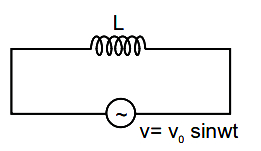
Consider a pure inductive $A$.$C$. circuit as shown in the figure. If the average power consumed is $P$, then
A
$P > 0$
B
$P < 0$
C
$P = 0$
D
$P$ is infinite
Solution
(C) In a pure inductive circuit, the current $I$ lags behind the voltage $V$ by a phase angle of $\phi = 90^{\circ}$ (or $\pi/2$ radians).
The average power consumed in an $A$.$C$. circuit is given by the formula $P = V_{rms} I_{rms} \cos \phi$.
Substituting the phase angle $\phi = 90^{\circ}$ into the formula, we get $\cos 90^{\circ} = 0$.
Therefore, $P = V_{rms} I_{rms} \times 0 = 0$.
Thus, a pure inductor consumes no average power.
The average power consumed in an $A$.$C$. circuit is given by the formula $P = V_{rms} I_{rms} \cos \phi$.
Substituting the phase angle $\phi = 90^{\circ}$ into the formula, we get $\cos 90^{\circ} = 0$.
Therefore, $P = V_{rms} I_{rms} \times 0 = 0$.
Thus, a pure inductor consumes no average power.
0 likes
View Solution163
DifficultMCQ
$A$ $15.0 \mu\text{F}$ capacitor is connected to a $220 \text{ V}$, $50 \text{ Hz}$ source. The capacitive reactance of the circuit is . . . . . . $\Omega$.
A
$2.12$
B
$212$
C
$21.2$
D
$2120$
Solution
(B) The capacitive reactance $X_C$ is given by the formula $X_C = \frac{1}{2\pi f C}$.
Given values are frequency $f = 50 \text{ Hz}$ and capacitance $C = 15.0 \mu\text{F} = 15.0 \times 10^{-6} \text{ F}$.
Substituting these values into the formula:
$X_C = \frac{1}{2 \times 3.14159 \times 50 \times 15.0 \times 10^{-6}}$
$X_C = \frac{1}{314.159 \times 15.0 \times 10^{-6}}$
$X_C = \frac{1}{4712.385 \times 10^{-6}}$
$X_C = \frac{10^6}{4712.385} \approx 212.2 \Omega$.
Rounding to the nearest integer, the capacitive reactance is $212 \Omega$.
Given values are frequency $f = 50 \text{ Hz}$ and capacitance $C = 15.0 \mu\text{F} = 15.0 \times 10^{-6} \text{ F}$.
Substituting these values into the formula:
$X_C = \frac{1}{2 \times 3.14159 \times 50 \times 15.0 \times 10^{-6}}$
$X_C = \frac{1}{314.159 \times 15.0 \times 10^{-6}}$
$X_C = \frac{1}{4712.385 \times 10^{-6}}$
$X_C = \frac{10^6}{4712.385} \approx 212.2 \Omega$.
Rounding to the nearest integer, the capacitive reactance is $212 \Omega$.
0 likes
View Solution164
MediumMCQ
In an a.c. circuit with pure capacitance $C$ and a.c. source $E = E_0 \sin \omega t$, the equation of instantaneous current is given by
A
$I = E_0 \omega C \sin(\omega t)$
B
$I = E_0 \omega C \sin(\omega t + \pi/2)$
C
$I = \frac{E_0}{\omega C} \sin(\omega t)$
D
$I = \frac{E_0}{\omega C} \sin(\omega t + \pi/2)$
Solution
(B) In a pure capacitive circuit, the current leads the voltage by a phase angle of $\pi/2$ radians.
The instantaneous voltage is given by $E = E_0 \sin(\omega t)$.
The capacitive reactance is $X_C = \frac{1}{\omega C}$.
The instantaneous current $I$ is given by $I = \frac{E}{X_C} = \frac{E_0 \sin(\omega t)}{1/(\omega C)} = E_0 \omega C \sin(\omega t)$.
Since the current leads the voltage by $\pi/2$, we add $\pi/2$ to the phase of the voltage.
Therefore, the instantaneous current is $I = E_0 \omega C \sin(\omega t + \pi/2)$.
The instantaneous voltage is given by $E = E_0 \sin(\omega t)$.
The capacitive reactance is $X_C = \frac{1}{\omega C}$.
The instantaneous current $I$ is given by $I = \frac{E}{X_C} = \frac{E_0 \sin(\omega t)}{1/(\omega C)} = E_0 \omega C \sin(\omega t)$.
Since the current leads the voltage by $\pi/2$, we add $\pi/2$ to the phase of the voltage.
Therefore, the instantaneous current is $I = E_0 \omega C \sin(\omega t + \pi/2)$.
0 likes
View Solution165
DifficultMCQ
An alternating voltage $e = 150\sqrt{2} \sin 100t \text{ V}$ is applied to a capacitor of capacity $2 \mu F$. The root mean square value of current in the circuit is (in $mA$)
A
$300$
B
$150$
C
$30$
D
$15$
Solution
(C) The given alternating voltage is $e = 150\sqrt{2} \sin 100t \text{ V}$.
Comparing this with the standard equation $e = E_0 \sin \omega t$, we get the peak voltage $E_0 = 150\sqrt{2} \text{ V}$ and angular frequency $\omega = 100 \text{ rad/s}$.
The root mean square $(RMS)$ voltage is $V_{rms} = E_0 / \sqrt{2} = 150 \text{ V}$.
The capacitive reactance $X_C$ is given by $X_C = 1 / (\omega C)$.
Given $C = 2 \mu F = 2 \times 10^{-6} \text{ F}$, we have $X_C = 1 / (100 \times 2 \times 10^{-6}) = 1 / (2 \times 10^{-4}) = 5000 \Omega$.
The $RMS$ current $I_{rms}$ is $I_{rms} = V_{rms} / X_C = 150 / 5000 = 0.03 \text{ A}$.
Converting to milliamperes, $I_{rms} = 0.03 \times 1000 \text{ mA} = 30 \text{ mA}$.
Comparing this with the standard equation $e = E_0 \sin \omega t$, we get the peak voltage $E_0 = 150\sqrt{2} \text{ V}$ and angular frequency $\omega = 100 \text{ rad/s}$.
The root mean square $(RMS)$ voltage is $V_{rms} = E_0 / \sqrt{2} = 150 \text{ V}$.
The capacitive reactance $X_C$ is given by $X_C = 1 / (\omega C)$.
Given $C = 2 \mu F = 2 \times 10^{-6} \text{ F}$, we have $X_C = 1 / (100 \times 2 \times 10^{-6}) = 1 / (2 \times 10^{-4}) = 5000 \Omega$.
The $RMS$ current $I_{rms}$ is $I_{rms} = V_{rms} / X_C = 150 / 5000 = 0.03 \text{ A}$.
Converting to milliamperes, $I_{rms} = 0.03 \times 1000 \text{ mA} = 30 \text{ mA}$.
0 likes
View Solution166
MediumMCQ
$A$ coil has an inductance of $3 \ H$. The ratio of its reactance when it is first connected to an a.c. source and then to a d.c. source is:
A
zero
B
$3$
C
infinite
D
$5$
Solution
(C) कुंडली का प्रेरकत्व $L = 3 \ H$ है।
$a.c.$ स्रोत के लिए, प्रेरणिक प्रतिघात (inductive reactance) $X_L = \omega L = 2 \pi f L$ होता है।
$d.c.$ स्रोत के लिए, आवृत्ति $f = 0$ होती है, इसलिए प्रेरणिक प्रतिघात $X_{dc} = 2 \pi (0) L = 0$ होता है।
प्रश्न के अनुसार, $a.c.$ प्रतिघात और $d.c.$ प्रतिघात का अनुपात $\frac{X_L}{X_{dc}} = \frac{\omega L}{0} = \infty$ (अनंत) होगा।
अतः, सही विकल्प $C$ है।
$a.c.$ स्रोत के लिए, प्रेरणिक प्रतिघात (inductive reactance) $X_L = \omega L = 2 \pi f L$ होता है।
$d.c.$ स्रोत के लिए, आवृत्ति $f = 0$ होती है, इसलिए प्रेरणिक प्रतिघात $X_{dc} = 2 \pi (0) L = 0$ होता है।
प्रश्न के अनुसार, $a.c.$ प्रतिघात और $d.c.$ प्रतिघात का अनुपात $\frac{X_L}{X_{dc}} = \frac{\omega L}{0} = \infty$ (अनंत) होगा।
अतः, सही विकल्प $C$ है।
0 likes
View Solution167
DifficultMCQ
Determine the frequency for which a $10$ $\mu$$F$ capacitor has a reactance of $2 \times 10^{-3} \Omega$.
A
$\frac{25}{\pi}$ MHz
B
$\frac{20}{\pi}$ MHz
C
$2 \times 10^{-3}$ MHz
D
$10\pi$ MHz
Solution
(A) The capacitive reactance $X_C$ is given by the formula: $X_C = \frac{1}{2\pi f C}$.
Given values are $C = 10 \mu F = 10 \times 10^{-6} F = 10^{-5} F$ and $X_C = 2 \times 10^{-3} \Omega$.
Rearranging the formula to solve for frequency $f$: $f = \frac{1}{2\pi X_C C}$.
Substituting the values: $f = \frac{1}{2 \times \pi \times (2 \times 10^{-3}) \times 10^{-5}}$.
$f = \frac{1}{4 \times \pi \times 10^{-8}} = \frac{10^8}{4\pi} = \frac{100 \times 10^6}{4\pi} = \frac{25}{\pi} \times 10^6$ Hz.
Since $10^6$ Hz = $1$ MHz, the frequency is $\frac{25}{\pi}$ MHz.
Given values are $C = 10 \mu F = 10 \times 10^{-6} F = 10^{-5} F$ and $X_C = 2 \times 10^{-3} \Omega$.
Rearranging the formula to solve for frequency $f$: $f = \frac{1}{2\pi X_C C}$.
Substituting the values: $f = \frac{1}{2 \times \pi \times (2 \times 10^{-3}) \times 10^{-5}}$.
$f = \frac{1}{4 \times \pi \times 10^{-8}} = \frac{10^8}{4\pi} = \frac{100 \times 10^6}{4\pi} = \frac{25}{\pi} \times 10^6$ Hz.
Since $10^6$ Hz = $1$ MHz, the frequency is $\frac{25}{\pi}$ MHz.
0 likes
View Solution168
MediumMCQ
When an $a.c.$ source is connected across a pure capacitor, the correct phase relation between current and $emf$ is:
A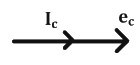
B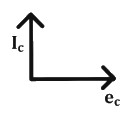
C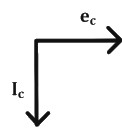
D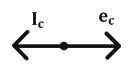
Solution
(B) When an alternating current $(a.c.)$ source is connected across a pure capacitor, the voltage $(e_c)$ across the capacitor lags behind the current $(I_c)$ by a phase angle of $90^{\circ}$ (or $\pi/2$ radians).
Alternatively, we can say that the current leads the voltage by $90^{\circ}$.
Mathematically, if the voltage is $e_c = E_0 \sin(\omega t)$, then the current is $I_c = I_0 \sin(\omega t + \pi/2)$.
In a phasor diagram, if the voltage vector is along the positive $x$-axis, the current vector points along the positive $y$-axis, indicating a $90^{\circ}$ lead.
Therefore, option $B$ correctly represents this phase relationship.
Alternatively, we can say that the current leads the voltage by $90^{\circ}$.
Mathematically, if the voltage is $e_c = E_0 \sin(\omega t)$, then the current is $I_c = I_0 \sin(\omega t + \pi/2)$.
In a phasor diagram, if the voltage vector is along the positive $x$-axis, the current vector points along the positive $y$-axis, indicating a $90^{\circ}$ lead.
Therefore, option $B$ correctly represents this phase relationship.
0 likes
View Solution169
EasyMCQ
In a circuit containing a pure resistor connected to an $AC$ source,
A
Voltage leads the current by $90^\circ$
B
Current leads the voltage by $90^\circ$
C
Voltage and current are in same phase with each other
D
Current leads the voltage by $180^\circ$
Solution
(C) Step $1$: For a pure resistor, the instantaneous voltage is given by $V = V_m \sin(\omega t)$.
Step $2$: According to Ohm's law, the current is $I = \frac{V}{R} = \frac{V_m}{R} \sin(\omega t) = I_m \sin(\omega t)$.
Step $3$: Comparing the phase of voltage and current, both have the same phase angle $\omega t$.
Step $4$: Therefore, the voltage and current are in the same phase.
Step $2$: According to Ohm's law, the current is $I = \frac{V}{R} = \frac{V_m}{R} \sin(\omega t) = I_m \sin(\omega t)$.
Step $3$: Comparing the phase of voltage and current, both have the same phase angle $\omega t$.
Step $4$: Therefore, the voltage and current are in the same phase.
0 likes
View SolutionAlternating Current — Only Inductor, Only Capacitor and Only Resistor Circuit · Frequently Asked Questions
1Are these Alternating Current questions useful for JEE and NEET?
Yes. All questions in this section are mapped to JEE Main and NEET exam patterns. Previous year questions from JEE Main, NEET, GUJCET and state-level exams are included with full solutions.
2Can I switch to Hindi or Gujarati for these questions?
Yes. Use the language tabs in the hero section or the sidebar to view the same questions and solutions in English, Hindi or Gujarati.
3How do I generate a question paper from this subtopic?
Use the Vedclass Exam Paper Generator — select the chapter and subtopic, set difficulty, and generate Sets A, B, C, D automatically. First 3 chapters of every subject are free.
Vedclass Products
For Students
Vedclass Test Series
Mock tests in real JEE/NEET style with performance analysis. 5-day free trial.
Start Free TrialFor Teachers
Exam Paper Generator
Generate Set A/B/C/D papers from this chapter in 2 minutes. 3 chapters free.
Try FreeFor Institutes
Online Exam Module
Live online exams with unlimited students, 360° analytics & white-label branding.
See DemoFor Teachers & Institutes
Generate a Alternating Current Exam Paper in 2 Minutes
Select subtopic & difficulty — Sets A, B, C, D auto-generated with No Repeat logic.
First 3 chapters of every subject are free — no payment required.