
A English
Force on a Current Carrying Conductor Questions in English
Class 12 Physics · Moving Charges and Magnetism · Force on a Current Carrying Conductor
266+
Questions
English
Language
100%
With Solutions
Showing 16 of 266 questions in English
251
MediumMCQ
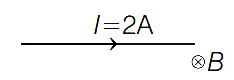
$A$ straight wire of mass $0.2 \,kg$ and length $1.5 \,m$ carries a current of $2 \,A$, as shown in the figure. It is suspended in mid-air by a uniform magnetic field $B$ pointing into the plane of the paper. Calculate the magnitude of the magnetic field. (Ignore Earth's magnetic field and assume $g = 10 \,m/s^2$) (in $\,T$)
A
$0.55$
B
$0.67$
C
$0.75$
D
$0.85$
Solution
(B) Given: Mass of the wire, $m = 0.2 \,kg$. Length of the wire, $l = 1.5 \,m$. Current, $I = 2 \,A$. Acceleration due to gravity, $g = 10 \,m/s^2$.
The magnetic force $F_m$ acting on a current-carrying wire in a uniform magnetic field is given by $F_m = I l B \sin \theta$. Since the magnetic field is perpendicular to the wire, $\theta = 90^{\circ}$, so $F_m = I l B$.
For the wire to be suspended in mid-air, the upward magnetic force must balance the downward gravitational force (weight) of the wire.
$F_m = w$
$I l B = m g$
Rearranging to solve for $B$:
$B = \frac{m g}{I l}$
$B = \frac{0.2 \times 10}{2 \times 1.5}$
$B = \frac{2}{3} \approx 0.67 \,T$
Therefore, the magnitude of the magnetic field is $0.67 \,T$.
The magnetic force $F_m$ acting on a current-carrying wire in a uniform magnetic field is given by $F_m = I l B \sin \theta$. Since the magnetic field is perpendicular to the wire, $\theta = 90^{\circ}$, so $F_m = I l B$.
For the wire to be suspended in mid-air, the upward magnetic force must balance the downward gravitational force (weight) of the wire.
$F_m = w$
$I l B = m g$
Rearranging to solve for $B$:
$B = \frac{m g}{I l}$
$B = \frac{0.2 \times 10}{2 \times 1.5}$
$B = \frac{2}{3} \approx 0.67 \,T$
Therefore, the magnitude of the magnetic field is $0.67 \,T$.
0 likes
View Solution252
DifficultMCQ
$A$ wire of length $L$ carries a current $I$ along the $X$-axis. The magnetic force acting on the wire is given by $\vec{F} = I B_0 L(\hat{k} - \hat{j})$. The existing magnetic field $\vec{B}$ is
A
$B_0 \hat{i}$
B
$B_0(\hat{i} + \hat{j} - \hat{k})$
C
$B_0(\hat{i} + \hat{j} + \hat{k})$
D
$B_0(\hat{i} - \hat{j} - \hat{k})$
Solution
(C) The magnetic force on a current-carrying wire is given by $\vec{F} = I(\vec{L} \times \vec{B})$.
Here, the length vector is $\vec{L} = L \hat{i}$.
Given $\vec{F} = I B_0 L(\hat{k} - \hat{j})$.
Substituting these into the formula: $I B_0 L(\hat{k} - \hat{j}) = I(L \hat{i} \times \vec{B})$.
Dividing by $I L$, we get: $B_0(\hat{k} - \hat{j}) = \hat{i} \times \vec{B}$.
Let $\vec{B} = B_x \hat{i} + B_y \hat{j} + B_z \hat{k}$.
Then $\hat{i} \times (B_x \hat{i} + B_y \hat{j} + B_z \hat{k}) = B_y \hat{k} - B_z \hat{j}$.
Comparing this with $B_0(\hat{k} - \hat{j})$, we get $B_y = B_0$ and $B_z = B_0$.
Since the cross product with $\hat{i}$ eliminates any component along $\hat{i}$, $B_x$ can be any value, but looking at the options, $B_x = B_0$ satisfies the condition.
Thus, $\vec{B} = B_0(\hat{i} + \hat{j} + \hat{k})$.
Here, the length vector is $\vec{L} = L \hat{i}$.
Given $\vec{F} = I B_0 L(\hat{k} - \hat{j})$.
Substituting these into the formula: $I B_0 L(\hat{k} - \hat{j}) = I(L \hat{i} \times \vec{B})$.
Dividing by $I L$, we get: $B_0(\hat{k} - \hat{j}) = \hat{i} \times \vec{B}$.
Let $\vec{B} = B_x \hat{i} + B_y \hat{j} + B_z \hat{k}$.
Then $\hat{i} \times (B_x \hat{i} + B_y \hat{j} + B_z \hat{k}) = B_y \hat{k} - B_z \hat{j}$.
Comparing this with $B_0(\hat{k} - \hat{j})$, we get $B_y = B_0$ and $B_z = B_0$.
Since the cross product with $\hat{i}$ eliminates any component along $\hat{i}$, $B_x$ can be any value, but looking at the options, $B_x = B_0$ satisfies the condition.
Thus, $\vec{B} = B_0(\hat{i} + \hat{j} + \hat{k})$.
0 likes
View Solution253
MediumMCQ
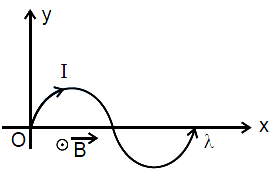
$A$ wire carrying a steady current $I$ is kept in the $x$-$y$ plane along the curve $y=A \sin \left(\frac{2 \pi}{\lambda} x\right)$. $A$ magnetic field $B$ exists in the $z$-direction. The magnitude of the magnetic force on the portion of the wire between $x=0$ and $x=\lambda$ is
A
$0$
B
$2 I \lambda B$
C
$I \lambda B$
D
$I \lambda B / 2$
Solution
(C) The magnetic force on a current-carrying wire in a uniform magnetic field is given by $\vec{F} = I (\vec{L}_{eff} \times \vec{B})$, where $\vec{L}_{eff}$ is the effective displacement vector from the starting point to the end point of the wire.
For the given curve $y = A \sin \left(\frac{2 \pi}{\lambda} x\right)$, the starting point is at $x=0$, which gives $y=0$. The end point is at $x=\lambda$, which gives $y = A \sin(2\pi) = 0$.
Thus, the effective displacement vector $\vec{L}_{eff}$ is the vector from $(0, 0)$ to $(\lambda, 0)$, which is $\vec{L}_{eff} = \lambda \hat{i}$.
The magnetic field is in the $z$-direction, so $\vec{B} = B \hat{k}$.
The magnetic force is $\vec{F} = I (\lambda \hat{i} \times B \hat{k}) = I \lambda B (\hat{i} \times \hat{k}) = -I \lambda B \hat{j}$.
The magnitude of the magnetic force is $|\vec{F}| = I \lambda B$.
For the given curve $y = A \sin \left(\frac{2 \pi}{\lambda} x\right)$, the starting point is at $x=0$, which gives $y=0$. The end point is at $x=\lambda$, which gives $y = A \sin(2\pi) = 0$.
Thus, the effective displacement vector $\vec{L}_{eff}$ is the vector from $(0, 0)$ to $(\lambda, 0)$, which is $\vec{L}_{eff} = \lambda \hat{i}$.
The magnetic field is in the $z$-direction, so $\vec{B} = B \hat{k}$.
The magnetic force is $\vec{F} = I (\lambda \hat{i} \times B \hat{k}) = I \lambda B (\hat{i} \times \hat{k}) = -I \lambda B \hat{j}$.
The magnitude of the magnetic force is $|\vec{F}| = I \lambda B$.
0 likes
View Solution254
MediumMCQ
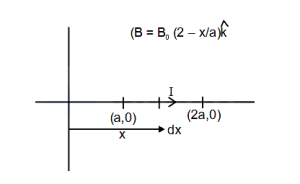
$A$ straight wire is placed in a magnetic field that varies with distance $x$ from the origin as $\vec{B} = B_0 \left( 2 - \frac{x}{a} \right) \hat{k}$. The ends of the wire are at $(a, 0)$ and $(2a, 0)$ and it carries a current $I$ in the positive $x$-direction. If the force on the wire is $\vec{F} = IB_0 \left( \frac{ka}{2} \right) \hat{j}$, then the value of $k$ is:
A
$1$
B
$5$
C
$-1$
D
$\frac{1}{2}$
Solution
(C) The magnetic force on a small current element $I d\vec{l}$ is given by $d\vec{F} = I (d\vec{l} \times \vec{B})$.
Here, the current element is $d\vec{l} = dx \hat{i}$ and the magnetic field is $\vec{B} = B_0 \left( 2 - \frac{x}{a} \right) \hat{k}$.
Thus, $d\vec{F} = I (dx \hat{i}) \times B_0 \left( 2 - \frac{x}{a} \right) \hat{k} = I B_0 \left( 2 - \frac{x}{a} \right) dx (\hat{i} \times \hat{k}) = I B_0 \left( 2 - \frac{x}{a} \right) dx (-\hat{j})$.
To find the total force, we integrate from $x = a$ to $x = 2a$:
$\vec{F} = \int_{a}^{2a} I B_0 \left( 2 - \frac{x}{a} \right) dx (-\hat{j})$
$\vec{F} = -I B_0 \hat{j} \int_{a}^{2a} \left( 2 - \frac{x}{a} \right) dx$
$\vec{F} = -I B_0 \hat{j} \left[ 2x - \frac{x^2}{2a} \right]_{a}^{2a}$
$\vec{F} = -I B_0 \hat{j} \left[ \left( 2(2a) - \frac{(2a)^2}{2a} \right) - \left( 2(a) - \frac{a^2}{2a} \right) \right]$
$\vec{F} = -I B_0 \hat{j} \left[ (4a - 2a) - (2a - 0.5a) \right]$
$\vec{F} = -I B_0 \hat{j} [ 2a - 1.5a ] = -I B_0 \left( \frac{a}{2} \right) \hat{j}$.
Comparing this with the given force $\vec{F} = I B_0 \left( \frac{ka}{2} \right) \hat{j}$, we get $k = -1$.
Here, the current element is $d\vec{l} = dx \hat{i}$ and the magnetic field is $\vec{B} = B_0 \left( 2 - \frac{x}{a} \right) \hat{k}$.
Thus, $d\vec{F} = I (dx \hat{i}) \times B_0 \left( 2 - \frac{x}{a} \right) \hat{k} = I B_0 \left( 2 - \frac{x}{a} \right) dx (\hat{i} \times \hat{k}) = I B_0 \left( 2 - \frac{x}{a} \right) dx (-\hat{j})$.
To find the total force, we integrate from $x = a$ to $x = 2a$:
$\vec{F} = \int_{a}^{2a} I B_0 \left( 2 - \frac{x}{a} \right) dx (-\hat{j})$
$\vec{F} = -I B_0 \hat{j} \int_{a}^{2a} \left( 2 - \frac{x}{a} \right) dx$
$\vec{F} = -I B_0 \hat{j} \left[ 2x - \frac{x^2}{2a} \right]_{a}^{2a}$
$\vec{F} = -I B_0 \hat{j} \left[ \left( 2(2a) - \frac{(2a)^2}{2a} \right) - \left( 2(a) - \frac{a^2}{2a} \right) \right]$
$\vec{F} = -I B_0 \hat{j} \left[ (4a - 2a) - (2a - 0.5a) \right]$
$\vec{F} = -I B_0 \hat{j} [ 2a - 1.5a ] = -I B_0 \left( \frac{a}{2} \right) \hat{j}$.
Comparing this with the given force $\vec{F} = I B_0 \left( \frac{ka}{2} \right) \hat{j}$, we get $k = -1$.
0 likes
View Solution255
MediumMCQ
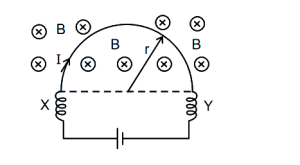
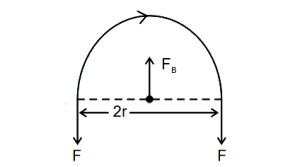
$A$ horizontal semi-circular wire of radius $r$ is connected to a battery through two similar springs $X$ and $Y$. The battery sends a current $I$ through the wire. $A$ uniform magnetic field $B$ is applied perpendicular to the plane of the wire, as shown in the figure. What is the force acting on each spring?
A
$2 \pi rBI$
B
$\frac{1}{2} \pi rBI$
C
$BIr$
D
$2 BIr$
Solution
(C) The magnetic force $F_B$ acting on a current-carrying wire in a magnetic field is given by $F_B = I \vec{L}_{eff} \times \vec{B}$.
For a semi-circular wire of radius $r$, the effective length $\vec{L}_{eff}$ is the straight-line distance between the two ends, which is the diameter $2r$.
Therefore, the magnitude of the magnetic force is $F_B = I(2r)B = 2IrB$.
This total upward magnetic force is shared equally by the two identical springs $X$ and $Y$ attached to the ends of the wire.
Let $F$ be the force acting on each spring. Then, $2F = F_B$.
Substituting the value of $F_B$, we get $2F = 2IrB$.
Thus, the force on each spring is $F = I r B$.
For a semi-circular wire of radius $r$, the effective length $\vec{L}_{eff}$ is the straight-line distance between the two ends, which is the diameter $2r$.
Therefore, the magnitude of the magnetic force is $F_B = I(2r)B = 2IrB$.
This total upward magnetic force is shared equally by the two identical springs $X$ and $Y$ attached to the ends of the wire.
Let $F$ be the force acting on each spring. Then, $2F = F_B$.
Substituting the value of $F_B$, we get $2F = 2IrB$.
Thus, the force on each spring is $F = I r B$.
1 likes
View Solution256
EasyMCQ
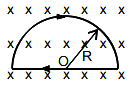
As shown in the figure, a wire is bent to form a $D$-shaped loop carrying current $I$, where the curved part is a semi-circle of radius $R$. The loop is placed in a uniform magnetic field $\overrightarrow{B}$, which is directed into the plane of the paper. The net magnetic force on the closed loop is:
A
$0$
B
$IRB$
C
$2 IRB$
D
$\frac{1}{2} IRB$
Solution
(A) The magnetic force on a current-carrying conductor in a uniform magnetic field is given by $\overrightarrow{F} = I(\overrightarrow{L} \times \overrightarrow{B})$, where $\overrightarrow{L}$ is the displacement vector from the starting point to the end point of the conductor.
For any closed loop, the starting point and the end point are the same, which means the total displacement vector $\overrightarrow{L}$ is zero.
Therefore, the net magnetic force $\overrightarrow{F}$ on any closed current loop placed in a uniform magnetic field is always zero.
For any closed loop, the starting point and the end point are the same, which means the total displacement vector $\overrightarrow{L}$ is zero.
Therefore, the net magnetic force $\overrightarrow{F}$ on any closed current loop placed in a uniform magnetic field is always zero.
0 likes
View Solution257
EasyMCQ
$A$ current of $1 \ A$ is flowing along the positive $x$-axis through a straight wire of length $0.5 \ m$ placed in a region of a magnetic field given by $\vec{B} = (2\hat{i} + 4\hat{j}) \ T$. The magnitude and the direction of the force experienced by the wire are, respectively:
A
$\sqrt{18} \ N$, along positive $z$-axis
B
$\sqrt{20} \ N$, along positive $x$-axis
C
$2 \ N$, along positive $z$-axis
D
$4 \ N$, along positive $y$-axis
Solution
(C) The force $\vec{F}$ on a current-carrying wire is given by $\vec{F} = I(\vec{L} \times \vec{B})$.
Here, $I = 1 \ A$, $\vec{L} = 0.5 \hat{i} \ m$, and $\vec{B} = (2\hat{i} + 4\hat{j}) \ T$.
Substituting the values:
$\vec{F} = 1 \times (0.5 \hat{i} \times (2\hat{i} + 4\hat{j}))$
$\vec{F} = 0.5 \times 2(\hat{i} \times \hat{i}) + 0.5 \times 4(\hat{i} \times \hat{j})$
Since $\hat{i} \times \hat{i} = 0$ and $\hat{i} \times \hat{j} = \hat{k}$:
$\vec{F} = 0 + 2\hat{k} = 2\hat{k} \ N$.
The magnitude of the force is $|\vec{F}| = 2 \ N$, and the direction is along the positive $z$-axis.
Here, $I = 1 \ A$, $\vec{L} = 0.5 \hat{i} \ m$, and $\vec{B} = (2\hat{i} + 4\hat{j}) \ T$.
Substituting the values:
$\vec{F} = 1 \times (0.5 \hat{i} \times (2\hat{i} + 4\hat{j}))$
$\vec{F} = 0.5 \times 2(\hat{i} \times \hat{i}) + 0.5 \times 4(\hat{i} \times \hat{j})$
Since $\hat{i} \times \hat{i} = 0$ and $\hat{i} \times \hat{j} = \hat{k}$:
$\vec{F} = 0 + 2\hat{k} = 2\hat{k} \ N$.
The magnitude of the force is $|\vec{F}| = 2 \ N$, and the direction is along the positive $z$-axis.
0 likes
View Solution258
EasyMCQ
$A$ straight wire of length $2 \ m$ carries a current of $10 \ A$. If this wire is placed in a uniform magnetic field of $0.15 \ T$ making an angle of $45^{\circ}$ with the magnetic field, the applied force on the wire will be
A
$1.5 \ N$
B
$3 \ N$
C
$3 \sqrt{2} \ N$
D
$\frac{3}{\sqrt{2}} \ N$
Solution
(D) The force $F$ on a current-carrying wire in a magnetic field is given by the formula $F = I L B \sin \theta$.
Given values are:
Current $I = 10 \ A$
Length $L = 2 \ m$
Magnetic field $B = 0.15 \ T$
Angle $\theta = 45^{\circ}$
Substituting these values into the formula:
$F = 10 \times 2 \times 0.15 \times \sin 45^{\circ}$
$F = 3 \times \frac{1}{\sqrt{2}}$
$F = \frac{3}{\sqrt{2}} \ N$.
Given values are:
Current $I = 10 \ A$
Length $L = 2 \ m$
Magnetic field $B = 0.15 \ T$
Angle $\theta = 45^{\circ}$
Substituting these values into the formula:
$F = 10 \times 2 \times 0.15 \times \sin 45^{\circ}$
$F = 3 \times \frac{1}{\sqrt{2}}$
$F = \frac{3}{\sqrt{2}} \ N$.
0 likes
View Solution259
DifficultMCQ
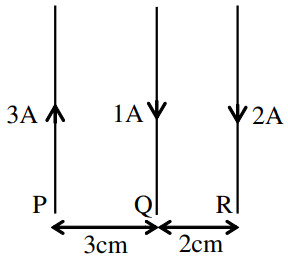
Three long straight wires carrying current are arranged mutually parallel as shown in the figure. The force experienced by $15 \ cm$ length of wire $Q$ is . . . . . . . $(\mu_0 = 4 \pi \times 10^{-7} \ T \cdot m/A)$
A
$6 \times 10^{-7} \ N$ towards $P$
B
$6 \times 10^{-6} \ N$ towards $R$
C
$6 \times 10^{-7} \ N$ towards $R$
D
$6 \times 10^{-6} \ N$ towards $P$
Solution
(B) The force per unit length between two parallel wires carrying currents $I_1$ and $I_2$ separated by distance $d$ is given by $f = \frac{\mu_0 I_1 I_2}{2 \pi d}$.
For wire $Q$ (current $I_Q = 1 \ A$):
$1$. Force due to wire $P$ ($I_P = 3 \ A$, $d_1 = 3 \ cm = 0.03 \ m$): Since currents are in opposite directions, the force is repulsive (away from $P$, i.e.,towards $R$).
$F_{QP} = \frac{\mu_0 I_Q I_P}{2 \pi d_1} \ell = (2 \times 10^{-7}) \times \frac{1 \times 3}{0.03} \times 0.15 = 2 \times 10^{-7} \times 100 \times 0.15 = 3 \times 10^{-6} \ N$ (towards $R$).
$2$. Force due to wire $R$ ($I_R = 2 \ A$, $d_2 = 2 \ cm = 0.02 \ m$): Since currents are in the same direction, the force is attractive (towards $R$).
$F_{QR} = \frac{\mu_0 I_Q I_R}{2 \pi d_2} \ell = (2 \times 10^{-7}) \times \frac{1 \times 2}{0.02} \times 0.15 = 2 \times 10^{-7} \times 100 \times 0.15 = 3 \times 10^{-6} \ N$ (towards $R$).
Total force $F_{net} = F_{QP} + F_{QR} = 3 \times 10^{-6} + 3 \times 10^{-6} = 6 \times 10^{-6} \ N$ towards $R$.
For wire $Q$ (current $I_Q = 1 \ A$):
$1$. Force due to wire $P$ ($I_P = 3 \ A$, $d_1 = 3 \ cm = 0.03 \ m$): Since currents are in opposite directions, the force is repulsive (away from $P$, i.e.,towards $R$).
$F_{QP} = \frac{\mu_0 I_Q I_P}{2 \pi d_1} \ell = (2 \times 10^{-7}) \times \frac{1 \times 3}{0.03} \times 0.15 = 2 \times 10^{-7} \times 100 \times 0.15 = 3 \times 10^{-6} \ N$ (towards $R$).
$2$. Force due to wire $R$ ($I_R = 2 \ A$, $d_2 = 2 \ cm = 0.02 \ m$): Since currents are in the same direction, the force is attractive (towards $R$).
$F_{QR} = \frac{\mu_0 I_Q I_R}{2 \pi d_2} \ell = (2 \times 10^{-7}) \times \frac{1 \times 2}{0.02} \times 0.15 = 2 \times 10^{-7} \times 100 \times 0.15 = 3 \times 10^{-6} \ N$ (towards $R$).
Total force $F_{net} = F_{QP} + F_{QR} = 3 \times 10^{-6} + 3 \times 10^{-6} = 6 \times 10^{-6} \ N$ towards $R$.
0 likes
View Solution260
MediumMCQ
The horizontal component of the Earth's magnetic field at a certain place is $3 \times 10^{-5} \text{T}$ and the direction of the field is from the geographic South to the geographic North. $A$ very long straight conductor is carrying a steady current of $1 \text{A}$. What is the force per unit length on it when it is placed on a horizontal table and the direction of current is South to North?
A
zero
B
$1 \times 10^{-5} \text{Nm}^{-1}$
C
$6 \times 10^{-5} \text{Nm}^{-1}$
D
$9 \times 10^{-5} \text{Nm}^{-1}$
Solution
(A) The force $\vec{F}$ on a conductor of length $L$ carrying current $I$ in a magnetic field $\vec{B}$ is given by $\vec{F} = I(\vec{L} \times \vec{B})$.
The magnitude of the force per unit length $f$ is given by $f = I B \sin\theta$, where $\theta$ is the angle between the direction of the current and the magnetic field.
In this case, the magnetic field $\vec{B}$ is directed from South to North, and the current $I$ is also flowing from South to North.
Therefore, the angle $\theta$ between the current and the magnetic field is $0^\circ$.
Since $\sin(0^\circ) = 0$, the force per unit length $f = I \times B \times \sin(0^\circ) = 0 \text{ N/m}$.
The magnitude of the force per unit length $f$ is given by $f = I B \sin\theta$, where $\theta$ is the angle between the direction of the current and the magnetic field.
In this case, the magnetic field $\vec{B}$ is directed from South to North, and the current $I$ is also flowing from South to North.
Therefore, the angle $\theta$ between the current and the magnetic field is $0^\circ$.
Since $\sin(0^\circ) = 0$, the force per unit length $f = I \times B \times \sin(0^\circ) = 0 \text{ N/m}$.
0 likes
View Solution261
DifficultMCQ
Two infinitely long parallel conducting wires $A$ and $B$ carry currents $I$ and $2I$, respectively, in the same direction. The wire $A$ has uniform mass per unit length $\lambda$ and lies on an insulated floor. The wire $B$ is kept fixed at a height $h$ above the floor. The minimum magnitude of $h$ so that the wire $A$ does not rise from the floor is : [$g$ is the acceleration due to gravity and $\mu_0$ is the permeability of free space]
A
$\frac{\mu_0 I^2}{2\pi \lambda g}$
B
$\frac{\mu_0 I^2}{\pi \lambda g}$
C
$\frac{2\mu_0 I^2}{\pi \lambda g}$
D
$\frac{4\mu_0 I^2}{\pi \lambda g}$
Solution
(B) The magnetic force per unit length between two parallel wires carrying currents $I_1$ and $I_2$ separated by a distance $h$ is given by $F/L = \frac{\mu_0 I_1 I_2}{2\pi h}$.
Here, $I_1 = I$, $I_2 = 2I$, and the distance is $h$.
So, the magnetic force per unit length is $F/L = \frac{\mu_0 I (2I)}{2\pi h} = \frac{\mu_0 I^2}{\pi h}$.
Since the currents are in the same direction, the force is attractive, meaning wire $A$ is pulled upward towards wire $B$.
For wire $A$ not to rise from the floor, the upward magnetic force must be less than or equal to the downward gravitational force per unit length.
The gravitational force per unit length on wire $A$ is $W/L = \lambda g$.
Therefore, the condition is $\frac{\mu_0 I^2}{\pi h} \leq \lambda g$.
Rearranging for $h$, we get $h \geq \frac{\mu_0 I^2}{\pi \lambda g}$.
The minimum magnitude of $h$ is $\frac{\mu_0 I^2}{\pi \lambda g}$.
Here, $I_1 = I$, $I_2 = 2I$, and the distance is $h$.
So, the magnetic force per unit length is $F/L = \frac{\mu_0 I (2I)}{2\pi h} = \frac{\mu_0 I^2}{\pi h}$.
Since the currents are in the same direction, the force is attractive, meaning wire $A$ is pulled upward towards wire $B$.
For wire $A$ not to rise from the floor, the upward magnetic force must be less than or equal to the downward gravitational force per unit length.
The gravitational force per unit length on wire $A$ is $W/L = \lambda g$.
Therefore, the condition is $\frac{\mu_0 I^2}{\pi h} \leq \lambda g$.
Rearranging for $h$, we get $h \geq \frac{\mu_0 I^2}{\pi \lambda g}$.
The minimum magnitude of $h$ is $\frac{\mu_0 I^2}{\pi \lambda g}$.
0 likes
View Solution262
DifficultMCQ
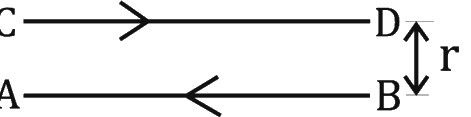
$A$ wire $AB$ is carrying a steady current $I_1$ and is kept on a table. Another wire $CD$ carrying current $I_2$ is held directly above it at a distance $r$. When the wire $CD$ is left free and it remains suspended at its position, find its mass per unit length. (Given: $g$ = acceleration due to gravity, $\mu_0$ = permeability of free space)
A
$\frac{\mu_0 I_1 I_2}{2\pi r g}$
B
$\frac{\mu_0 I_1 I_2}{4\pi r g}$
C
$\frac{\mu_0 I_1 I_2}{\pi r g}$
D
$\frac{\mu_0 I_1 I_2}{\pi r^2 g}$
Solution
(A) The magnetic force per unit length between two parallel wires carrying currents $I_1$ and $I_2$ separated by a distance $r$ is given by the formula:
$F/L = \frac{\mu_0 I_1 I_2}{2\pi r}$
Since the wire $CD$ is suspended in equilibrium, the upward magnetic force must balance the downward gravitational force per unit length.
The gravitational force per unit length is given by $\lambda g$, where $\lambda$ is the mass per unit length.
Equating the two forces:
$\lambda g = \frac{\mu_0 I_1 I_2}{2\pi r}$
Solving for $\lambda$:
$\lambda = \frac{\mu_0 I_1 I_2}{2\pi r g}$
Therefore, the mass per unit length is $\frac{\mu_0 I_1 I_2}{2\pi r g}$.
$F/L = \frac{\mu_0 I_1 I_2}{2\pi r}$
Since the wire $CD$ is suspended in equilibrium, the upward magnetic force must balance the downward gravitational force per unit length.
The gravitational force per unit length is given by $\lambda g$, where $\lambda$ is the mass per unit length.
Equating the two forces:
$\lambda g = \frac{\mu_0 I_1 I_2}{2\pi r}$
Solving for $\lambda$:
$\lambda = \frac{\mu_0 I_1 I_2}{2\pi r g}$
Therefore, the mass per unit length is $\frac{\mu_0 I_1 I_2}{2\pi r g}$.
0 likes
View Solution263
DifficultMCQ
Two long straight wires are arranged parallel to each other and are kept $20$ cm apart in vacuum. They carry currents of $2$ $A$ and $4$ $A$ respectively in the same direction. What will be the magnetic force on a length of $10$ cm of either wire? $(\mu_0 = 4\pi \times 10^{-7} \text{ SI units})$
A
$10^{-7} \text{ N}$
B
$2 \times 10^{-7} \text{ N}$
C
$4 \times 10^{-7} \text{ N}$
D
$8 \times 10^{-7} \text{ N}$
Solution
(D) The formula for the magnetic force per unit length between two parallel current-carrying wires is given by $F/L = \frac{\mu_0 I_1 I_2}{2\pi d}$.
Given values are $I_1 = 2 \text{ A}$, $I_2 = 4 \text{ A}$, $d = 20 \text{ cm} = 0.2 \text{ m}$, and $L = 10 \text{ cm} = 0.1 \text{ m}$.
Substituting these values into the formula for force $F = \frac{\mu_0 I_1 I_2 L}{2\pi d}$:
$F = \frac{(4\pi \times 10^{-7}) \times 2 \times 4 \times 0.1}{2\pi \times 0.2}$.
$F = \frac{2 \times 10^{-7} \times 8 \times 0.1}{0.2} = \frac{1.6 \times 10^{-7}}{0.2} = 8 \times 10^{-7} \text{ N}$.
Given values are $I_1 = 2 \text{ A}$, $I_2 = 4 \text{ A}$, $d = 20 \text{ cm} = 0.2 \text{ m}$, and $L = 10 \text{ cm} = 0.1 \text{ m}$.
Substituting these values into the formula for force $F = \frac{\mu_0 I_1 I_2 L}{2\pi d}$:
$F = \frac{(4\pi \times 10^{-7}) \times 2 \times 4 \times 0.1}{2\pi \times 0.2}$.
$F = \frac{2 \times 10^{-7} \times 8 \times 0.1}{0.2} = \frac{1.6 \times 10^{-7}}{0.2} = 8 \times 10^{-7} \text{ N}$.
0 likes
View Solution264
DifficultMCQ
$A$ wire carrying current '$I$' along the $x$-axis has length '$L$' and is kept in a magnetic field $\vec{B} = B(\hat{i} + 2\hat{j} - 2\hat{k}) \text{ T}$. The magnitude of the magnetic force acting on the wire is:
A
$\sqrt{8} ILB$
B
$2 ILB$
C
$4 ILB$
D
$\sqrt{2} ILB$
Solution
(A) The magnetic force on a current-carrying wire is given by the formula $\vec{F} = I(\vec{L} \times \vec{B})$.
Here, the wire is along the $x$-axis, so the length vector is $\vec{L} = L\hat{i}$.
The magnetic field is $\vec{B} = B(\hat{i} + 2\hat{j} - 2\hat{k})$.
Calculating the cross product: $\vec{L} \times \vec{B} = (L\hat{i}) \times (B\hat{i} + 2B\hat{j} - 2B\hat{k})$.
Using the properties of cross products ($\hat{i} \times \hat{i} = 0$, $\hat{i} \times \hat{j} = \hat{k}$, $\hat{i} \times \hat{k} = -\hat{j}$):
$\vec{L} \times \vec{B} = L B (\hat{i} \times \hat{i}) + 2LB (\hat{i} \times \hat{j}) - 2LB (\hat{i} \times \hat{k}) = 0 + 2LB\hat{k} - 2LB(-\hat{j}) = 2LB\hat{j} + 2LB\hat{k}$.
The force vector is $\vec{F} = I(2LB\hat{j} + 2LB\hat{k}) = 2ILB\hat{j} + 2ILB\hat{k}$.
The magnitude of the force is $|\vec{F}| = \sqrt{(2ILB)^2 + (2ILB)^2} = \sqrt{4(ILB)^2 + 4(ILB)^2} = \sqrt{8(ILB)^2} = \sqrt{8} ILB$.
Here, the wire is along the $x$-axis, so the length vector is $\vec{L} = L\hat{i}$.
The magnetic field is $\vec{B} = B(\hat{i} + 2\hat{j} - 2\hat{k})$.
Calculating the cross product: $\vec{L} \times \vec{B} = (L\hat{i}) \times (B\hat{i} + 2B\hat{j} - 2B\hat{k})$.
Using the properties of cross products ($\hat{i} \times \hat{i} = 0$, $\hat{i} \times \hat{j} = \hat{k}$, $\hat{i} \times \hat{k} = -\hat{j}$):
$\vec{L} \times \vec{B} = L B (\hat{i} \times \hat{i}) + 2LB (\hat{i} \times \hat{j}) - 2LB (\hat{i} \times \hat{k}) = 0 + 2LB\hat{k} - 2LB(-\hat{j}) = 2LB\hat{j} + 2LB\hat{k}$.
The force vector is $\vec{F} = I(2LB\hat{j} + 2LB\hat{k}) = 2ILB\hat{j} + 2ILB\hat{k}$.
The magnitude of the force is $|\vec{F}| = \sqrt{(2ILB)^2 + (2ILB)^2} = \sqrt{4(ILB)^2 + 4(ILB)^2} = \sqrt{8(ILB)^2} = \sqrt{8} ILB$.
0 likes
View Solution265
DifficultMCQ
Two thin long parallel wires, $W_1$ and $W_2$ separated by distance '$a$',carry currents $i$ and $3i$ respectively in the same direction. The magnitude of the force per unit length exerted by wire $W_1$ on wire $W_2$ is
A
$\frac{\mu_0 i^2}{2\pi a}$
B
$\frac{\mu_0 i^2}{\pi a}$
C
$\frac{3\mu_0 i^2}{2\pi a}$
D
$\frac{2\mu_0 i^2}{3\pi a}$
Solution
(C) The magnetic field $B_1$ produced by wire $W_1$ at the position of wire $W_2$ is given by the formula $B_1 = \frac{\mu_0 i}{2\pi a}$.
Since the wires are parallel and separated by distance '$a$',the force per unit length $f$ exerted on wire $W_2$ carrying current $I_2 = 3i$ is given by $f = B_1 I_2$.
Substituting the values, we get $f = \left(\frac{\mu_0 i}{2\pi a}\right) \times (3i)$.
Therefore, $f = \frac{3\mu_0 i^2}{2\pi a}$.
Since the wires are parallel and separated by distance '$a$',the force per unit length $f$ exerted on wire $W_2$ carrying current $I_2 = 3i$ is given by $f = B_1 I_2$.
Substituting the values, we get $f = \left(\frac{\mu_0 i}{2\pi a}\right) \times (3i)$.
Therefore, $f = \frac{3\mu_0 i^2}{2\pi a}$.
0 likes
View Solution266
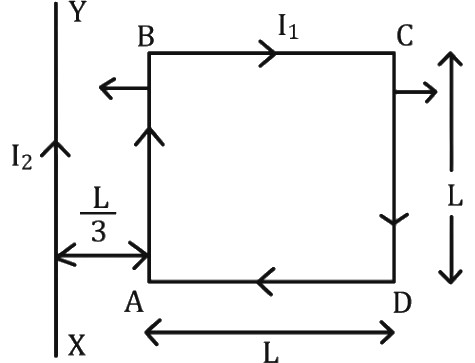
DifficultMCQ
$A$ square loop $ABCD$ of side $L$ carrying a current $I_1$ is placed at a distance $(L/3)$ from a straight conductor $XY$ carrying current $I_2$. The loop and the conductor are coplanar. The net force on the loop will be ($\mu_0$ = magnetic permeability).
A
$\frac{\mu_0 I_1 I_2}{3\pi}$
B
$\frac{3\mu_0 I_1 I_2}{8\pi}$
C
$\frac{9\mu_0 I_1 I_2}{8\pi}$
D
$\frac{3\mu_0 I_1 I_2}{4\pi}$
Solution
(C) The magnetic field $B$ at a distance $r$ from a long straight wire carrying current $I_2$ is given by $B = \frac{\mu_0 I_2}{2\pi r}$.
For the square loop, the forces on the top segment $BC$ and bottom segment $AD$ are equal and opposite, so they cancel each other out.
The force on the segment $AB$ (at distance $r_1 = L/3$) is $F_{AB} = \frac{\mu_0 I_1 I_2 L}{2\pi (L/3)} = \frac{3\mu_0 I_1 I_2}{2\pi}$ (attractive, towards the wire).
The force on the segment $CD$ (at distance $r_2 = L/3 + L = 4L/3$) is $F_{CD} = \frac{\mu_0 I_1 I_2 L}{2\pi (4L/3)} = \frac{3\mu_0 I_1 I_2}{8\pi}$ (repulsive, away from the wire).
The net force $F_{net} = F_{AB} - F_{CD} = \frac{3\mu_0 I_1 I_2}{2\pi} - \frac{3\mu_0 I_1 I_2}{8\pi} = \frac{12\mu_0 I_1 I_2 - 3\mu_0 I_1 I_2}{8\pi} = \frac{9\mu_0 I_1 I_2}{8\pi}$.
For the square loop, the forces on the top segment $BC$ and bottom segment $AD$ are equal and opposite, so they cancel each other out.
The force on the segment $AB$ (at distance $r_1 = L/3$) is $F_{AB} = \frac{\mu_0 I_1 I_2 L}{2\pi (L/3)} = \frac{3\mu_0 I_1 I_2}{2\pi}$ (attractive, towards the wire).
The force on the segment $CD$ (at distance $r_2 = L/3 + L = 4L/3$) is $F_{CD} = \frac{\mu_0 I_1 I_2 L}{2\pi (4L/3)} = \frac{3\mu_0 I_1 I_2}{8\pi}$ (repulsive, away from the wire).
The net force $F_{net} = F_{AB} - F_{CD} = \frac{3\mu_0 I_1 I_2}{2\pi} - \frac{3\mu_0 I_1 I_2}{8\pi} = \frac{12\mu_0 I_1 I_2 - 3\mu_0 I_1 I_2}{8\pi} = \frac{9\mu_0 I_1 I_2}{8\pi}$.
0 likes
View SolutionMoving Charges and Magnetism — Force on a Current Carrying Conductor · Frequently Asked Questions
1Are these Moving Charges and Magnetism questions useful for JEE and NEET?
Yes. All questions in this section are mapped to JEE Main and NEET exam patterns. Previous year questions from JEE Main, NEET, GUJCET and state-level exams are included with full solutions.
2Can I switch to Hindi or Gujarati for these questions?
Yes. Use the language tabs in the hero section or the sidebar to view the same questions and solutions in English, Hindi or Gujarati.
3How do I generate a question paper from this subtopic?
Use the Vedclass Exam Paper Generator — select the chapter and subtopic, set difficulty, and generate Sets A, B, C, D automatically. First 3 chapters of every subject are free.
Vedclass Products
For Students
Vedclass Test Series
Mock tests in real JEE/NEET style with performance analysis. 5-day free trial.
Start Free TrialFor Teachers
Exam Paper Generator
Generate Set A/B/C/D papers from this chapter in 2 minutes. 3 chapters free.
Try FreeFor Institutes
Online Exam Module
Live online exams with unlimited students, 360° analytics & white-label branding.
See DemoFor Teachers & Institutes
Generate a Moving Charges and Magnetism Exam Paper in 2 Minutes
Select subtopic & difficulty — Sets A, B, C, D auto-generated with No Repeat logic.
First 3 chapters of every subject are free — no payment required.