
A English
Young's Double Slit Experiment (YDSE) Questions in English
Class 12 Physics · Wave Optics · Young's Double Slit Experiment (YDSE)
631+
Questions
English
Language
100%
With Solutions
Showing 31 of 631 questions in English
601
MediumMCQ
In a Young's double slit experiment, the intensity of light at a point on the screen where the path difference between the interfering waves is $\lambda$ ($\lambda$ being the wavelength of light used) is $I$. The intensity at a point where the path difference is $\frac{\lambda}{4}$ will be (assume two waves have same amplitude).
A
zero
B
$I$
C
$0.5I$
D
$0.25I$
Solution
(C) The intensity of light in an interference pattern is given by $I_{res} = 4I_0 \cos^2(\frac{\phi}{2})$, where $I_0$ is the intensity of each individual wave and $\phi$ is the phase difference.
At a path difference of $\Delta x = \lambda$, the phase difference is $\phi = \frac{2\pi}{\lambda} \cdot \lambda = 2\pi$.
The intensity is $I = 4I_0 \cos^2(\frac{2\pi}{2}) = 4I_0 \cos^2(\pi) = 4I_0(1)^2 = 4I_0$.
Now, for a path difference of $\Delta x = \frac{\lambda}{4}$, the phase difference is $\phi' = \frac{2\pi}{\lambda} \cdot \frac{\lambda}{4} = \frac{\pi}{2}$.
The new intensity $I'$ is $4I_0 \cos^2(\frac{\pi/2}{2}) = 4I_0 \cos^2(\frac{\pi}{4})$.
Since $\cos(\frac{\pi}{4}) = \frac{1}{\sqrt{2}}$, we have $I' = 4I_0 (\frac{1}{\sqrt{2}})^2 = 4I_0 \cdot \frac{1}{2} = 2I_0$.
Since $I = 4I_0$, then $I_0 = \frac{I}{4}$.
Substituting this into the expression for $I'$, we get $I' = 2(\frac{I}{4}) = 0.5I$.
At a path difference of $\Delta x = \lambda$, the phase difference is $\phi = \frac{2\pi}{\lambda} \cdot \lambda = 2\pi$.
The intensity is $I = 4I_0 \cos^2(\frac{2\pi}{2}) = 4I_0 \cos^2(\pi) = 4I_0(1)^2 = 4I_0$.
Now, for a path difference of $\Delta x = \frac{\lambda}{4}$, the phase difference is $\phi' = \frac{2\pi}{\lambda} \cdot \frac{\lambda}{4} = \frac{\pi}{2}$.
The new intensity $I'$ is $4I_0 \cos^2(\frac{\pi/2}{2}) = 4I_0 \cos^2(\frac{\pi}{4})$.
Since $\cos(\frac{\pi}{4}) = \frac{1}{\sqrt{2}}$, we have $I' = 4I_0 (\frac{1}{\sqrt{2}})^2 = 4I_0 \cdot \frac{1}{2} = 2I_0$.
Since $I = 4I_0$, then $I_0 = \frac{I}{4}$.
Substituting this into the expression for $I'$, we get $I' = 2(\frac{I}{4}) = 0.5I$.
0 likes
View Solution602
MediumMCQ
In Young's double-slit experiment with monochromatic light, the maximum intensity is $4$ times the minimum intensity in the interference pattern. What is the ratio of the intensities of the two interfering waves?
A
$1/9$
B
$1/3$
C
$1/16$
D
$1/2$
Solution
(A) The maximum intensity $I_{max}$ and minimum intensity $I_{min}$ in an interference pattern are given by $I_{max} = (\sqrt{I_1} + \sqrt{I_2})^2$ and $I_{min} = (\sqrt{I_1} - \sqrt{I_2})^2$.
Given that $I_{max} = 4 I_{min}$, we have $(\sqrt{I_1} + \sqrt{I_2})^2 = 4(\sqrt{I_1} - \sqrt{I_2})^2$.
Taking the square root on both sides: $\sqrt{I_1} + \sqrt{I_2} = 2(\sqrt{I_1} - \sqrt{I_2})$.
Rearranging the terms: $\sqrt{I_1} + \sqrt{I_2} = 2\sqrt{I_1} - 2\sqrt{I_2}$.
This simplifies to $3\sqrt{I_2} = \sqrt{I_1}$.
Squaring both sides gives $9I_2 = I_1$, so the ratio $\frac{I_1}{I_2} = 9/1$.
The ratio of the intensities of the two waves is $I_2/I_1 = 1/9$.
Given that $I_{max} = 4 I_{min}$, we have $(\sqrt{I_1} + \sqrt{I_2})^2 = 4(\sqrt{I_1} - \sqrt{I_2})^2$.
Taking the square root on both sides: $\sqrt{I_1} + \sqrt{I_2} = 2(\sqrt{I_1} - \sqrt{I_2})$.
Rearranging the terms: $\sqrt{I_1} + \sqrt{I_2} = 2\sqrt{I_1} - 2\sqrt{I_2}$.
This simplifies to $3\sqrt{I_2} = \sqrt{I_1}$.
Squaring both sides gives $9I_2 = I_1$, so the ratio $\frac{I_1}{I_2} = 9/1$.
The ratio of the intensities of the two waves is $I_2/I_1 = 1/9$.
0 likes
View Solution603
EasyMCQ
In Young's double slit experiment, light of wavelength $\lambda$ passes through the double-slit and forms interference fringes on a screen $1.2 \,m$ away. If the distance between the $3^{rd}$ order maximum and the $3^{rd}$ order minimum is $0.18 \,cm$ and the slits are $0.02 \,cm$ apart, then $\lambda$ is: (in $\,nm$)
A
$1200$
B
$450$
C
$600$
D
$300$
Solution
(C) The position of the $n^{th}$ order maximum is $x_n = n \frac{D \lambda}{d}$.
The position of the $n^{th}$ order minimum is $x'_n = (n - 0.5) \frac{D \lambda}{d}$.
The distance between the $3^{rd}$ order maximum $(n=3)$ and the $3^{rd}$ order minimum $(n=3)$ is:
$\Delta x = x_3 - x'_3 = 3 \frac{D \lambda}{d} - (3 - 0.5) \frac{D \lambda}{d} = 0.5 \frac{D \lambda}{d} = \frac{\beta}{2}$.
Given $\Delta x = 0.18 \,cm = 1.8 \times 10^{-3} \,m$, $D = 1.2 \,m$, and $d = 0.02 \,cm = 2 \times 10^{-4} \,m$.
$\frac{\beta}{2} = 1.8 \times 10^{-3} \,m \implies \beta = 3.6 \times 10^{-3} \,m$.
Since $\beta = \frac{D \lambda}{d}$, we have $\lambda = \frac{\beta d}{D}$.
$\lambda = \frac{(3.6 \times 10^{-3} \,m) \times (2 \times 10^{-4} \,m)}{1.2 \,m} = 6 \times 10^{-7} \,m = 600 \,nm$.
The position of the $n^{th}$ order minimum is $x'_n = (n - 0.5) \frac{D \lambda}{d}$.
The distance between the $3^{rd}$ order maximum $(n=3)$ and the $3^{rd}$ order minimum $(n=3)$ is:
$\Delta x = x_3 - x'_3 = 3 \frac{D \lambda}{d} - (3 - 0.5) \frac{D \lambda}{d} = 0.5 \frac{D \lambda}{d} = \frac{\beta}{2}$.
Given $\Delta x = 0.18 \,cm = 1.8 \times 10^{-3} \,m$, $D = 1.2 \,m$, and $d = 0.02 \,cm = 2 \times 10^{-4} \,m$.
$\frac{\beta}{2} = 1.8 \times 10^{-3} \,m \implies \beta = 3.6 \times 10^{-3} \,m$.
Since $\beta = \frac{D \lambda}{d}$, we have $\lambda = \frac{\beta d}{D}$.
$\lambda = \frac{(3.6 \times 10^{-3} \,m) \times (2 \times 10^{-4} \,m)}{1.2 \,m} = 6 \times 10^{-7} \,m = 600 \,nm$.
0 likes
View Solution604
MediumMCQ
In Young's experiment for the interference of light, the separation between the slits is $d$ and the distance of the screen from the slits is $D$. If $D$ is increased by $0.5 \%$ and $d$ is decreased by $0.3 \%$, then for the light of a given wavelength, which one of the following is true? The fringe width.........
A
increases by $0.8 \%$
B
decreases by $0.8 \%$
C
increases by $0.2 \%$
D
decreases by $0.2 \%$
Solution
(A) The formula for fringe width in Young's double slit experiment is $\beta = \frac{\lambda D}{d}$.
Taking the logarithmic differentiation, we get the relative error formula: $\frac{\Delta \beta}{\beta} = \frac{\Delta D}{D} - \frac{\Delta d}{d}$.
Given that $D$ is increased by $0.5 \%$, so $\frac{\Delta D}{D} \times 100 = 0.5 \%$.
Given that $d$ is decreased by $0.3 \%$, so $\frac{\Delta d}{d} \times 100 = -0.3 \%$.
Substituting these values into the error formula:
$\frac{\Delta \beta}{\beta} \times 100 = 0.5 \% - (-0.3 \%) = 0.5 \% + 0.3 \% = 0.8 \%$.
Therefore, the fringe width increases by $0.8 \%$.
Taking the logarithmic differentiation, we get the relative error formula: $\frac{\Delta \beta}{\beta} = \frac{\Delta D}{D} - \frac{\Delta d}{d}$.
Given that $D$ is increased by $0.5 \%$, so $\frac{\Delta D}{D} \times 100 = 0.5 \%$.
Given that $d$ is decreased by $0.3 \%$, so $\frac{\Delta d}{d} \times 100 = -0.3 \%$.
Substituting these values into the error formula:
$\frac{\Delta \beta}{\beta} \times 100 = 0.5 \% - (-0.3 \%) = 0.5 \% + 0.3 \% = 0.8 \%$.
Therefore, the fringe width increases by $0.8 \%$.
0 likes
View Solution605
EasyMCQ
If Young's double slit experiment is performed with white light, which of the following statements will be true?
A
All the bright fringes will be coloured.
B
All the bright fringes will be white.
C
The central fringe will be white.
D
No stable interference pattern will be visible.
Solution
(C) In Young's double slit experiment, white light consists of wavelengths ranging from $4000 \ Å$ to $7000 \ Å$.
At the central position on the screen, the path difference for all wavelengths is zero.
Since the path difference is zero, all wavelengths interfere constructively at the center, resulting in a white fringe.
As we move away from the center, the path difference increases, causing different wavelengths to interfere constructively at different positions, resulting in coloured fringes.
At the central position on the screen, the path difference for all wavelengths is zero.
Since the path difference is zero, all wavelengths interfere constructively at the center, resulting in a white fringe.
As we move away from the center, the path difference increases, causing different wavelengths to interfere constructively at different positions, resulting in coloured fringes.
0 likes
View Solution606
EasyMCQ
In Young's double slit experiment, the fringe width is $\beta$. If the entire arrangement is placed in a liquid of refractive index $n$, the fringe width becomes :
A
$n \beta$
B
$\frac{\beta}{n+1}$
C
$\frac{\beta}{n-1}$
D
$\frac{\beta}{n}$
Solution
(D) The fringe width $\beta$ in Young's double slit experiment is given by the formula $\beta = \frac{\lambda D}{d}$, where $\lambda$ is the wavelength of light, $D$ is the distance between the slits and the screen, and $d$ is the distance between the two slits.
When the entire arrangement is placed in a liquid of refractive index $n$, the wavelength of light changes to $\lambda' = \frac{\lambda}{n}$.
Since $D$ and $d$ remain unchanged, the new fringe width $\beta'$ becomes $\beta' = \frac{\lambda' D}{d} = \frac{(\lambda / n) D}{d} = \frac{1}{n} \left( \frac{\lambda D}{d} \right) = \frac{\beta}{n}$.
Therefore, the new fringe width is $\frac{\beta}{n}$.
When the entire arrangement is placed in a liquid of refractive index $n$, the wavelength of light changes to $\lambda' = \frac{\lambda}{n}$.
Since $D$ and $d$ remain unchanged, the new fringe width $\beta'$ becomes $\beta' = \frac{\lambda' D}{d} = \frac{(\lambda / n) D}{d} = \frac{1}{n} \left( \frac{\lambda D}{d} \right) = \frac{\beta}{n}$.
Therefore, the new fringe width is $\frac{\beta}{n}$.
0 likes
View Solution607
MediumMCQ
$A$ beam of light consisting of wavelengths $650 \ nm$ and $550 \ nm$ illuminates the Young's double slits with separation of $2 \ mm$ such that the interference fringes are formed on a screen, placed at a distance of $1.2 \ m$ from the slits. The least distance of a point from the central maximum, where the bright fringes due to both the wavelengths coincide, is . . . . . . $\times 10^{-5} \ m$.
A
$429$
B
$550$
C
$650$
D
$380$
Solution
(A) The condition for the $n$-th bright fringe is given by $y = n \frac{\lambda D}{d}$.
For the bright fringes of both wavelengths $\lambda_1 = 650 \ nm$ and $\lambda_2 = 550 \ nm$ to coincide, their positions must be equal: $y_1 = y_2$.
$n_1 \frac{\lambda_1 D}{d} = n_2 \frac{\lambda_2 D}{d}$.
$\frac{n_1}{n_2} = \frac{\lambda_2}{\lambda_1} = \frac{550}{650} = \frac{11}{13}$.
Since we want the least distance, we take the smallest integers $n_1 = 11$ and $n_2 = 13$.
Substituting $n_1 = 11$ into the position formula:
$y = 11 \times \frac{650 \times 10^{-9} \times 1.2}{2 \times 10^{-3}}$.
$y = 11 \times 325 \times 1.2 \times 10^{-6} = 4290 \times 10^{-6} \ m = 429 \times 10^{-5} \ m$.
For the bright fringes of both wavelengths $\lambda_1 = 650 \ nm$ and $\lambda_2 = 550 \ nm$ to coincide, their positions must be equal: $y_1 = y_2$.
$n_1 \frac{\lambda_1 D}{d} = n_2 \frac{\lambda_2 D}{d}$.
$\frac{n_1}{n_2} = \frac{\lambda_2}{\lambda_1} = \frac{550}{650} = \frac{11}{13}$.
Since we want the least distance, we take the smallest integers $n_1 = 11$ and $n_2 = 13$.
Substituting $n_1 = 11$ into the position formula:
$y = 11 \times \frac{650 \times 10^{-9} \times 1.2}{2 \times 10^{-3}}$.
$y = 11 \times 325 \times 1.2 \times 10^{-6} = 4290 \times 10^{-6} \ m = 429 \times 10^{-5} \ m$.
0 likes
View Solution608
MediumMCQ
In the $Young's$ double slit experiment, the intensity produced by each of the individual slits is $I_0$. The distance between the two slits is $2 \ mm$. The distance of the screen from the slits is $10 \ m$. The wavelength of light is $6000 \ \mathring{A}$. What is the intensity of light on the screen in front of one of the slits?
A
$2 I_0$
B
$I_0$
C
$\frac{I_0}{2}$
D
$4 I_0$
Solution
(B) Given: Slit separation $d = 2 \ mm = 2 \times 10^{-3} \ m$, Screen distance $D = 10 \ m$, Wavelength $\lambda = 6000 \ \mathring{A} = 6 \times 10^{-7} \ m$.
In $Young's$ double slit experiment, the intensity at any point on the screen is given by $I = 4 I_0 \cos^2(\frac{\phi}{2})$, where $\phi$ is the phase difference.
The path difference $\Delta x$ at a position $y$ on the screen is $\Delta x = \frac{yd}{D}$.
For a point in front of one of the slits, $y = \frac{d}{2}$.
Thus, $\Delta x = \frac{(d/2)d}{D} = \frac{d^2}{2D}$.
Substituting the values: $\Delta x = \frac{(2 \times 10^{-3})^2}{2 \times 10} = \frac{4 \times 10^{-6}}{20} = 2 \times 10^{-7} \ m$.
The phase difference $\phi = \frac{2\pi}{\lambda} \Delta x = \frac{2\pi}{6 \times 10^{-7}} \times 2 \times 10^{-7} = \frac{2\pi}{3}$.
The intensity $I = I_{max} \cos^2(\frac{\phi}{2}) = (4 I_0) \cos^2(\frac{2\pi/3}{2}) = 4 I_0 \cos^2(\frac{\pi}{3})$.
Since $\cos(\frac{\pi}{3}) = \frac{1}{2}$, we have $I = 4 I_0 (\frac{1}{2})^2 = 4 I_0 \times \frac{1}{4} = I_0$.
In $Young's$ double slit experiment, the intensity at any point on the screen is given by $I = 4 I_0 \cos^2(\frac{\phi}{2})$, where $\phi$ is the phase difference.
The path difference $\Delta x$ at a position $y$ on the screen is $\Delta x = \frac{yd}{D}$.
For a point in front of one of the slits, $y = \frac{d}{2}$.
Thus, $\Delta x = \frac{(d/2)d}{D} = \frac{d^2}{2D}$.
Substituting the values: $\Delta x = \frac{(2 \times 10^{-3})^2}{2 \times 10} = \frac{4 \times 10^{-6}}{20} = 2 \times 10^{-7} \ m$.
The phase difference $\phi = \frac{2\pi}{\lambda} \Delta x = \frac{2\pi}{6 \times 10^{-7}} \times 2 \times 10^{-7} = \frac{2\pi}{3}$.
The intensity $I = I_{max} \cos^2(\frac{\phi}{2}) = (4 I_0) \cos^2(\frac{2\pi/3}{2}) = 4 I_0 \cos^2(\frac{\pi}{3})$.
Since $\cos(\frac{\pi}{3}) = \frac{1}{2}$, we have $I = 4 I_0 (\frac{1}{2})^2 = 4 I_0 \times \frac{1}{4} = I_0$.
0 likes
View Solution609
DifficultMCQ
Given below are two statements:
Statement $I$: In a Young's double slit experiment, the angular separation of fringes will increase as the screen is moved away from the plane of the slits.
Statement $II$: In a Young's double slit experiment, the angular separation of fringes will increase when a monochromatic source is replaced by another monochromatic source of higher wavelength.
In the light of the above statements, choose the correct answer from the options given below:
Statement $I$: In a Young's double slit experiment, the angular separation of fringes will increase as the screen is moved away from the plane of the slits.
Statement $II$: In a Young's double slit experiment, the angular separation of fringes will increase when a monochromatic source is replaced by another monochromatic source of higher wavelength.
In the light of the above statements, choose the correct answer from the options given below:
A
Both Statement $I$ and Statement $II$ are true
B
Both Statement $I$ and Statement $II$ are false
C
Statement $I$ is false but Statement $II$ is true
D
Statement $I$ is true but Statement $II$ is false
Solution
(C) The angular fringe width $\theta$ in a Young's double slit experiment is given by the formula $\theta = \frac{\lambda}{d}$, where $\lambda$ is the wavelength of the light used and $d$ is the distance between the two slits.
Statement $I$: The angular fringe width depends only on the wavelength $\lambda$ and the slit separation $d$. It is independent of the distance $D$ between the screen and the slits. Therefore, moving the screen away does not change the angular separation. Thus, Statement $I$ is false.
Statement $II$: Since $\theta = \frac{\lambda}{d}$, the angular fringe width is directly proportional to the wavelength $\lambda$. If the source is replaced by one with a higher wavelength, $\theta$ will increase. Thus, Statement $II$ is true.
Conclusion: Statement $I$ is false and Statement $II$ is true.
Statement $I$: The angular fringe width depends only on the wavelength $\lambda$ and the slit separation $d$. It is independent of the distance $D$ between the screen and the slits. Therefore, moving the screen away does not change the angular separation. Thus, Statement $I$ is false.
Statement $II$: Since $\theta = \frac{\lambda}{d}$, the angular fringe width is directly proportional to the wavelength $\lambda$. If the source is replaced by one with a higher wavelength, $\theta$ will increase. Thus, Statement $II$ is true.
Conclusion: Statement $I$ is false and Statement $II$ is true.
0 likes
View Solution610
MediumMCQ
In two separate Young's double-slit experimental set-ups, two monochromatic light sources of different wavelengths are used to get fringes of equal width. The ratios of the slit separations and that of the wavelengths of light used are $2:1$ and $1:2$ respectively. The corresponding ratio of the distances between the slits and the respective screens $(D_1 / D_2)$ is . . . . . . .
A
$1$
B
$2$
C
$4$
D
$8$
Solution
(C) The fringe width $\beta$ in a Young's double-slit experiment is given by $\beta = \frac{D\lambda}{d}$.
Given that the fringe widths are equal, we have $\beta_1 = \beta_2$.
Therefore, $\frac{D_1 \lambda_1}{d_1} = \frac{D_2 \lambda_2}{d_2}$.
Rearranging the terms to find the ratio $\frac{D_1}{D_2}$, we get $\frac{D_1}{D_2} = \frac{\lambda_2}{\lambda_1} \times \frac{d_1}{d_2}$.
Given the ratios of slit separations $\frac{d_1}{d_2} = 2$ and the ratio of wavelengths $\frac{\lambda_1}{\lambda_2} = \frac{1}{2}$, which implies $\frac{\lambda_2}{\lambda_1} = 2$.
Substituting these values, we get $\frac{D_1}{D_2} = 2 \times 2 = 4$.
Given that the fringe widths are equal, we have $\beta_1 = \beta_2$.
Therefore, $\frac{D_1 \lambda_1}{d_1} = \frac{D_2 \lambda_2}{d_2}$.
Rearranging the terms to find the ratio $\frac{D_1}{D_2}$, we get $\frac{D_1}{D_2} = \frac{\lambda_2}{\lambda_1} \times \frac{d_1}{d_2}$.
Given the ratios of slit separations $\frac{d_1}{d_2} = 2$ and the ratio of wavelengths $\frac{\lambda_1}{\lambda_2} = \frac{1}{2}$, which implies $\frac{\lambda_2}{\lambda_1} = 2$.
Substituting these values, we get $\frac{D_1}{D_2} = 2 \times 2 = 4$.
0 likes
View Solution611
DifficultMCQ
In Young's double slit experiment, the slits are separated by $0.54$ mm and the screen is placed $1.8$ m away. The distance between the central bright fringe and the sixth bright fringe is measured to be $1.2$ cm. Determine the wavelength of light used in the experiment.
A
$5000$ $\mathring{A}$
B
$600$ nm
C
$8000$ nm
D
$800$ nm
Solution
(B) Given: Slit separation $d = 0.54$ mm $= 0.54 \times 10^{-3}$ m.
Distance of screen $D = 1.8$ m.
Distance of the $n^{th}$ bright fringe from the central fringe is given by $y_n = \frac{n\lambda D}{d}$.
For the $6^{th}$ bright fringe, $n = 6$ and $y_6 = 1.2$ cm $= 1.2 \times 10^{-2}$ m.
Rearranging the formula for wavelength $\lambda$: $\lambda = \frac{y_n d}{n D}$.
Substituting the values: $\lambda = \frac{1.2 \times 10^{-2} \times 0.54 \times 10^{-3}}{6 \times 1.8}$.
$\lambda = \frac{0.648 \times 10^{-5}}{10.8} = 0.06 \times 10^{-5}$ m.
$\lambda = 600 \times 10^{-9}$ m $= 600$ nm.
Distance of screen $D = 1.8$ m.
Distance of the $n^{th}$ bright fringe from the central fringe is given by $y_n = \frac{n\lambda D}{d}$.
For the $6^{th}$ bright fringe, $n = 6$ and $y_6 = 1.2$ cm $= 1.2 \times 10^{-2}$ m.
Rearranging the formula for wavelength $\lambda$: $\lambda = \frac{y_n d}{n D}$.
Substituting the values: $\lambda = \frac{1.2 \times 10^{-2} \times 0.54 \times 10^{-3}}{6 \times 1.8}$.
$\lambda = \frac{0.648 \times 10^{-5}}{10.8} = 0.06 \times 10^{-5}$ m.
$\lambda = 600 \times 10^{-9}$ m $= 600$ nm.
0 likes
View Solution612
DifficultMCQ
In a Young's double slit experiment, the slits are separated by $0.2 \text{ mm}$ and the screen is placed $2.0 \text{ m}$ away. The distance between the central bright fringe and the third bright fringe is measured to be $1.5 \text{ cm}$. Determine the wavelength of light used in the experiment.
A
$4200 \mathring{A}$
B
$5000 \mathring{A}$
C
$4600 \mathring{A}$
D
$6000 \mathring{A}$
Solution
(B) Given: Slit separation $d = 0.2 \text{ mm} = 2 \times 10^{-4} \text{ m}$.
Distance to screen $D = 2.0 \text{ m}$.
Order of fringe $n = 3$.
Distance of $n^{th}$ bright fringe $y_n = 1.5 \text{ cm} = 1.5 \times 10^{-2} \text{ m}$.
The formula for the position of the $n^{th}$ bright fringe is $y_n = \frac{n \lambda D}{d}$.
Rearranging for wavelength $\lambda$: $\lambda = \frac{y_n d}{n D}$.
Substituting the values: $\lambda = \frac{1.5 \times 10^{-2} \times 2 \times 10^{-4}}{3 \times 2.0}$.
$\lambda = \frac{3 \times 10^{-6}}{6} = 0.5 \times 10^{-6} \text{ m}$.
Converting to $ \mathring{A}$s: $\lambda = 0.5 \times 10^{-6} \times 10^{10} \mathring{A} = 5000 \mathring{A}$.
Thus, the wavelength of light used is $5000 \mathring{A}$.
Distance to screen $D = 2.0 \text{ m}$.
Order of fringe $n = 3$.
Distance of $n^{th}$ bright fringe $y_n = 1.5 \text{ cm} = 1.5 \times 10^{-2} \text{ m}$.
The formula for the position of the $n^{th}$ bright fringe is $y_n = \frac{n \lambda D}{d}$.
Rearranging for wavelength $\lambda$: $\lambda = \frac{y_n d}{n D}$.
Substituting the values: $\lambda = \frac{1.5 \times 10^{-2} \times 2 \times 10^{-4}}{3 \times 2.0}$.
$\lambda = \frac{3 \times 10^{-6}}{6} = 0.5 \times 10^{-6} \text{ m}$.
Converting to $ \mathring{A}$s: $\lambda = 0.5 \times 10^{-6} \times 10^{10} \mathring{A} = 5000 \mathring{A}$.
Thus, the wavelength of light used is $5000 \mathring{A}$.
1 likes
View Solution613
MediumMCQ
In Young's double slit experiment, the fringe width of the interference pattern produced on the screen is $2.4 \text{ } \mu\text{m}$. If the experiment is carried out in another medium having refractive index $1.2$, the fringe width will be . . . . . . $\mu\text{m}$.
A
$1.2$
B
$2$
C
$2.4$
D
$2.88$
Solution
(B) The fringe width $\beta$ in a medium of refractive index $\mu$ is given by the formula $\beta' = \frac{\beta}{\mu}$.
Given the initial fringe width $\beta = 2.4 \text{ } \mu\text{m}$ and the refractive index of the new medium $\mu = 1.2$.
Substituting these values into the formula, we get $\beta' = \frac{2.4}{1.2} = 2 \text{ } \mu\text{m}$.
Therefore, the new fringe width is $2 \text{ } \mu\text{m}$.
Given the initial fringe width $\beta = 2.4 \text{ } \mu\text{m}$ and the refractive index of the new medium $\mu = 1.2$.
Substituting these values into the formula, we get $\beta' = \frac{2.4}{1.2} = 2 \text{ } \mu\text{m}$.
Therefore, the new fringe width is $2 \text{ } \mu\text{m}$.
0 likes
View Solution614
DifficultMCQ
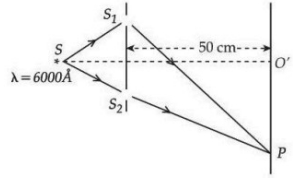
In a Young's double-slit experiment, the wavelength of incident light is $6000 \mathring{A}$, the separation between slits $S_1$ and $S_2$ is $5 \text{ cm}$, and the distance between the slits plane and the screen is $50 \text{ cm}$, as shown in the figure below. If the resultant intensity at $P$ is equal to the intensity due to an individual slit, the path difference between the interfering waves is . . . . . . $\mathring{A}$.
A
$4000$
B
$3000$
C
$2000$
D
$1000$
Solution
(C) Let $I_s$ be the intensity due to an individual slit.
The resultant intensity $I_R$ is given by the formula: $I_R = I_s + I_s + 2 \sqrt{I_s I_s} \cos \phi = 2I_s + 2I_s \cos \phi = 2I_s(1 + \cos \phi) = 4I_s \cos^2(\phi/2)$.
Given that the resultant intensity $I_R$ at point $P$ is equal to the intensity due to an individual slit $(I_s)$, we have:
$4I_s \cos^2(\phi/2) = I_s$
$\cos^2(\phi/2) = 1/4$
$\cos(\phi/2) = 1/2$
This implies $\phi/2 = \pi/3$, so the phase difference $\phi = 2\pi/3$.
The path difference $\Delta x$ is related to the phase difference $\phi$ by the formula $\Delta x = (\lambda / 2\pi) \phi$.
Substituting the given values: $\Delta x = (6000 \mathring{A} / 2\pi) \times (2\pi/3) = 2000 \mathring{A}$.
The resultant intensity $I_R$ is given by the formula: $I_R = I_s + I_s + 2 \sqrt{I_s I_s} \cos \phi = 2I_s + 2I_s \cos \phi = 2I_s(1 + \cos \phi) = 4I_s \cos^2(\phi/2)$.
Given that the resultant intensity $I_R$ at point $P$ is equal to the intensity due to an individual slit $(I_s)$, we have:
$4I_s \cos^2(\phi/2) = I_s$
$\cos^2(\phi/2) = 1/4$
$\cos(\phi/2) = 1/2$
This implies $\phi/2 = \pi/3$, so the phase difference $\phi = 2\pi/3$.
The path difference $\Delta x$ is related to the phase difference $\phi$ by the formula $\Delta x = (\lambda / 2\pi) \phi$.
Substituting the given values: $\Delta x = (6000 \mathring{A} / 2\pi) \times (2\pi/3) = 2000 \mathring{A}$.
0 likes
View Solution615
MediumMCQ
In a Young's double slit experiment, the intensity at some point on the screen is found to be $\frac{3}{4}$ times of the maximum intensity of the interference pattern. The path difference between the interfering waves at this point is $\frac{\lambda}{x}$, where $\lambda$ is the wavelength of the incident light. The value of $x$ is . . . . . . .
A
$3$
B
$4$
C
$6$
D
$8$
Solution
(C) The intensity $I$ at any point in an interference pattern is given by $I = I_{max} \cos^2(\frac{\phi}{2})$, where $\phi$ is the phase difference.
Given $I = \frac{3}{4} I_{max}$, we have $\frac{3}{4} I_{max} = I_{max} \cos^2(\frac{\phi}{2})$.
This simplifies to $\cos^2(\frac{\phi}{2}) = \frac{3}{4}$, which implies $\cos(\frac{\phi}{2}) = \frac{\sqrt{3}}{2}$.
Therefore, $\frac{\phi}{2} = \frac{\pi}{6}$, which gives the phase difference $\phi = \frac{\pi}{3}$.
The relationship between path difference $\Delta x$ and phase difference $\phi$ is $\Delta x = \frac{\lambda}{2\pi} \phi$.
Substituting $\phi = \frac{\pi}{3}$, we get $\Delta x = \frac{\lambda}{2\pi} \cdot \frac{\pi}{3} = \frac{\lambda}{6}$.
Comparing this with $\frac{\lambda}{x}$, we find $x = 6$.
Given $I = \frac{3}{4} I_{max}$, we have $\frac{3}{4} I_{max} = I_{max} \cos^2(\frac{\phi}{2})$.
This simplifies to $\cos^2(\frac{\phi}{2}) = \frac{3}{4}$, which implies $\cos(\frac{\phi}{2}) = \frac{\sqrt{3}}{2}$.
Therefore, $\frac{\phi}{2} = \frac{\pi}{6}$, which gives the phase difference $\phi = \frac{\pi}{3}$.
The relationship between path difference $\Delta x$ and phase difference $\phi$ is $\Delta x = \frac{\lambda}{2\pi} \phi$.
Substituting $\phi = \frac{\pi}{3}$, we get $\Delta x = \frac{\lambda}{2\pi} \cdot \frac{\pi}{3} = \frac{\lambda}{6}$.
Comparing this with $\frac{\lambda}{x}$, we find $x = 6$.
0 likes
View Solution616
MediumMCQ
In Young's double slit experiment, using monochromatic light of wavelength $\lambda$, the intensity of light at a point on the screen where the path difference is $\frac{\lambda}{3}$ is $K$ units. The intensity of light at a point where the path difference is $\lambda$ will be:
A
$K$
B
$2K$
C
$4K$
D
$K/4$
Solution
(C) The intensity of light in Young's double slit experiment is given by $I = I_{max} \cos^2(\frac{\phi}{2})$, where $\phi$ is the phase difference.
Phase difference $\phi$ is related to path difference $\Delta x$ by $\phi = \frac{2\pi}{\lambda} \Delta x$.
For path difference $\Delta x = \frac{\lambda}{3}$, the phase difference is $\phi = \frac{2\pi}{\lambda} \times \frac{\lambda}{3} = \frac{2\pi}{3}$.
The intensity at this point is $I_1 = I_{max} \cos^2(\frac{2\pi/3}{2}) = I_{max} \cos^2(\frac{\pi}{3}) = I_{max} (\frac{1}{2})^2 = \frac{I_{max}}{4}$.
Given $I_1 = K$, we have $K = \frac{I_{max}}{4}$, which implies $I_{max} = 4K$.
For path difference $\Delta x = \lambda$, the phase difference is $\phi = \frac{2\pi}{\lambda} \times \lambda = 2\pi$.
The intensity at this point is $I_2 = I_{max} \cos^2(\frac{2\pi}{2}) = I_{max} \cos^2(\pi) = I_{max} (-1)^2 = I_{max}$.
Since $I_{max} = 4K$, the intensity at path difference $\lambda$ is $4K$.
Phase difference $\phi$ is related to path difference $\Delta x$ by $\phi = \frac{2\pi}{\lambda} \Delta x$.
For path difference $\Delta x = \frac{\lambda}{3}$, the phase difference is $\phi = \frac{2\pi}{\lambda} \times \frac{\lambda}{3} = \frac{2\pi}{3}$.
The intensity at this point is $I_1 = I_{max} \cos^2(\frac{2\pi/3}{2}) = I_{max} \cos^2(\frac{\pi}{3}) = I_{max} (\frac{1}{2})^2 = \frac{I_{max}}{4}$.
Given $I_1 = K$, we have $K = \frac{I_{max}}{4}$, which implies $I_{max} = 4K$.
For path difference $\Delta x = \lambda$, the phase difference is $\phi = \frac{2\pi}{\lambda} \times \lambda = 2\pi$.
The intensity at this point is $I_2 = I_{max} \cos^2(\frac{2\pi}{2}) = I_{max} \cos^2(\pi) = I_{max} (-1)^2 = I_{max}$.
Since $I_{max} = 4K$, the intensity at path difference $\lambda$ is $4K$.
0 likes
View Solution617
DifficultMCQ
In Young's double slit experiment, in an interference pattern, a minimum is observed exactly in front of one slit. The distance between the two coherent sources is $d$ and $D$ is the distance between the source and the screen. The possible wavelengths used are inversely proportional to
A
$d^2/D, d^2/3D, d^2/5D, \dots$
B
$d^2/D, d^2/2D, d^2/3D, \dots$
C
$d^2/D, d^2/3D, d^2/5D, \dots$ (Wait, let's re-evaluate)
D
$d^2/D, d^2/2D, d^2/4D, \dots$
Solution
(A) In Young's double slit experiment, the path difference $\Delta x$ at a point $y$ on the screen is given by $\Delta x = \frac{yd}{D}$.
For a point exactly in front of one slit, $y = d/2$.
Therefore, the path difference is $\Delta x = \frac{(d/2)d}{D} = \frac{d^2}{2D}$.
For a minimum (destructive interference) to occur, the path difference must be an odd multiple of $\lambda/2$, i.e.,$\Delta x = (2n-1)\frac{\lambda}{2}$ where $n = 1, 2, 3, \dots$.
Equating the two expressions: $\frac{d^2}{2D} = (2n-1)\frac{\lambda}{2}$.
Solving for $\lambda$: $\lambda = \frac{d^2}{D(2n-1)}$.
Thus, $\lambda \propto \frac{1}{2n-1}$.
For $n=1, 2, 3, \dots$, the values of $(2n-1)$ are $1, 3, 5, \dots$.
Therefore, the possible wavelengths are proportional to $\frac{d^2}{D}, \frac{d^2}{3D}, \frac{d^2}{5D}, \dots$.
For a point exactly in front of one slit, $y = d/2$.
Therefore, the path difference is $\Delta x = \frac{(d/2)d}{D} = \frac{d^2}{2D}$.
For a minimum (destructive interference) to occur, the path difference must be an odd multiple of $\lambda/2$, i.e.,$\Delta x = (2n-1)\frac{\lambda}{2}$ where $n = 1, 2, 3, \dots$.
Equating the two expressions: $\frac{d^2}{2D} = (2n-1)\frac{\lambda}{2}$.
Solving for $\lambda$: $\lambda = \frac{d^2}{D(2n-1)}$.
Thus, $\lambda \propto \frac{1}{2n-1}$.
For $n=1, 2, 3, \dots$, the values of $(2n-1)$ are $1, 3, 5, \dots$.
Therefore, the possible wavelengths are proportional to $\frac{d^2}{D}, \frac{d^2}{3D}, \frac{d^2}{5D}, \dots$.
0 likes
View Solution618
DifficultMCQ
In Young's double slit experiment, the angular width of a fringe is found to be $0.2^\circ$ on a screen placed $1 \text{ m}$ away. The wavelength of light used is $600 \text{ nm}$. If the entire apparatus is immersed in water of refractive index $4/3$, the angular width of the fringe will be: (in $^\circ$)
A
$0.10$
B
$0.15$
C
$0.20$
D
$0.25$
Solution
(B) The angular width of a fringe in Young's double slit experiment is given by the formula $\theta = \frac{\lambda}{d}$, where $\lambda$ is the wavelength of light and $d$ is the slit separation.
When the apparatus is immersed in a medium of refractive index $\mu$, the wavelength of light changes to $\lambda' = \frac{\lambda}{\mu}$.
Therefore, the new angular width $\theta'$ is given by $\theta' = \frac{\lambda'}{d} = \frac{\lambda}{\mu d} = \frac{\theta}{\mu}$.
Given $\theta = 0.2^\circ$ and $\mu = 4/3$.
Substituting the values, we get $\theta' = \frac{0.2}{4/3} = 0.2 \times \frac{3}{4} = 0.15^\circ$.
Thus, the new angular width of the fringe is $0.15^\circ$.
When the apparatus is immersed in a medium of refractive index $\mu$, the wavelength of light changes to $\lambda' = \frac{\lambda}{\mu}$.
Therefore, the new angular width $\theta'$ is given by $\theta' = \frac{\lambda'}{d} = \frac{\lambda}{\mu d} = \frac{\theta}{\mu}$.
Given $\theta = 0.2^\circ$ and $\mu = 4/3$.
Substituting the values, we get $\theta' = \frac{0.2}{4/3} = 0.2 \times \frac{3}{4} = 0.15^\circ$.
Thus, the new angular width of the fringe is $0.15^\circ$.
0 likes
View Solution619
DifficultMCQ
In Young's double slit experiment, two slits $S_1$ and $S_2$ are $d$ distance apart and the separation from slits to screen is $D$. If two transparent slabs of equal thickness $t = 0.1 \text{ mm}$ but refractive indices $\mu_1 = 1.51$ and $\mu_2 = 1.55$ are introduced in the path of the beam $(\lambda = 4000 \text{ Å})$ from $S_1$ and $S_2$ respectively, the central bright fringe will shift by how many fringes?
A
$5$
B
$10$
C
$15$
D
$20$
Solution
(B) The path difference introduced by the slabs is given by $\Delta x = (\mu_2 - 1)t - (\mu_1 - 1)t = (\mu_2 - \mu_1)t$.
Substituting the given values: $\Delta x = (1.55 - 1.51) \times 0.1 \text{ mm} = 0.04 \times 0.1 \text{ mm} = 0.004 \text{ mm} = 4 \times 10^{-6} \text{ m}$.
The shift in the central fringe in terms of fringe width $\beta$ is given by $n = \frac{\Delta x}{\lambda}$.
Given $\lambda = 4000 \text{ Å} = 4000 \times 10^{-10} \text{ m} = 4 \times 10^{-7} \text{ m}$.
Therefore, $n = \frac{4 \times 10^{-6}}{4 \times 10^{-7}} = 10$.
Thus, the central bright fringe shifts by $10$ fringes.
Substituting the given values: $\Delta x = (1.55 - 1.51) \times 0.1 \text{ mm} = 0.04 \times 0.1 \text{ mm} = 0.004 \text{ mm} = 4 \times 10^{-6} \text{ m}$.
The shift in the central fringe in terms of fringe width $\beta$ is given by $n = \frac{\Delta x}{\lambda}$.
Given $\lambda = 4000 \text{ Å} = 4000 \times 10^{-10} \text{ m} = 4 \times 10^{-7} \text{ m}$.
Therefore, $n = \frac{4 \times 10^{-6}}{4 \times 10^{-7}} = 10$.
Thus, the central bright fringe shifts by $10$ fringes.
0 likes
View Solution620
DifficultMCQ
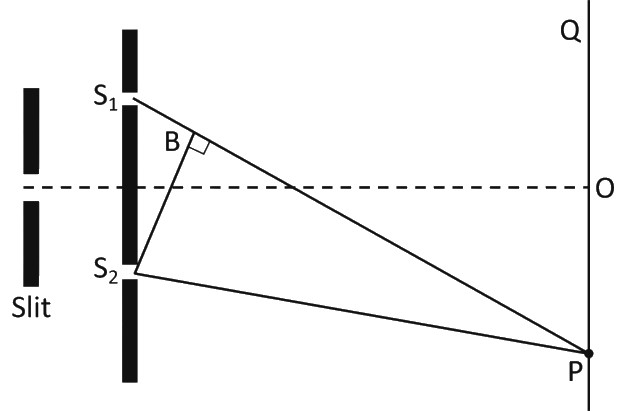
In Young's double slit experiment, the following figure shows that $Q$ is the position of the second bright fringe on the right side of point $O$. $P$ is the eleventh bright fringe on the other side measured from point $Q$. If the wavelength of light used is $6000 \text{ Å}$, then what will be the value of $S_1B$?
A
$3.142 \times 10^{-7} \text{ m}$
B
$3.138 \times 10^{-7} \text{ m}$
C
$6.6 \times 10^{-6} \text{ m}$
D
$5.4 \times 10^{-6} \text{ m}$
Solution
(D) In Young's double slit experiment, the path difference $\Delta x$ at any point $P$ is given by $S_2P - S_1P = d \sin \theta$. From the geometry of the figure, $S_2P - S_1P = S_2B = \Delta x$.
For a bright fringe, the path difference is $\Delta x = n\lambda$, where $n$ is the order of the fringe.
Point $Q$ is the $2^{nd}$ bright fringe on one side of the central maximum $O$, so its position is $y_Q = 2\beta$, where $\beta$ is the fringe width.
Point $P$ is the $11^{th}$ bright fringe on the other side of $Q$. The distance of $P$ from $O$ is $y_P = (11 - 2)\beta = 9\beta$ on the opposite side of $O$.
Thus, the path difference at point $P$ is $\Delta x = 9\lambda$.
Given $\lambda = 6000 \text{ Å} = 6000 \times 10^{-10} \text{ m} = 6 \times 10^{-7} \text{ m}$.
Therefore, $S_2B = 9 \times 6 \times 10^{-7} \text{ m} = 54 \times 10^{-7} \text{ m} = 5.4 \times 10^{-6} \text{ m}$.
For a bright fringe, the path difference is $\Delta x = n\lambda$, where $n$ is the order of the fringe.
Point $Q$ is the $2^{nd}$ bright fringe on one side of the central maximum $O$, so its position is $y_Q = 2\beta$, where $\beta$ is the fringe width.
Point $P$ is the $11^{th}$ bright fringe on the other side of $Q$. The distance of $P$ from $O$ is $y_P = (11 - 2)\beta = 9\beta$ on the opposite side of $O$.
Thus, the path difference at point $P$ is $\Delta x = 9\lambda$.
Given $\lambda = 6000 \text{ Å} = 6000 \times 10^{-10} \text{ m} = 6 \times 10^{-7} \text{ m}$.
Therefore, $S_2B = 9 \times 6 \times 10^{-7} \text{ m} = 54 \times 10^{-7} \text{ m} = 5.4 \times 10^{-6} \text{ m}$.
0 likes
View Solution621
DifficultMCQ
$A$ double slit experiment is immersed in water of refractive index $n = 1.33$. The slit separation is $d = 1 \text{ mm}$, and the distance between the slit and the screen is $D = 1.33 \text{ m}$. The slits are illuminated by light of wavelength $\lambda_0 = 6300 \text{ Å}$ in vacuum. The fringe width is:
A
$4.9 \times 10^{-4} \text{ m}$
B
$6.3 \times 10^{-4} \text{ m}$
C
$8.6 \times 10^{-4} \text{ m}$
D
$5.8 \times 10^{-4} \text{ m}$
Solution
(B) The fringe width $\beta$ in a medium of refractive index $n$ is given by the formula: $\beta = \frac{\lambda_n D}{d}$, where $\lambda_n = \frac{\lambda_0}{n}$.
Given:
$\lambda_0 = 6300 \text{ Å} = 6300 \times 10^{-10} \text{ m}$
$n = 1.33$
$D = 1.33 \text{ m}$
$d = 1 \text{ mm} = 10^{-3} \text{ m}$
Substituting the values:
$\lambda_n = \frac{6300 \times 10^{-10}}{1.33} \text{ m}$
$\beta = \frac{(6300 \times 10^{-10} / 1.33) \times 1.33}{10^{-3}}$
$\beta = \frac{6300 \times 10^{-10}}{10^{-3}} = 6300 \times 10^{-7} \text{ m} = 6.3 \times 10^{-4} \text{ m}$.
Given:
$\lambda_0 = 6300 \text{ Å} = 6300 \times 10^{-10} \text{ m}$
$n = 1.33$
$D = 1.33 \text{ m}$
$d = 1 \text{ mm} = 10^{-3} \text{ m}$
Substituting the values:
$\lambda_n = \frac{6300 \times 10^{-10}}{1.33} \text{ m}$
$\beta = \frac{(6300 \times 10^{-10} / 1.33) \times 1.33}{10^{-3}}$
$\beta = \frac{6300 \times 10^{-10}}{10^{-3}} = 6300 \times 10^{-7} \text{ m} = 6.3 \times 10^{-4} \text{ m}$.
0 likes
View Solution622
DifficultMCQ
In Young's double slit experiment, the distance between the slits is $3 \text{ mm}$ and the slits are $2 \text{ m}$ away from the screen. Two interference patterns can be obtained on the screen due to light of wavelength $480 \text{ nm}$ and $600 \text{ nm}$ respectively. The separation on the screen between the $5^{th}$ order bright fringes of the two interference patterns is
A
$2 \times 10^{-4} \text{ m}$
B
$1 \times 10^{-4} \text{ m}$
C
$8 \times 10^{-4} \text{ m}$
D
$4 \times 10^{-4} \text{ m}$
Solution
(D) The position of the $n^{th}$ order bright fringe in Young's double slit experiment is given by $y_n = \frac{n \lambda D}{d}$.
Given:
Slit separation $d = 3 \text{ mm} = 3 \times 10^{-3} \text{ m}$.
Distance to screen $D = 2 \text{ m}$.
Order $n = 5$.
Wavelengths $\lambda_1 = 480 \text{ nm} = 480 \times 10^{-9} \text{ m}$ and $\lambda_2 = 600 \text{ nm} = 600 \times 10^{-9} \text{ m}$.
The position of the $5^{th}$ bright fringe for $\lambda_1$ is $y_1 = \frac{5 \times 480 \times 10^{-9} \times 2}{3 \times 10^{-3}} = 1600 \times 10^{-6} \text{ m} = 1.6 \times 10^{-3} \text{ m}$.
The position of the $5^{th}$ bright fringe for $\lambda_2$ is $y_2 = \frac{5 \times 600 \times 10^{-9} \times 2}{3 \times 10^{-3}} = 2000 \times 10^{-6} \text{ m} = 2.0 \times 10^{-3} \text{ m}$.
The separation between the two fringes is $\Delta y = |y_2 - y_1| = (2.0 - 1.6) \times 10^{-3} \text{ m} = 0.4 \times 10^{-3} \text{ m} = 4 \times 10^{-4} \text{ m}$.
Given:
Slit separation $d = 3 \text{ mm} = 3 \times 10^{-3} \text{ m}$.
Distance to screen $D = 2 \text{ m}$.
Order $n = 5$.
Wavelengths $\lambda_1 = 480 \text{ nm} = 480 \times 10^{-9} \text{ m}$ and $\lambda_2 = 600 \text{ nm} = 600 \times 10^{-9} \text{ m}$.
The position of the $5^{th}$ bright fringe for $\lambda_1$ is $y_1 = \frac{5 \times 480 \times 10^{-9} \times 2}{3 \times 10^{-3}} = 1600 \times 10^{-6} \text{ m} = 1.6 \times 10^{-3} \text{ m}$.
The position of the $5^{th}$ bright fringe for $\lambda_2$ is $y_2 = \frac{5 \times 600 \times 10^{-9} \times 2}{3 \times 10^{-3}} = 2000 \times 10^{-6} \text{ m} = 2.0 \times 10^{-3} \text{ m}$.
The separation between the two fringes is $\Delta y = |y_2 - y_1| = (2.0 - 1.6) \times 10^{-3} \text{ m} = 0.4 \times 10^{-3} \text{ m} = 4 \times 10^{-4} \text{ m}$.
0 likes
View Solution623
DifficultMCQ
The ratio of intensities at two points on the screen in Young's double slit experiment when waves from the two slits have a path difference of $0$ and $\lambda/4$ ($\lambda$ is the wavelength of light used) $(\cos 0^\circ = 1, \cos \pi/2 = 0)$.
A
$1 : 2$
B
$2 : 1$
C
$1 : 4$
D
$4 : 1$
Solution
(B) The intensity $I$ at any point in Young's double slit experiment is given by $I = 4I_0 \cos^2(\phi/2)$, where $\phi$ is the phase difference.
Phase difference $\phi$ is related to path difference $\Delta x$ by $\phi = (2\pi/\lambda) \Delta x$.
For the first point, path difference $\Delta x_1 = 0$, so $\phi_1 = 0$. Intensity $I_1 = 4I_0 \cos^2(0) = 4I_0$.
For the second point, path difference $\Delta x_2 = \lambda/4$, so $\phi_2 = (2\pi/\lambda) \times (\lambda/4) = \pi/2$. Intensity $I_2 = 4I_0 \cos^2(\pi/4) = 4I_0 \times (1/\sqrt{2})^2 = 4I_0 \times (1/2) = 2I_0$.
The ratio of intensities is $I_1/I_2 = (4I_0)/(2I_0) = 2/1$ or $2:1$.
Phase difference $\phi$ is related to path difference $\Delta x$ by $\phi = (2\pi/\lambda) \Delta x$.
For the first point, path difference $\Delta x_1 = 0$, so $\phi_1 = 0$. Intensity $I_1 = 4I_0 \cos^2(0) = 4I_0$.
For the second point, path difference $\Delta x_2 = \lambda/4$, so $\phi_2 = (2\pi/\lambda) \times (\lambda/4) = \pi/2$. Intensity $I_2 = 4I_0 \cos^2(\pi/4) = 4I_0 \times (1/\sqrt{2})^2 = 4I_0 \times (1/2) = 2I_0$.
The ratio of intensities is $I_1/I_2 = (4I_0)/(2I_0) = 2/1$ or $2:1$.
0 likes
View Solution624
DifficultMCQ
In Young's double slit experiment, the fringe width is $0.4 \text{ mm}$. What is the distance between $4^{th}$ dark band and $6^{th}$ bright band on the same side of the interference pattern (in $\text{ mm}$)?
A
$0.5$
B
$0.75$
C
$1.0$
D
$1.5$
Solution
(C) The fringe width is given by $\beta = 0.4 \text{ mm}$.
For the $n^{th}$ bright band, the position is $y_n = n\beta$.
For the $m^{th}$ dark band, the position is $y'_m = (m - 0.5)\beta$.
Position of the $6^{th}$ bright band: $y_6 = 6\beta = 6 \times 0.4 = 2.4 \text{ mm}$.
Position of the $4^{th}$ dark band: $y'_4 = (4 - 0.5)\beta = 3.5 \times 0.4 = 1.4 \text{ mm}$.
The distance between them is $|y_6 - y'_4| = |2.4 - 1.4| = 1.0 \text{ mm}$.
For the $n^{th}$ bright band, the position is $y_n = n\beta$.
For the $m^{th}$ dark band, the position is $y'_m = (m - 0.5)\beta$.
Position of the $6^{th}$ bright band: $y_6 = 6\beta = 6 \times 0.4 = 2.4 \text{ mm}$.
Position of the $4^{th}$ dark band: $y'_4 = (4 - 0.5)\beta = 3.5 \times 0.4 = 1.4 \text{ mm}$.
The distance between them is $|y_6 - y'_4| = |2.4 - 1.4| = 1.0 \text{ mm}$.
0 likes
View Solution625
DifficultMCQ
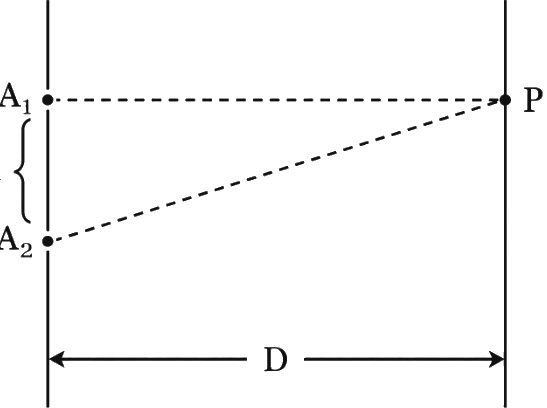
In Young's double slit experiment, two slits are illuminated with light of wavelength $\lambda$. The line joining $A_1P$ is perpendicular to $A_1A_2$. If the first minimum is detected at $P$, the value of slit separation '$a$' will be (where $D$ is the distance between the source and the screen):
A
$\lambda D$
B
$\sqrt{\lambda D}$
C
$\sqrt{\frac{\lambda}{D}}$
D
$\sqrt{\frac{D}{\lambda}}$
Solution
(B) In Young's double slit experiment, the path difference $\Delta x$ between the light waves reaching point $P$ from slits $A_1$ and $A_2$ is given by $\Delta x = A_2P - A_1P$.
Given that $A_1P$ is perpendicular to $A_1A_2$, we have a right-angled triangle $\Delta A_1A_2P$ where $A_1A_2 = a$ and $A_1P = D$.
Using the Pythagorean theorem, $A_2P = \sqrt{A_1A_2^2 + A_1P^2} = \sqrt{a^2 + D^2}$.
Thus, the path difference is $\Delta x = \sqrt{a^2 + D^2} - D$.
For the first minimum (destructive interference), the path difference must be equal to $\frac{\lambda}{2}$.
So, $\sqrt{a^2 + D^2} - D = \frac{\lambda}{2}$.
$\sqrt{a^2 + D^2} = D + \frac{\lambda}{2}$.
Squaring both sides, $a^2 + D^2 = (D + \frac{\lambda}{2})^2 = D^2 + \lambda D + \frac{\lambda^2}{4}$.
$a^2 = \lambda D + \frac{\lambda^2}{4}$.
Since $\lambda$ is very small compared to $D$, $\frac{\lambda^2}{4}$ can be neglected.
Therefore, $a^2 \approx \lambda D$, which gives $a = \sqrt{\lambda D}$.
Given that $A_1P$ is perpendicular to $A_1A_2$, we have a right-angled triangle $\Delta A_1A_2P$ where $A_1A_2 = a$ and $A_1P = D$.
Using the Pythagorean theorem, $A_2P = \sqrt{A_1A_2^2 + A_1P^2} = \sqrt{a^2 + D^2}$.
Thus, the path difference is $\Delta x = \sqrt{a^2 + D^2} - D$.
For the first minimum (destructive interference), the path difference must be equal to $\frac{\lambda}{2}$.
So, $\sqrt{a^2 + D^2} - D = \frac{\lambda}{2}$.
$\sqrt{a^2 + D^2} = D + \frac{\lambda}{2}$.
Squaring both sides, $a^2 + D^2 = (D + \frac{\lambda}{2})^2 = D^2 + \lambda D + \frac{\lambda^2}{4}$.
$a^2 = \lambda D + \frac{\lambda^2}{4}$.
Since $\lambda$ is very small compared to $D$, $\frac{\lambda^2}{4}$ can be neglected.
Therefore, $a^2 \approx \lambda D$, which gives $a = \sqrt{\lambda D}$.
0 likes
View Solution626
DifficultMCQ
In Young's double slit experiment, the width of the second slit is double the width of the first slit. Consequently, the amplitude of the light from the two slits is different. If $I_m$ is the maximum intensity, the resultant intensity $I$ when they interfere with a phase difference of $\phi$ is given by:
A
$\frac{I_m}{9}(1 + 8 \cos^2 \frac{\phi}{2})$
B
$\frac{I_m}{7}(3 + 5 \cos^2 \frac{\phi}{2})$
C
$\frac{I_m}{5}(1 + 2 \cos^2 \frac{\phi}{2})$
D
$\frac{I_m}{3}(1 + 6 \cos^2 \frac{\phi}{2})$
Solution
(A) Let the width of the first slit be $w_1 = w$ and the second slit be $w_2 = 2w$. Since intensity $I \propto \text{width}$, we have $I_1 = I_0$ and $I_2 = 2I_0$.
Since $I \propto A^2$, the amplitudes are $A_1 = a$ and $A_2 = a\sqrt{2}$.
The resultant intensity is given by $I = I_1 + I_2 + 2\sqrt{I_1 I_2} \cos \phi = I_0 + 2I_0 + 2\sqrt{2I_0^2} \cos \phi = 3I_0 + 2\sqrt{2} I_0 \cos \phi$.
The maximum intensity $I_m$ occurs when $\cos \phi = 1$, so $I_m = 3I_0 + 2\sqrt{2} I_0 = I_0(3 + 2\sqrt{2})$.
Using $\cos \phi = 2 \cos^2 \frac{\phi}{2} - 1$, we have $I = 3I_0 + 2\sqrt{2} I_0 (2 \cos^2 \frac{\phi}{2} - 1) = I_0(3 - 2\sqrt{2} + 4\sqrt{2} \cos^2 \frac{\phi}{2})$.
Since $I_0 = \frac{I_m}{3 + 2\sqrt{2}}$, we rationalize: $I_0 = I_m(3 - 2\sqrt{2})$.
Substituting this, $I = I_m(3 - 2\sqrt{2})(3 - 2\sqrt{2} + 4\sqrt{2} \cos^2 \frac{\phi}{2}) = I_m(1 + 8 \cos^2 \frac{\phi}{2}) / 9$.
Since $I \propto A^2$, the amplitudes are $A_1 = a$ and $A_2 = a\sqrt{2}$.
The resultant intensity is given by $I = I_1 + I_2 + 2\sqrt{I_1 I_2} \cos \phi = I_0 + 2I_0 + 2\sqrt{2I_0^2} \cos \phi = 3I_0 + 2\sqrt{2} I_0 \cos \phi$.
The maximum intensity $I_m$ occurs when $\cos \phi = 1$, so $I_m = 3I_0 + 2\sqrt{2} I_0 = I_0(3 + 2\sqrt{2})$.
Using $\cos \phi = 2 \cos^2 \frac{\phi}{2} - 1$, we have $I = 3I_0 + 2\sqrt{2} I_0 (2 \cos^2 \frac{\phi}{2} - 1) = I_0(3 - 2\sqrt{2} + 4\sqrt{2} \cos^2 \frac{\phi}{2})$.
Since $I_0 = \frac{I_m}{3 + 2\sqrt{2}}$, we rationalize: $I_0 = I_m(3 - 2\sqrt{2})$.
Substituting this, $I = I_m(3 - 2\sqrt{2})(3 - 2\sqrt{2} + 4\sqrt{2} \cos^2 \frac{\phi}{2}) = I_m(1 + 8 \cos^2 \frac{\phi}{2}) / 9$.
0 likes
View Solution627
DifficultMCQ
In Young's experiment, the intensity ratio of the maxima and minima in an interference pattern produced by two coherent sources is $36 : 1$. The ratio of the amplitudes of the two individual sources will be
A
$4 : 7$
B
$5 : 7$
C
$7 : 5$
D
$7 : 4$
Solution
(C) The intensity $I$ of a wave is proportional to the square of its amplitude $A$, i.e.,$I \propto A^2$.
Let the amplitudes of the two coherent sources be $A_1$ and $A_2$.
The maximum intensity is $I_{max} \propto (A_1 + A_2)^2$ and the minimum intensity is $I_{min} \propto (A_1 - A_2)^2$.
Given the ratio of maximum to minimum intensity is $\frac{I_{max}}{I_{min}} = \frac{36}{1}$.
Therefore, $\frac{(A_1 + A_2)^2}{(A_1 - A_2)^2} = \frac{36}{1}$.
Taking the square root on both sides, we get $\frac{A_1 + A_2}{A_1 - A_2} = \frac{6}{1}$.
By applying componendo and dividendo, $\frac{(A_1 + A_2) + (A_1 - A_2)}{(A_1 + A_2) - (A_1 - A_2)} = \frac{6 + 1}{6 - 1}$.
This simplifies to $\frac{2A_1}{2A_2} = \frac{7}{5}$.
Thus, the ratio of the amplitudes is $\frac{A_1}{A_2} = \frac{7}{5}$.
Let the amplitudes of the two coherent sources be $A_1$ and $A_2$.
The maximum intensity is $I_{max} \propto (A_1 + A_2)^2$ and the minimum intensity is $I_{min} \propto (A_1 - A_2)^2$.
Given the ratio of maximum to minimum intensity is $\frac{I_{max}}{I_{min}} = \frac{36}{1}$.
Therefore, $\frac{(A_1 + A_2)^2}{(A_1 - A_2)^2} = \frac{36}{1}$.
Taking the square root on both sides, we get $\frac{A_1 + A_2}{A_1 - A_2} = \frac{6}{1}$.
By applying componendo and dividendo, $\frac{(A_1 + A_2) + (A_1 - A_2)}{(A_1 + A_2) - (A_1 - A_2)} = \frac{6 + 1}{6 - 1}$.
This simplifies to $\frac{2A_1}{2A_2} = \frac{7}{5}$.
Thus, the ratio of the amplitudes is $\frac{A_1}{A_2} = \frac{7}{5}$.
0 likes
View Solution628
DifficultMCQ
In a certain region of the screen, the number of fringes formed is observed to be $8$ in Young's double slit experiment when light of wavelength $6600 \text{ Å}$ is used. If light of wavelength $4400 \text{ Å}$ is used, the number of fringes observed in the same region of the screen will be:
A
$10$
B
$12$
C
$16$
D
$18$
Solution
(B) The width of a certain region on the screen is $L$. The fringe width $\beta$ is given by $\beta = \frac{\lambda D}{d}$, where $\lambda$ is the wavelength, $D$ is the distance between the slits and the screen, and $d$ is the distance between the slits.
The number of fringes $n$ in a region of width $L$ is given by $n = \frac{L}{\beta} = \frac{Ld}{\lambda D}$.
Since $L, d,$ and $D$ are constant, we have $n \propto \frac{1}{\lambda}$, which implies $n_1 \lambda_1 = n_2 \lambda_2$.
Given $n_1 = 8$, $\lambda_1 = 6600 \text{ Å}$, and $\lambda_2 = 4400 \text{ Å}$.
Substituting the values: $8 \times 6600 = n_2 \times 4400$.
$n_2 = \frac{8 \times 6600}{4400} = \frac{8 \times 66}{44} = \frac{8 \times 3}{2} = 12$.
Therefore, the number of fringes observed is $12$.
The number of fringes $n$ in a region of width $L$ is given by $n = \frac{L}{\beta} = \frac{Ld}{\lambda D}$.
Since $L, d,$ and $D$ are constant, we have $n \propto \frac{1}{\lambda}$, which implies $n_1 \lambda_1 = n_2 \lambda_2$.
Given $n_1 = 8$, $\lambda_1 = 6600 \text{ Å}$, and $\lambda_2 = 4400 \text{ Å}$.
Substituting the values: $8 \times 6600 = n_2 \times 4400$.
$n_2 = \frac{8 \times 6600}{4400} = \frac{8 \times 66}{44} = \frac{8 \times 3}{2} = 12$.
Therefore, the number of fringes observed is $12$.
0 likes
View Solution629
MediumMCQ
In Young's double slit experiment, for the $n^{th}$ dark fringe $(n = 1, 2, 3, \dots)$ the phase difference of the interfering waves in radian will be
A
$n \cdot \frac{\pi}{2}$
B
$(2n + 1)\pi$
C
$(2n - 1)\pi$
D
$(2n - 1)\frac{\pi}{2}$
Solution
(C) In Young's double slit experiment, the condition for destructive interference (dark fringe) is that the path difference $\Delta x$ must be an odd multiple of half the wavelength, i.e.,$\Delta x = (2n - 1) \frac{\lambda}{2}$ for $n = 1, 2, 3, \dots$.
The relationship between phase difference $\Delta \phi$ and path difference $\Delta x$ is given by $\Delta \phi = \frac{2\pi}{\lambda} \cdot \Delta x$.
Substituting the value of $\Delta x$ for the $n^{th}$ dark fringe:
$\Delta \phi = \frac{2\pi}{\lambda} \cdot (2n - 1) \frac{\lambda}{2}$.
Simplifying the expression:
$\Delta \phi = (2n - 1)\pi$ radians.
Thus, the correct option is $C$.
The relationship between phase difference $\Delta \phi$ and path difference $\Delta x$ is given by $\Delta \phi = \frac{2\pi}{\lambda} \cdot \Delta x$.
Substituting the value of $\Delta x$ for the $n^{th}$ dark fringe:
$\Delta \phi = \frac{2\pi}{\lambda} \cdot (2n - 1) \frac{\lambda}{2}$.
Simplifying the expression:
$\Delta \phi = (2n - 1)\pi$ radians.
Thus, the correct option is $C$.
0 likes
View Solution630
DifficultMCQ
In an interference experiment, the $m^{th}$ bright fringe for light of wavelength $\lambda_1$ coincides with the $n^{th}$ dark fringe for light of wavelength $\lambda_2$. The ratio $\frac{\lambda_2}{\lambda_1}$ is
A
$\frac{2m}{2n-1}$
B
$\frac{2n-1}{2m}$
C
$\frac{m}{n}$
D
$\frac{2n+1}{2m}$
Solution
(A) The position of the $m^{th}$ bright fringe for wavelength $\lambda_1$ is given by $y_m = m \frac{D \lambda_1}{d}$.
The position of the $n^{th}$ dark fringe for wavelength $\lambda_2$ is given by $y_n = (n - \frac{1}{2}) \frac{D \lambda_2}{d} = \frac{(2n - 1)}{2} \frac{D \lambda_2}{d}$.
Since the fringes coincide, $y_m = y_n$:
$m \frac{D \lambda_1}{d} = \frac{(2n - 1)}{2} \frac{D \lambda_2}{d}$.
Simplifying the equation, we get $m \lambda_1 = \frac{(2n - 1)}{2} \lambda_2$.
Therefore, the ratio $\frac{\lambda_2}{\lambda_1} = \frac{2m}{2n - 1}$.
The position of the $n^{th}$ dark fringe for wavelength $\lambda_2$ is given by $y_n = (n - \frac{1}{2}) \frac{D \lambda_2}{d} = \frac{(2n - 1)}{2} \frac{D \lambda_2}{d}$.
Since the fringes coincide, $y_m = y_n$:
$m \frac{D \lambda_1}{d} = \frac{(2n - 1)}{2} \frac{D \lambda_2}{d}$.
Simplifying the equation, we get $m \lambda_1 = \frac{(2n - 1)}{2} \lambda_2$.
Therefore, the ratio $\frac{\lambda_2}{\lambda_1} = \frac{2m}{2n - 1}$.
0 likes
View Solution631
MediumMCQ
In Young’s double slit experiment, how many maxima can be seen on a screen (including the central maxima) if $d = \frac{5\lambda}{2}$ (where $\lambda$ is the wavelength of light and $d$ is the distance between the two slits)?
A
$5$
B
$4$
C
$7$
D
$1$
Solution
(A) The condition for constructive interference (maxima) is $d \sin \theta = n\lambda$, where $n$ is an integer.
Since $|\sin \theta| \le 1$, we have $|n| \le \frac{d}{\lambda}$.
Given $d = 2.5\lambda$, the condition becomes $|n| \le 2.5$.
The possible integer values for $n$ are $0, \pm 1, \pm 2$.
These correspond to $n = -2, -1, 0, 1, 2$.
Counting these values, there are $5$ maxima in total.
Since $|\sin \theta| \le 1$, we have $|n| \le \frac{d}{\lambda}$.
Given $d = 2.5\lambda$, the condition becomes $|n| \le 2.5$.
The possible integer values for $n$ are $0, \pm 1, \pm 2$.
These correspond to $n = -2, -1, 0, 1, 2$.
Counting these values, there are $5$ maxima in total.
0 likes
View SolutionWave Optics — Young's Double Slit Experiment (YDSE) · Frequently Asked Questions
1Are these Wave Optics questions useful for JEE and NEET?
Yes. All questions in this section are mapped to JEE Main and NEET exam patterns. Previous year questions from JEE Main, NEET, GUJCET and state-level exams are included with full solutions.
2Can I switch to Hindi or Gujarati for these questions?
Yes. Use the language tabs in the hero section or the sidebar to view the same questions and solutions in English, Hindi or Gujarati.
3How do I generate a question paper from this subtopic?
Use the Vedclass Exam Paper Generator — select the chapter and subtopic, set difficulty, and generate Sets A, B, C, D automatically. First 3 chapters of every subject are free.
Vedclass Products
For Students
Vedclass Test Series
Mock tests in real JEE/NEET style with performance analysis. 5-day free trial.
Start Free TrialFor Teachers
Exam Paper Generator
Generate Set A/B/C/D papers from this chapter in 2 minutes. 3 chapters free.
Try FreeFor Institutes
Online Exam Module
Live online exams with unlimited students, 360° analytics & white-label branding.
See DemoFor Teachers & Institutes
Generate a Wave Optics Exam Paper in 2 Minutes
Select subtopic & difficulty — Sets A, B, C, D auto-generated with No Repeat logic.
First 3 chapters of every subject are free — no payment required.