
Difficult
Ozonolysis of the given compound yields:
- A
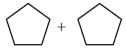
- B

- CDecanedial
- DNone of these
Explore More
Similar Questions
Assertion $(A)$: Propene on addition with hydrogen bromide in the presence of peroxide gives $1-$bromopropane as the major product.
Reason $(R)$: $1-$bromopropane is the major product because it is formed through the stable carbocation.
Reason $(R)$: $1-$bromopropane is the major product because it is formed through the stable carbocation.
Which of the following is the product of the reductive ozonolysis of $1-$methylcyclohexene?
Difficult
View SolutionWhich of the following alkenes does $\underline{NOT}$ exhibit cis-trans isomerism?
In the following reaction,$P$ gives two products $Q$ and $R$ each in $40 \,\%$ yield. If the reaction is carried out with $420 \,mg$ of $P$,the reaction yields $108.8 \,mg$ of $Q$. The amount of $R$ produced in the reaction is closest to $....\, mg$.
$R_f$ value for $2$-methylpropene in a solvent system (Ethyl acetate + ether) is $0.42$. $2$-methylpropene is treated with dilute $H_2SO_4$ to give major organic product $(X)$. $R_f$ value for $(X)$ in the same solvent system under identical condition will be:
DifficultJEE MAIN 2026
View SolutionVedclass Products
For Students
Vedclass Test Series
Mock tests in real JEE/NEET style with performance analysis. 5-day free trial.
Start Free TrialFor Teachers
Exam Paper Generator
Generate Set A/B/C/D exam papers from 7.5L+ questions in 2 minutes. 3 chapters free.
Try FreeFor Institutes
Online Exam Module
Live online exams with unlimited students, 360° analytics & white-label branding.
See Demo