
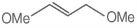
$0.102 \ g$ of an organic compound $X$ was oxidised with fuming nitric acid. The resulting solution,after reaction with excess of aqueous $BaCl_2$,produced $0.233 \ g$ of $BaSO_4$ as a precipitate. Compound $X$ is likely to be: [Given: Atomic wt. of $Ba = 137$]
- A$1,4-$dithiane

- B$1,4-$dimethoxybut$-2-$ene
- Ctert-butylthiol

- Dtetrahydrothiophene

Explore More
Similar Questions
$0.5 \ g$ of an organic compound $(X)$ with $60 \%$ carbon will produce $........ \times 10^{-1} \ g$ of $CO_2$ on complete combustion.
$A$ $1000 \ g$ sample of $NaOH$ contains $3 \ moles$ of $O$ atoms. What is the $Purity$ of $NaOH$ $\dots \dots \dots \dots \dots \dots \%$
Difficult
View SolutionAmong the following,the compound with the highest percentage of chlorine is:
Difficult
View SolutionAn organic compound containing $C$ and $H$ has $92.3 \%$ of carbon. Its empirical formula is:
$A$ pure compound contains $2.4 \ g$ of $C$,$1.2 \times 10^{23}$ atoms of $H$,and $0.2 \ mol$ of oxygen atoms. Its empirical formula is
Vedclass Products
For Students
Vedclass Test Series
Mock tests in real JEE/NEET style with performance analysis. 5-day free trial.
Start Free TrialFor Teachers
Exam Paper Generator
Generate Set A/B/C/D exam papers from 7.5L+ questions in 2 minutes. 3 chapters free.
Try FreeFor Institutes
Online Exam Module
Live online exams with unlimited students, 360° analytics & white-label branding.
See Demo